
Key Highlights
- Comet 3I/ATLAS is the third confirmed interstellar visitor observed by humanity.
- New measurements suggest it formed 10 to 12 billion years ago, during the early life of the Milky Way.
- The comet's isotopic signatures indicate it originated in a cold, metal-poor region of the galaxy.
[The Journey of Comet 3I/ATLAS]
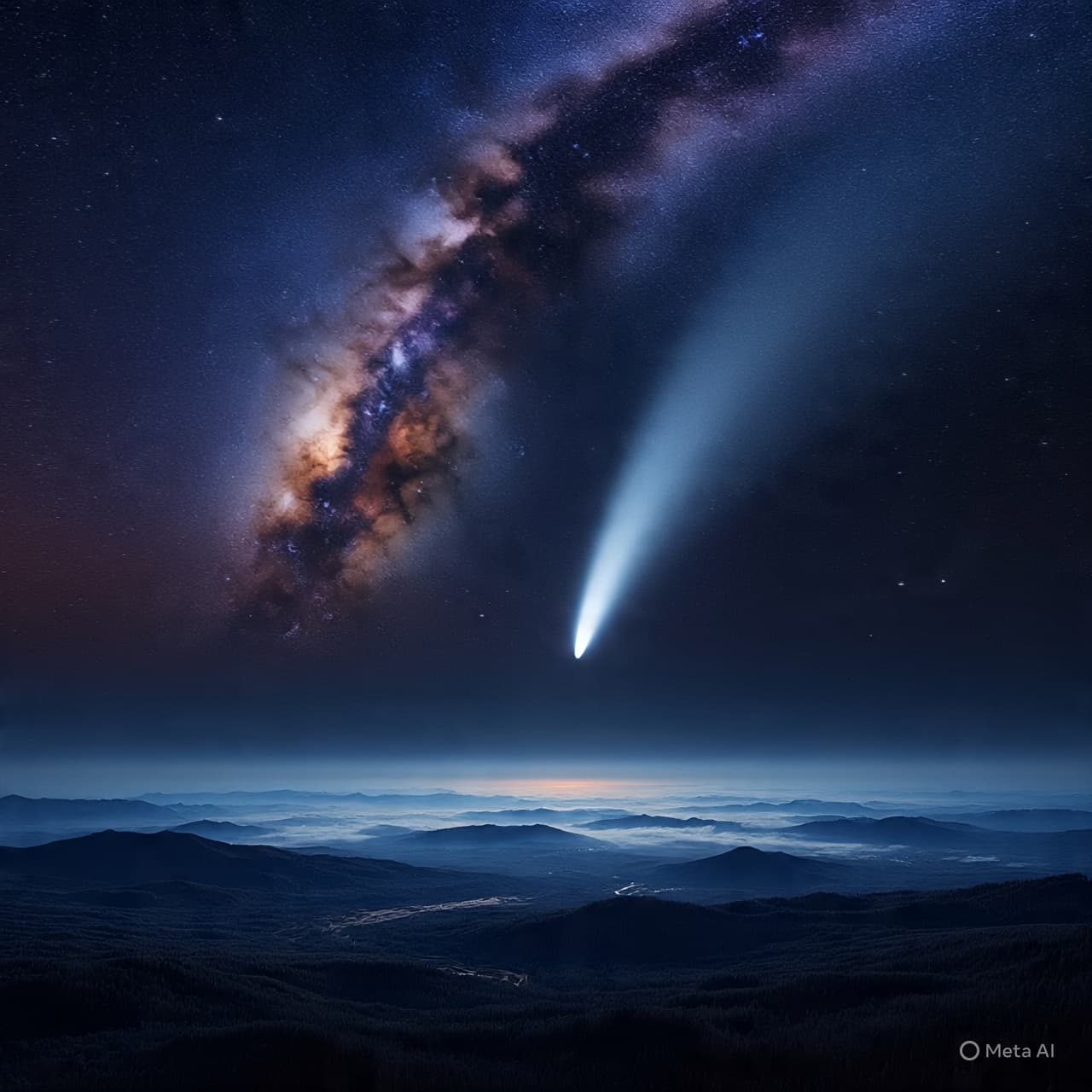
Comet 3I/ATLAS, a remarkable interstellar traveler, has captivated astronomers with its ancient origins and unique chemical signatures. This comet, the third confirmed interstellar visitor observed, may have formed between 10 to 12 billion years ago, placing its birth in the early epochs of our galaxy. The James Webb Space Telescope has provided groundbreaking measurements that shed light on the comet's formation during a time when the Milky Way was still young and teeming with cold, primitive stellar nurseries.
[Scientific Significance]
The significance of Comet 3I/ATLAS lies not only in its age but also in the chemical clues it carries. Researchers have identified tiny imbalances in carbon isotopes and an unusually high deuterium content in its water vapor. These isotopic signatures suggest that the comet formed in an exceptionally cold environment, likely below 30 kelvin, within a relatively metal-poor region of the galaxy's thick disk. This indicates that 3I/ATLAS is not merely old; it is chemically ancient, preserving a record of ice chemistry from an era predating the formation of our solar system by 4.6 billion years.
[The Elegy of a Lost Star System]
The narrative surrounding 3I/ATLAS evokes a sense of loss and wonder. If this comet indeed condensed around a star system formed during the galaxy's first great burst of star-making, that parent star may have long since changed or vanished entirely. What remains is a solitary shard of a once-vibrant architecture, drifting through the vastness of interstellar space for billions of years. The journey of this comet is a testament to the dynamic and often violent history of our galaxy, marked by collisions, star deaths, and the gradual evolution of its spiral arms.
[The Fastest Interstellar Comet]
NASA has confirmed that 3I/ATLAS entered our solar system on a hyperbolic trajectory, affirming its extrasolar origin. Traveling at an astonishing speed of approximately 58 kilometers per second, it holds the title of the fastest known interstellar comet detected to date. This rapid passage provides astronomers with a fleeting opportunity to study the building blocks of planets around ancient stars, offering insights into the conditions that prevailed in the early galaxy.
[Future Research and Implications]
As research continues, astronomers are eager to explore the implications of 3I/ATLAS's findings. The isotopic evidence suggests that this comet may be a preserved relic from a long-lost planetary system formed near the dawn of the Milky Way. Although the findings are still undergoing peer review, they represent one of the most significant windows into the chemistry of the early galaxy, potentially reshaping our understanding of cosmic evolution and the formation of planetary systems.
Published by Banx Network. This article is part of the Banx decentralized media programme, powered by the BXE token on the XRP Ledger.



