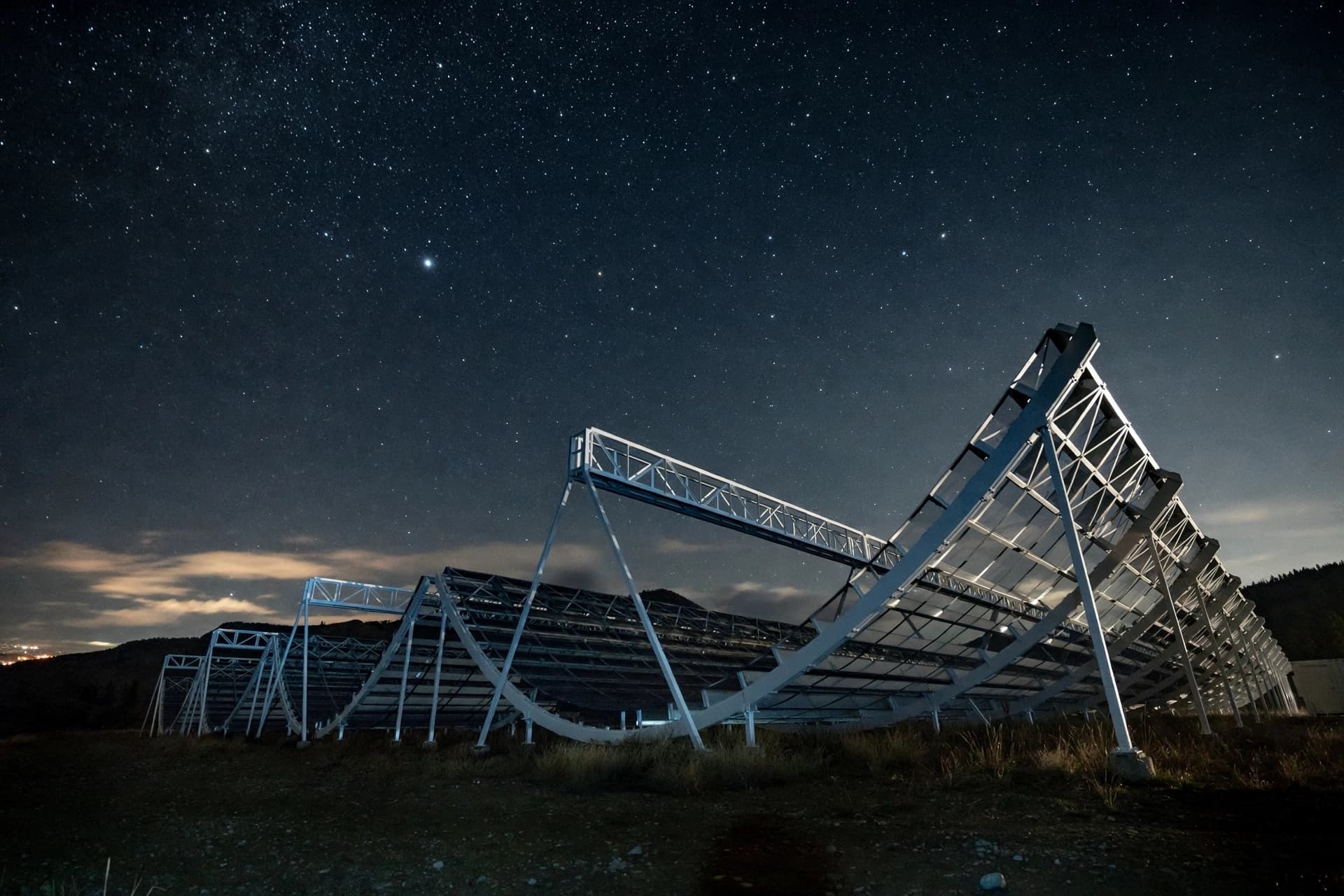
The universe often speaks in whispers rather than declarations. Across unimaginable distances, particles travel through space carrying traces of events that occurred long before human observers looked toward the sky. A recent scientific finding has drawn attention because one such particle may have originated from an extraordinarily powerful natural accelerator somewhere in the cosmos.
Researchers studying high-energy particles detected an unusual event that appears to involve a particle reaching Earth after being accelerated by an extreme astrophysical process. Such particles, commonly known as cosmic rays, routinely arrive from space, but the most energetic examples remain among the greatest mysteries in astronomy.
Scientists believe these particles are launched by environments far more powerful than anything humans can create. Potential sources include energetic regions surrounding black holes, exploding stars, or rapidly spinning stellar remnants known as pulsars. Each possibility represents a natural laboratory operating on scales beyond ordinary imagination.
The particle involved in the recent discussion appears to belong to a rare category characterized by immense energy. Although countless lower-energy cosmic rays pass through Earth's atmosphere every second, ultra-high-energy particles are exceptionally uncommon. Detecting one provides researchers with a valuable opportunity to investigate how nature accelerates matter to extraordinary speeds.
Understanding the source is not straightforward. Cosmic rays are charged particles, meaning magnetic fields encountered during their journey can bend their paths. By the time they reach Earth, tracing their exact origin becomes a difficult scientific puzzle.
Astronomers therefore examine not only the particles themselves but also related forms of radiation, including gamma rays and other energetic signals. Together, these observations can reveal clues about the environments responsible for cosmic acceleration.
The broader significance extends beyond identifying a single source. Each discovery helps researchers test theories about the structure and behavior of the universe. High-energy particles offer rare glimpses into physical conditions that cannot be reproduced in terrestrial laboratories.
For decades, scientists have sought answers to questions surrounding cosmic rays, dark matter, and extreme astrophysical phenomena. Every unusual detection contributes another piece to a puzzle that spans galaxies and perhaps even larger cosmic structures.
While many details remain uncertain, researchers continue to analyze the evidence. The mystery particle may eventually reveal more about the powerful natural engines hidden throughout the universe, reminding us that even a tiny particle can carry a story written across billions of miles.
AI Image Disclaimer: This article includes AI-generated illustrations intended only as visual interpretations of the scientific topic.
Sources Verified: National Geographic, arXiv research papers
Published by Banx Network. This article is part of the Banx decentralized media programme, powered by the BXE token on the XRP Ledger.