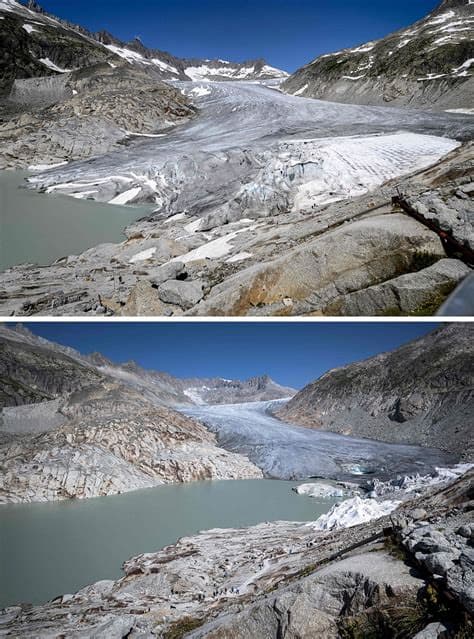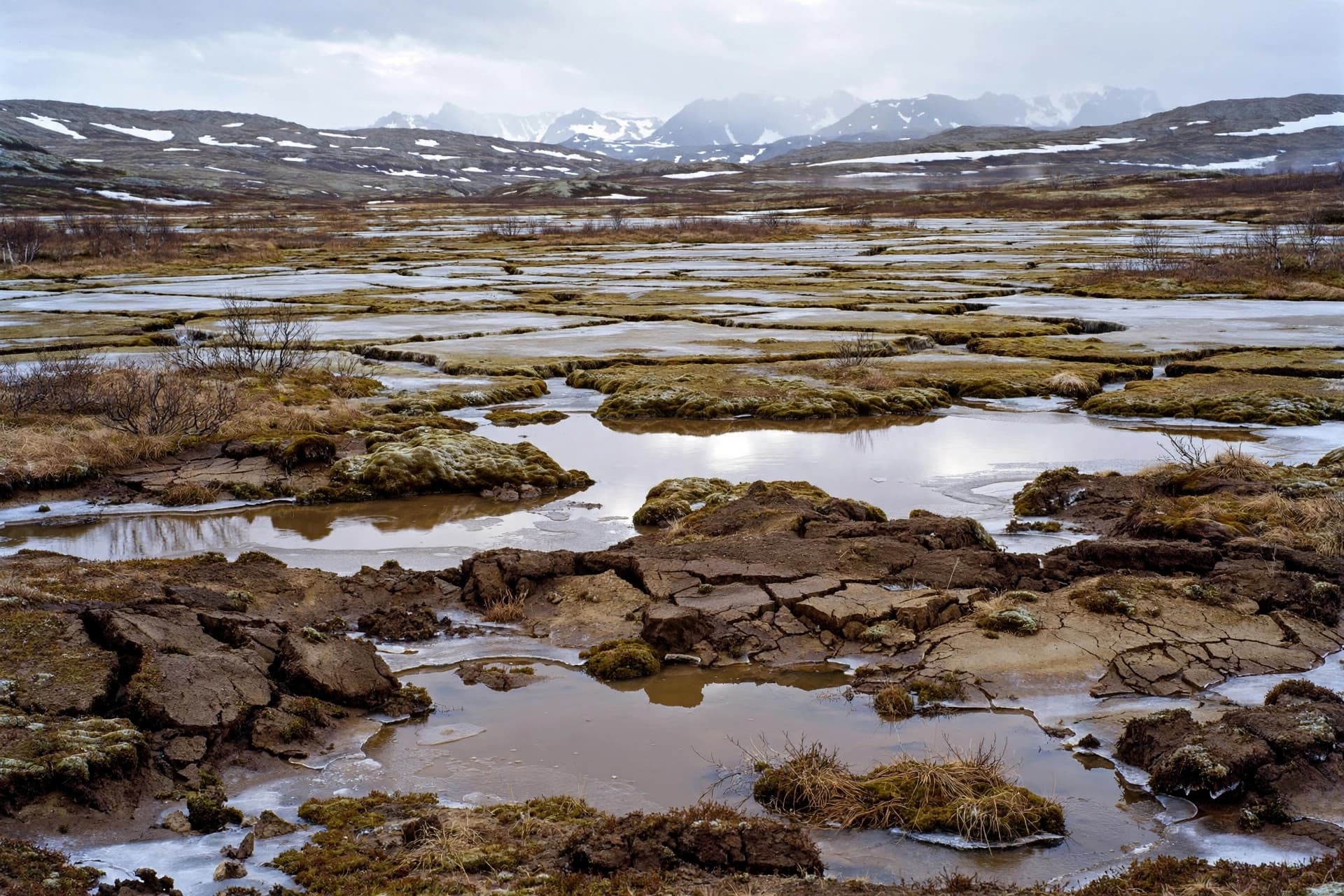
There is a quiet arithmetic to a warming world that humanity has only recently begun to calculate. For decades, the ledger of climate change recorded the obvious entries: smokestacks and tailpipes, the clearing of forests and the burning of coal. But beneath the frozen surface of the Arctic, within the oxygen-starved depths of wetlands, and along the drying edges of freshwater lakes, another accounting has been underway—one that the instruments of modern science are only now learning to read. A study published in Environmental Research Letters has drawn together four of these natural sources—permafrost, wetlands, wildfires, and freshwater—and arrived at a figure that unsettles the conventional calculus: together, they could amplify human-caused warming by 20 to 30 percent by the end of this century .
The mechanism is not mysterious, though it is deeply consequential. As the Arctic thaws, ancient organic matter that has been locked in frozen soil for millennia begins to decay, releasing methane and carbon dioxide into the atmosphere. Warmer wetlands and lakes accelerate the microbial processes that generate methane. Drier forests burn more frequently, sending stored carbon skyward in smoke. The study estimates that these feedbacks could add an additional 0.2 to 0.4 degrees Celsius of warming by 2100, with methane accounting for roughly half of that total . Lead author Sam Abernethy, a climate scientist at Spark Climate Solutions, noted that this was the first study to pull all four sources together and quantify their collective amplification of anthropogenic warming .
What makes the finding particularly significant is not merely the number itself, but what it reveals about the models upon which policymakers have relied. Of the eleven Earth system models used by the Intergovernmental Panel on Climate Change in its most recent assessment, none included warming-induced emissions from wetlands or freshwaters. Only two incorporated permafrost, and just five included wildfires . The projections of future warming, in other words, have been built upon a foundation that omitted some of the very processes now accelerating. The remaining carbon budget—the amount of greenhouse gases humanity can still emit before breaching temperature targets—may be more generous than the planet can actually afford.
The study’s authors are careful to acknowledge the limits of their work. They note that their estimate could be too high, since they excluded processes such as vegetation regrowth that might offset some of the emissions. But they also observe that it could be too low. A separate study cited in their paper placed methane released by wetlands at nearly twice the figure they used. Other sources—rice farming, forest die-back—were left out entirely . Euan Nisbet, an emeritus professor of Earth sciences at Royal Holloway, University of London, described the research as “important” and pointed to strong evidence of rising methane emissions from tropical wetlands, which are increasing in response to human-driven climate change .
Perhaps the most difficult aspect of the study is its temporal horizon. Even if society were to make rapid and drastic cuts to emissions, the authors found that warming from these natural sources would continue to rise through 2100. Near-term reductions shrink future natural emissions, but they cannot undo the warming from gases already released. The reason is physical: carbon dioxide accumulates in the atmosphere, and the warming it causes persists as long as those emissions continue . There is no switch to turn off, no valve to close. The planet’s own systems, once stirred, keep moving.
The study arrives at a moment when the international architecture of climate cooperation is under strain. The United States withdrew from the Paris Agreement in January 2026 for the second time . Nearly two hundred countries had pledged to hold warming well below 2 degrees Celsius, but the trajectory of emissions and the emerging feedbacks from natural systems suggest that target is slipping further from reach. Every fraction of a degree matters: the IPCC notes that each additional half-degree brings more frequent heat waves, more intense rainfall, more devastating droughts .
The authors are working to improve the modeling of these emissions so they can be incorporated into the next IPCC assessment, due in 2029 . That is a necessary step, but it is also a reminder of how much remains unknown. Arctic permafrost and tropical wetlands are difficult places to install measurement towers, and the data they might yield are sparse. As Abernethy observed, these natural sources are “a bit of a blind spot for observations,” which makes them difficult to model and, in turn, difficult to build policy around . The blind spot is closing, but slowly, and the planet is not waiting.
AI Image Disclaimer: The images accompanying this article were generated by artificial intelligence and are for illustrative purposes only.
Sources: Mongabay, Environmental Research Letters
Published by Banx Network. This article is part of the Banx decentralized media programme, powered by the BXE token on the XRP Ledger.