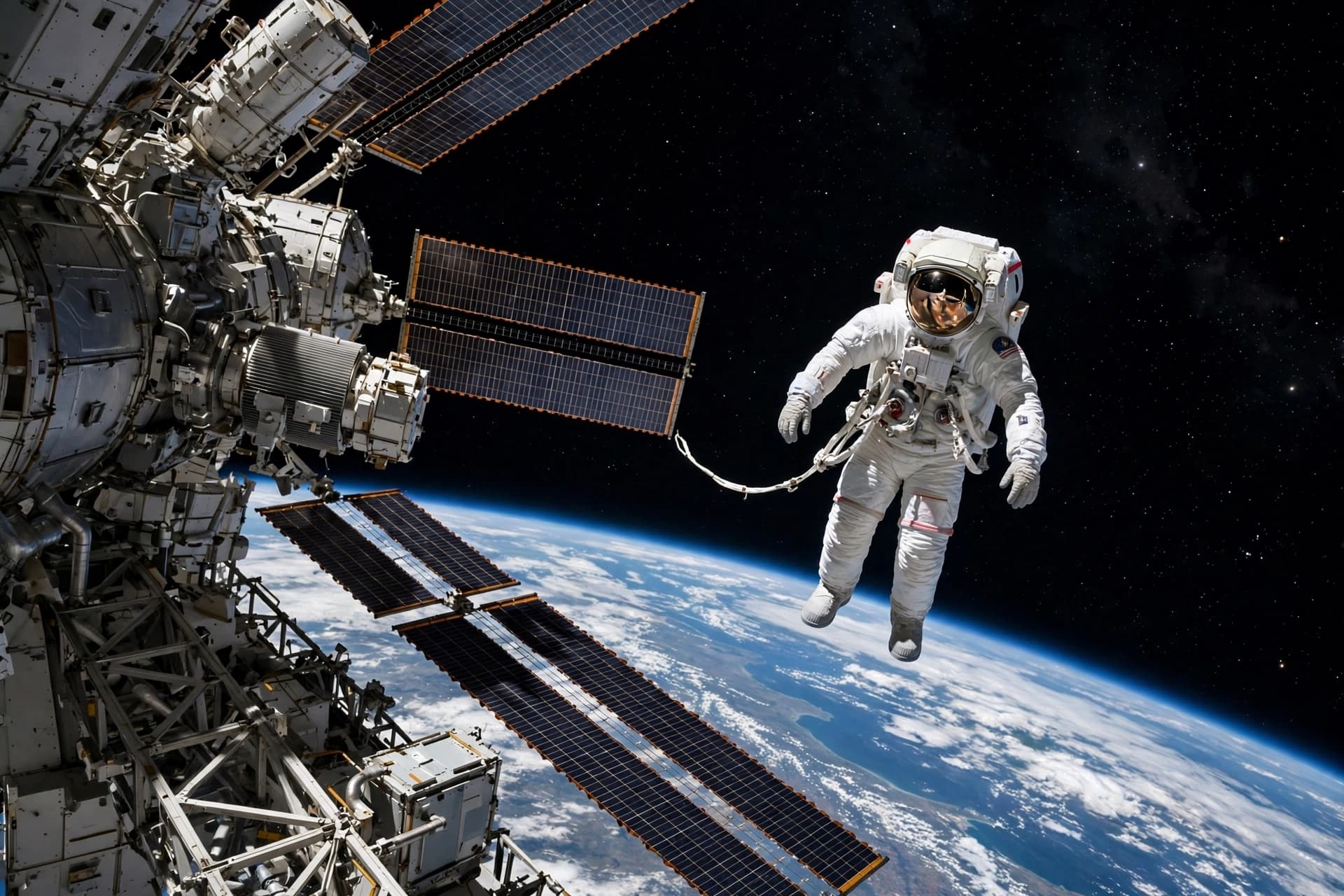
Four hundred kilometers above the Earth, moving at roughly 7.66 kilometers per second, a human being stepped outside. There is no metaphor that quite captures this—the emptiness, the speed, the smallness of the figure against the curve of the planet. On Thursday, Canadian Space Agency astronaut Joshua Kutryk performed his first spacewalk, and in doing so, joined a small group of Canadians who have floated in the void outside the International Space Station.
The spacewalk lasted seven hours and eleven minutes. Kutryk and NASA astronaut Anil Menon worked to install a new solar array, part of an upgrade campaign that will increase the station’s power capacity from 160 kilowatts to 215 kilowatts after a second spacewalk scheduled for November 5 . It was the 100th spacewalk at the station, a quiet milestone in a facility that has hosted hundreds of them.
Canada’s role extended well beyond Kutryk’s presence outside the hatch. CSA astronaut Jenni Gibbons served as capcom, the voice connecting the crew to ground teams in Houston . At the CSA’s Robotics Mission Control Centre in Longueuil, Quebec, flight controllers worked alongside NASA counterparts to monitor the operation . And Canadarm2, the robotic arm that helped build the station more than twenty-five years ago, provided a stable platform for Menon while he and Kutryk worked .
David Saint-Jacques, the last Canadian to perform a spacewalk in 2019, offered a description that captured both the danger and the wonder. “It’s ridiculously dangerous, but we’re well-prepared,” he said. He described the spacesuit not as clothing but as “a miniature spacecraft in the shape of a human body that you have to fly” . The training, he said, is extensive; the preparation is thorough. And yet the experience of being, as he put it, “your own little satellite of the Earth” is unlike anything else.
Kutryk launched to the station on October 1 and has since supported six science experiments, including three Canadian investigations . The solar array installation is part of a broader upgrade that began in 2021. The new arrays are rolled out from a cargo vehicle and positioned by the robotic arm, a choreography of human and machine that has become routine at the station but remains, in its fundamentals, extraordinary.
There was a time when a Canadian spacewalk was a rarity. Chris Hadfield, Steve MacLean, Dave Williams, and David Saint-Jacques preceded Kutryk; he is the fifth . The smallness of that number is a reminder of how few people have seen what he saw on Thursday—the Earth from outside, the station’s structure against the black, the sun rising every ninety minutes. Saint-Jacques’ advice to Kutryk before the walk was simple: take a moment to look around.
The second spacewalk is scheduled for November 5. By then, the final solar array will be in place, and the station’s power will be greater than it was before. Kutryk will have completed his first walks, and the small Canadian cohort of spacewalkers will remain at five. The work is technical, the risks are real, and the view, by all accounts, is worth the years of preparation.
Image Disclaimer: The visual for this report was generated by artificial intelligence and is not an actual photograph from the spacewalk or of the astronaut.
Sources: CBC News, Canadian Space Agency, Radio-Canada, Skies Magazine
Published by Banx Network. This article is part of the Banx decentralized media programme, powered by the BXE token on the XRP Ledger.