
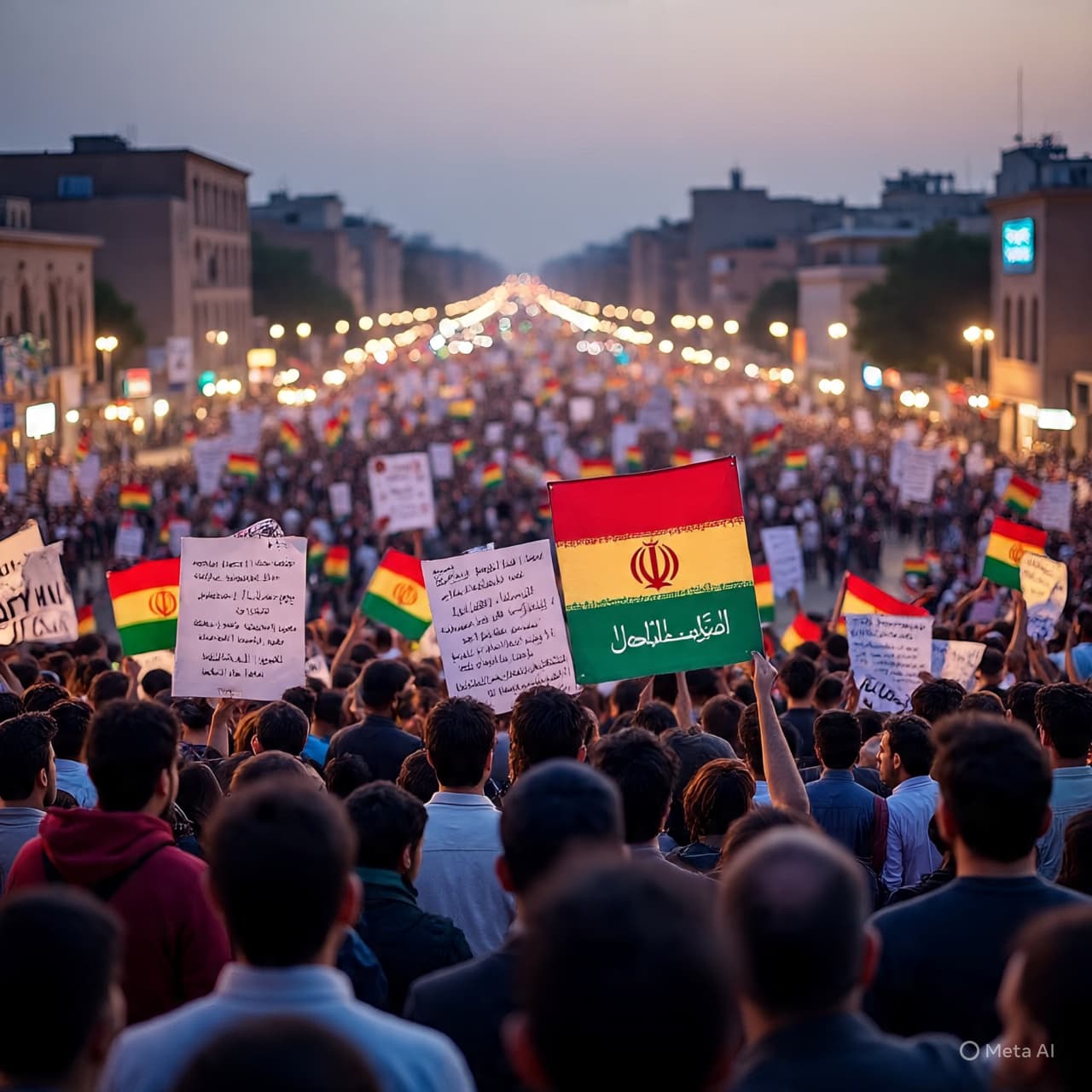
As dusk settles over Iran’s cities, the air gathers a different kind of weight. Streets that usually absorb the day’s heat begin to cool, and with that cooling comes motion—footsteps converging, voices rising and falling like wind along stone corridors. In public squares and along broad avenues, the evening takes on a density shaped not by traffic, but by presence.
Mass demonstrations were held across parts of Iran, as crowds gathered to oppose the country’s government. Witnesses and rights groups described large turnouts in major urban centers, where people moved together in coordinated waves, holding signs, chanting, and pausing as security forces monitored from the edges. The gatherings unfolded over hours, stretching from late afternoon into night, drawing energy from shared momentum rather than formal organization.
Authorities responded with a visible security presence, erecting checkpoints and limiting access to certain areas. In some locations, internet disruptions were reported, a familiar feature of past unrest that reshapes how information travels in real time. Officials reiterated warnings against unauthorized demonstrations, while state media emphasized order and stability, framing the streets through a different lens than those walking them.
The protests reflect a broader undercurrent of discontent that has surfaced repeatedly in recent years, shaped by economic strain, social restrictions, and questions of political voice. Analysts note that such demonstrations often blend immediate grievances with longer-standing frustrations, making them difficult to contain within a single demand. The streets become a forum where individual concerns briefly align, forming a collective expression that is both fragile and forceful.
For those attending, the experience is as sensory as it is political. Chants echo off concrete facades, banners ripple in the evening breeze, and the press of bodies creates a shared rhythm. Participation is measured not only by slogans, but by endurance—how long people remain, how steadily they return, how quietly they disperse when night deepens.
As the demonstrations concluded in some areas, the cities gradually resumed their usual patterns. Shops closed, traffic resumed, and the crowds thinned into smaller clusters moving homeward. The facts remained clear: large protests took place, security forces were deployed, and opposition to the government was voiced openly in public spaces.
What lingers is less tangible. It is the memory of streets briefly transformed, of voices carried farther than usual, of an evening when ordinary routines gave way to something shared. In Iran, as elsewhere, such moments settle into the city’s long memory—waiting, perhaps, for the next time dusk brings people back into the open.
AI Image Disclaimer Illustrations were created using AI tools and are not real photographs.
Sources (names only) Reuters Associated Press Human Rights Watch Amnesty International United Nations Human Rights Office
Published by Banx Network. This article is part of the Banx decentralized media programme, powered by the BXE token on the XRP Ledger.
.jpg&w=3840&q=75 "Convicted War Criminal Ratko Mladić to Be Buried With Full State Honors")

