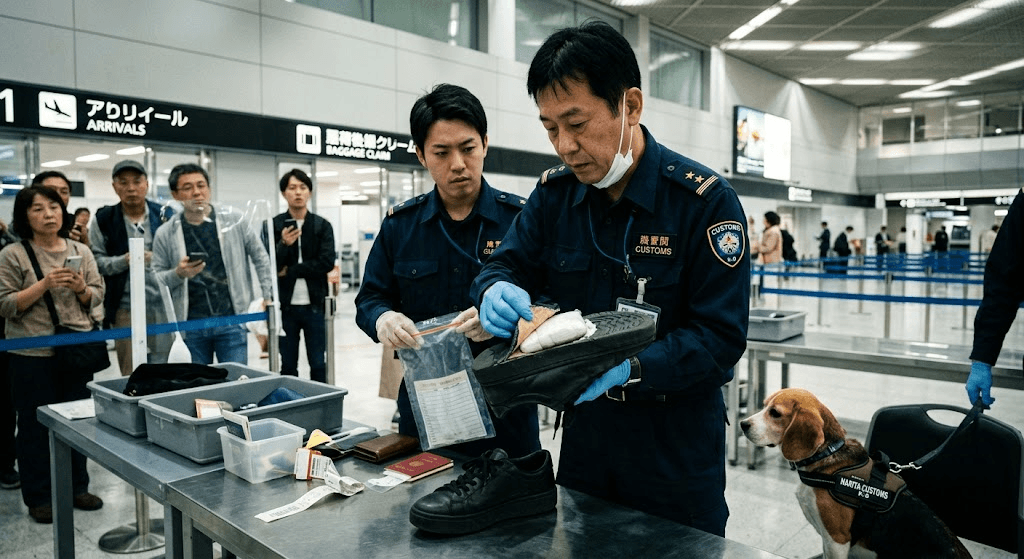
TOKYO — What was meant to be a swift walkthrough at Tokyo’s Haneda Airport ended in cuffs for five Malaysian travelers when custom officers noticed something suspicious about their footwear: unusually thick, heavy soles.
Upon closer inspection, Japanese border authorities uncovered a high-value smuggling attempt, discovering approximately 5 kilograms of high-grade cocaine packed inside the insoles of the group's shoes. The total haul is estimated to be worth ¥120 million (roughly RM3.1 million / US$757,000).
The group—comprising young men and women aged between 19 and 26—arrived in Tokyo on a flight departing from Kuala Lumpur International Airport (KLIA).
According to officials from the Metropolitan Police Department's Drug and Firearm Control Division and Haneda Customs, each suspect had approximately 1 kilogram of cocaine divided evenly (500 grams per shoe) hidden beneath their insoles.
While routine border sweeps often flag oversized luggage or taped packages, it was the unnatural height, rigid gait, and bulky soles of the travelers' footwear that alerted vigilant customs officers to pull them aside for detailed screening.
Preliminary investigations reveal a troubling tactic increasingly used by international drug networks: targeting young adults through social media platforms.
During questioning, suspects admitted to being recruited over online messaging apps like Telegram by individuals promising substantial payouts—around RM8,000 (US$1,800)—simply to transport "special footwear" or carry packages overseas.
"I was offered money over social media to transport illegal drugs overseas and was given the shoes to wear before departing," one of the detained men told investigators during questioning.
While four of the five suspects have admitted to their involvement, one suspect continues to deny knowledge of the illicit contents.
In response to the major bust, Malaysia’s Bukit Aman Narcotics Crime Investigation Department (NCID) confirmed it is dispatching a specialized team of investigators to Tokyo.
Federal police aim to liaise directly with Japanese authorities to determine whether the suspects were working on behalf of a domestic Malaysian syndicate or a wider international drug ring, how 5 kilograms of hidden narcotics managed to clear departure security checks at KLIA, and the true identities of the handlers recruiting couriers online.
Malaysian authorities have issued a stark warning to the public, particularly young jobseekers and tourists, regarding travel scams and "free trip" offers circulating on social media.
Police reiterated that unknowingly carrying items or wearing gifted apparel provided by third parties is no defense in international courts—where drug trafficking offenses carry severe, life-altering penalties, including decades in foreign prisons.
The five suspects remain in Japanese custody at Haneda as joint investigations continue.
Published by Banx Network. This article is part of the Banx decentralized media programme, powered by the BXE token on the XRP Ledger.