In the silent depths of space, where gravity reigns supreme, black holes have long been understood through static images and theoretical models. However, a new era of observation has arrived, bringing motion to the previously still. Recent continuous video footage of radio emissions from a black hole’s jet has emerged, offering a dynamic view that challenges established theories about how these cosmic engines generate shock waves. This moving portrait invites us to reconsider the mechanics of one of the universe’s most powerful phenomena.
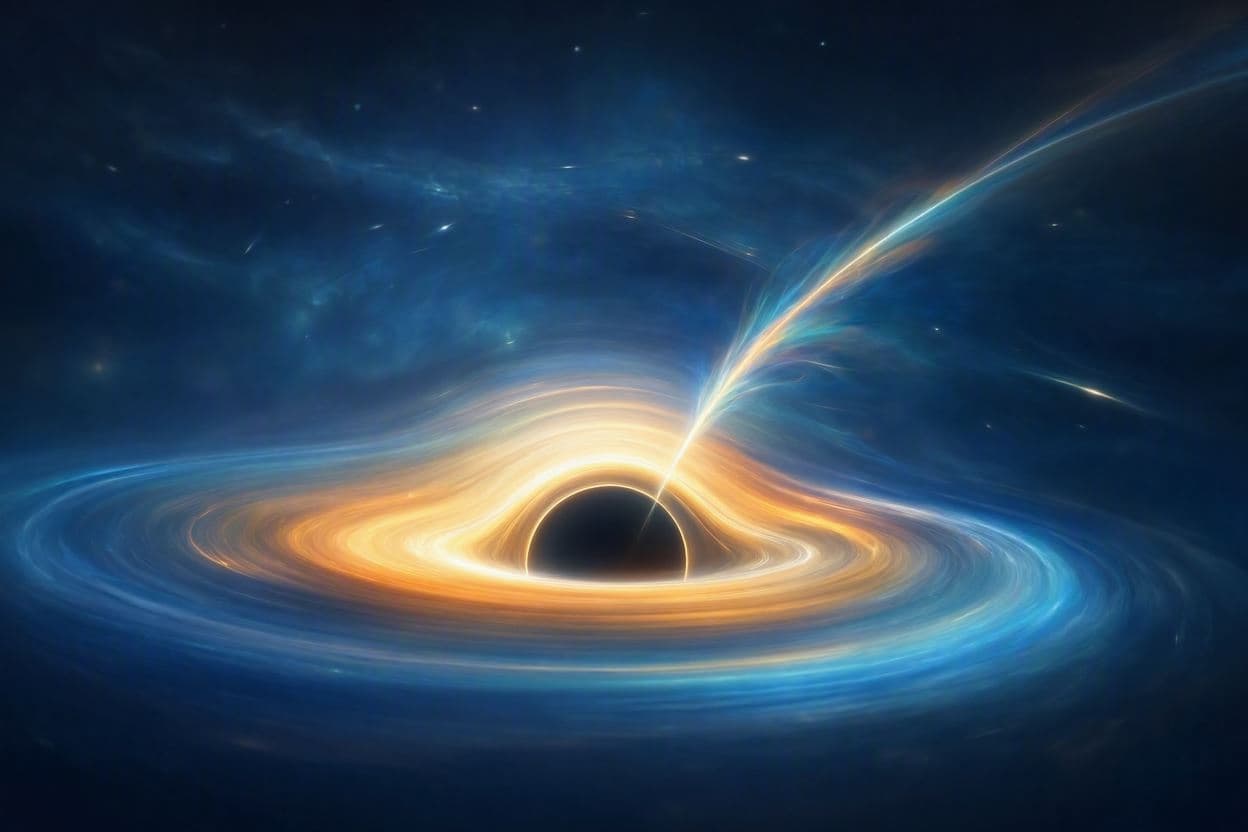
The observations focus on the relativistic jets ejected by supermassive black holes, streams of plasma that travel at near-light speeds. Traditional models suggested that bright flares in these jets were caused by internal shock waves, similar to sonic booms created when objects move faster than sound. These shocks were thought to accelerate particles, causing them to emit the radio waves detected by telescopes on Earth. It was a tidy explanation, fitting neatly into our understanding of high-energy astrophysics.
However, the new video data tells a different story. Instead of sudden, discrete brightening events consistent with shock fronts, the footage reveals a more complex, turbulent flow. The brightness variations appear smoother and more continuous, suggesting that magnetic reconnection or other fluid dynamics might play a larger role than previously assumed. This subtle shift in behavior undermines the simplicity of the shock wave hypothesis, pointing toward a more intricate interplay of forces.
Researchers utilized very long baseline interferometry (VLBI), a technique that links radio telescopes across the globe to create a virtual Earth-sized dish. This method allowed them to capture the evolution of the jet over time, rather than just snapshots. The resulting video provides a temporal dimension to spatial data, revealing how structures within the jet evolve, merge, and dissipate in real-time. It is akin to watching a river flow rather than examining a single drop of water.
The implications for astrophysics are significant. If shock waves are not the primary driver of particle acceleration in these jets, then models of energy transfer in active galactic nuclei need revision. This could affect our understanding of how black holes influence their host galaxies, regulating star formation and distributing heavy elements across the cosmos. The feedback loop between black holes and their environments is more nuanced than a simple mechanical impact.
Scientists are now exploring alternative mechanisms, such as magnetic turbulence or instabilities in the plasma flow. These processes can also accelerate particles to high energies but do so in a more distributed and continuous manner. The new data supports these alternatives, encouraging a broader exploration of plasma physics in extreme gravitational fields. It is a reminder that nature often favors complexity over simplicity.
For the public, this development highlights the power of technological advancement in expanding our horizons. What was once invisible and static is now visible and dynamic, transforming abstract concepts into observable reality. It invites a sense of wonder, as we witness the universe behaving in ways that defy our initial expectations. The black hole is no longer just a dark void but a source of lively, chaotic activity.
As further observations are collected, the scientific community will refine its theories to match the new evidence. The journey to understand black holes is ongoing, with each discovery adding depth to our cosmic narrative. By challenging old assumptions, we open the door to new insights, ensuring that our picture of the universe remains vibrant and evolving.
AI Image Disclaimer: The visual representations in this article are AI-generated interpretations designed to illustrate the concepts of relativistic jets and radio astronomy, without depicting specific real-world telescope data or actual black hole imagery.
Sources: Nature Astronomy, National Radio Astronomy Observatory (NRAO), Space.com, Phys.org
Published by Banx Network. This article is part of the Banx decentralized media programme, powered by the BXE token on the XRP Ledger.