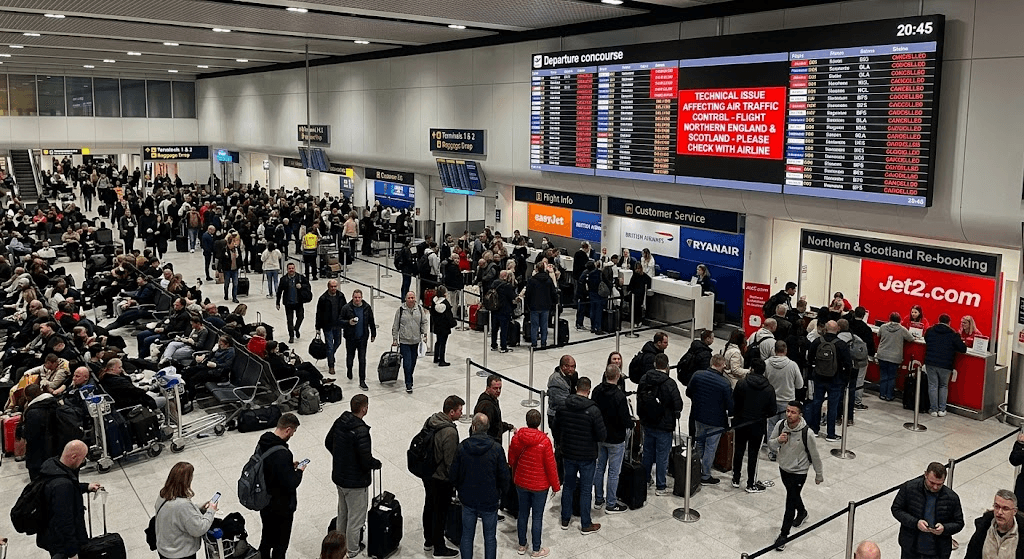
LONDON — A fresh technical glitch in Britain's air traffic control network triggered severe delays and flight cancellations across Scotland, Northern Ireland, and Northern England.
The malfunction, centered at National Air Traffic Services' (NATS) control facility in Prestwick, Scotland, forced air traffic managers to restrict airspace capacity to safely handle flights while engineers worked to identify and resolve the failure.
Airports operating across the northern regions reported mounting delays and ground stops throughout the day. Key hubs including Edinburgh, Glasgow, Manchester, Newcastle, and Belfast City experienced extensive flight delays and cancellations, while airports south of Manchester—including major London hubs—remained broadly unaffected. In response, airlines such as easy Jet and British Airways expressed deep frustration over recurring infrastructure failures, urging officials to guarantee future network resilience.
NATS confirmed that engineers resolved the network connectivity issue later in the day and began working with airlines and airports to safely lift air traffic restrictions. Transport Secretary Heidi Alexander acknowledged passenger frustration following recent travel disruptions, confirming that systems are resetting while residual delays remain.
NATS emphasized that today’s incident was completely unrelated to the major software glitch experienced earlier this month, which had grounded thousands of flights nationwide. Airlines continue to advise travelers to verify their flight status before heading to the airport as schedules gradually return to normal.
Industry experts noted that the timing of the disruption compounded the fallout, as airports were already managing heavy passenger volumes. Aviation analysts pointed out that even brief restriction on airspace capacity can create a cascading effect across international schedules, forcing aircraft to hold in pattern, divert to secondary airports, or remain stranded on tarmacs awaiting revised departure slots.
Meanwhile, consumer advocacy groups have called for clearer communication and swift compensation processing for thousands of stranded passengers. Under existing regulations, affected travelers may be entitled to food, accommodation, and rebooking assistance, though airlines have warned that clearing the backlog of delayed passengers and repositioning displaced aircraft and flight crews will likely take another 24 to 48 hours.
Published by Banx Network. This article is part of the Banx decentralized media programme, powered by the BXE token on the XRP Ledger.