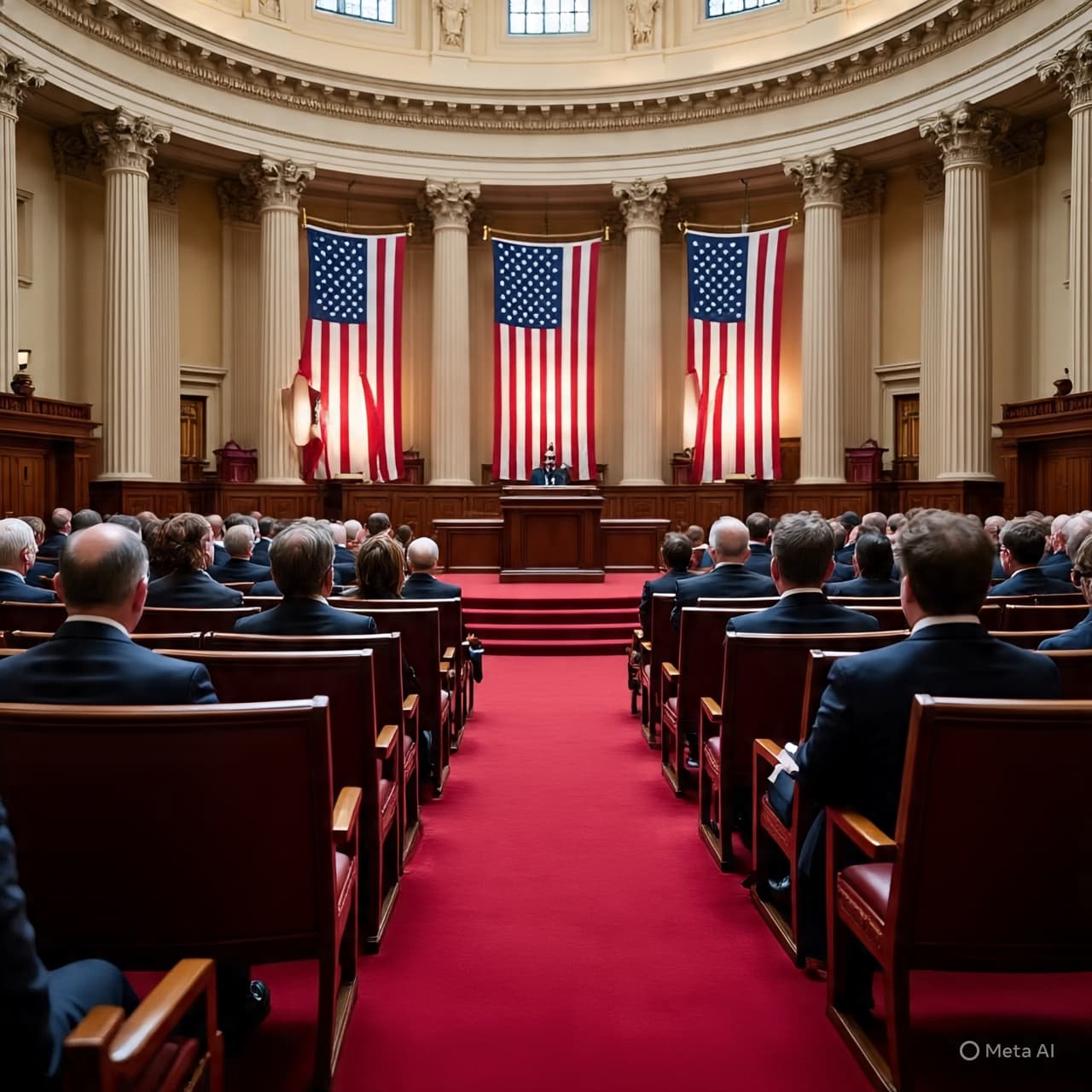
The winter air in Washington carries a particular stillness after the State of the Union—when applause fades, flags are folded, and the bright theater of politics dissolves back into marble corridors and late-night television panels. In that hush, words linger longer than the ceremony itself. They settle into headlines, into conversations at kitchen tables, into the quiet spaces where national identity is debated not with gavels but with memory.
It was in this afterglow that President Donald Trump, responding to visible dissent during his address to Congress, suggested that certain Muslim congresswomen who opposed him should be “sent back from where they came.” The remark arrived not as a formal policy proposal but as a sharp aside in the broader cadence of partisan dispute. Still, like a stone dropped into still water, it rippled outward.
The exchange followed a tense State of the Union in which Democratic lawmakers—including Muslim members of Congress—sat in protest or refrained from applause at various moments. The President’s words, directed at elected officials born or naturalized as American citizens, reopened a familiar and unsettled conversation about belonging. For supporters, the comment was framed as political counterpunching in a season of deep division. For critics, it echoed older refrains once used to question the legitimacy of immigrants and minorities, even those whose citizenship is unquestioned.
Among those drawn into the moment were high-profile Muslim congresswomen who have become prominent voices in recent years, navigating the symbolic weight of their presence as much as the substance of legislation. Their political journeys—rooted in districts as varied as urban Minneapolis and suburban Detroit—have unfolded under persistent scrutiny. To some constituents, they represent a widening of the American story; to detractors, they embody ideological opposition sharpened by identity.
The President’s comments were met swiftly with condemnation from Democratic leaders and civil rights organizations, who described the language as inflammatory and contrary to democratic norms. Republican responses were more varied—some defending the President’s right to respond forcefully to critics, others cautioning against rhetoric that might deepen cultural fractures. Across social media, reactions accumulated in real time, a digital echo chamber amplifying every syllable.
The incident sits within a broader political climate shaped by immigration debates, religious freedom disputes, and questions about what it means to dissent within a democracy. The State of the Union, traditionally a tableau of unity beneath disagreement, has in recent years become more visibly partisan—white and blue ensembles replacing bipartisan ovations, symbolic gestures layered atop policy differences. In that setting, moments of protest and retort can seem less like disruptions and more like chapters in an ongoing narrative of polarization.
Yet beyond the immediate uproar, the constitutional reality remains steady: members of Congress are elected by American voters, sworn under the same oath, and entrusted with the same legislative responsibilities. The friction between executive and legislative branches, while sometimes theatrical, is a long-standing feature of the American system. What changes are the tones and textures of the argument.
As the news cycle turns, the episode becomes another entry in the evolving ledger of American political speech—studied, debated, contextualized. For some, it reinforces a sense of grievance; for others, it underscores resilience in the face of rhetoric. And for many watching from afar, it offers a glimpse into a nation still negotiating the language of its diversity.
In the quiet after the chamber empties, the echo of that suggestion—“sent back”—collides with the enduring reality that citizenship, once granted or born into, is not a matter of sentiment but of law. The marble halls remain. The flags are raised again the next morning. And the country, restless and plural, continues its conversation about who belongs beneath them.
AI Image Disclaimer Illustrations were created using AI tools and are not real photographs.
Sources BBC News Reuters The New York Times Associated Press CNN
Published by Banx Network. This article is part of the Banx decentralized media programme, powered by the BXE token on the XRP Ledger.