There is a particular kind of anticipation that precedes a telescope's first light—the moment when years of engineering, testing, and hope are finally met with a stream of photons from the cosmos. In observatories around the world, that moment is approaching for instruments that promise to reshape our understanding of the universe.
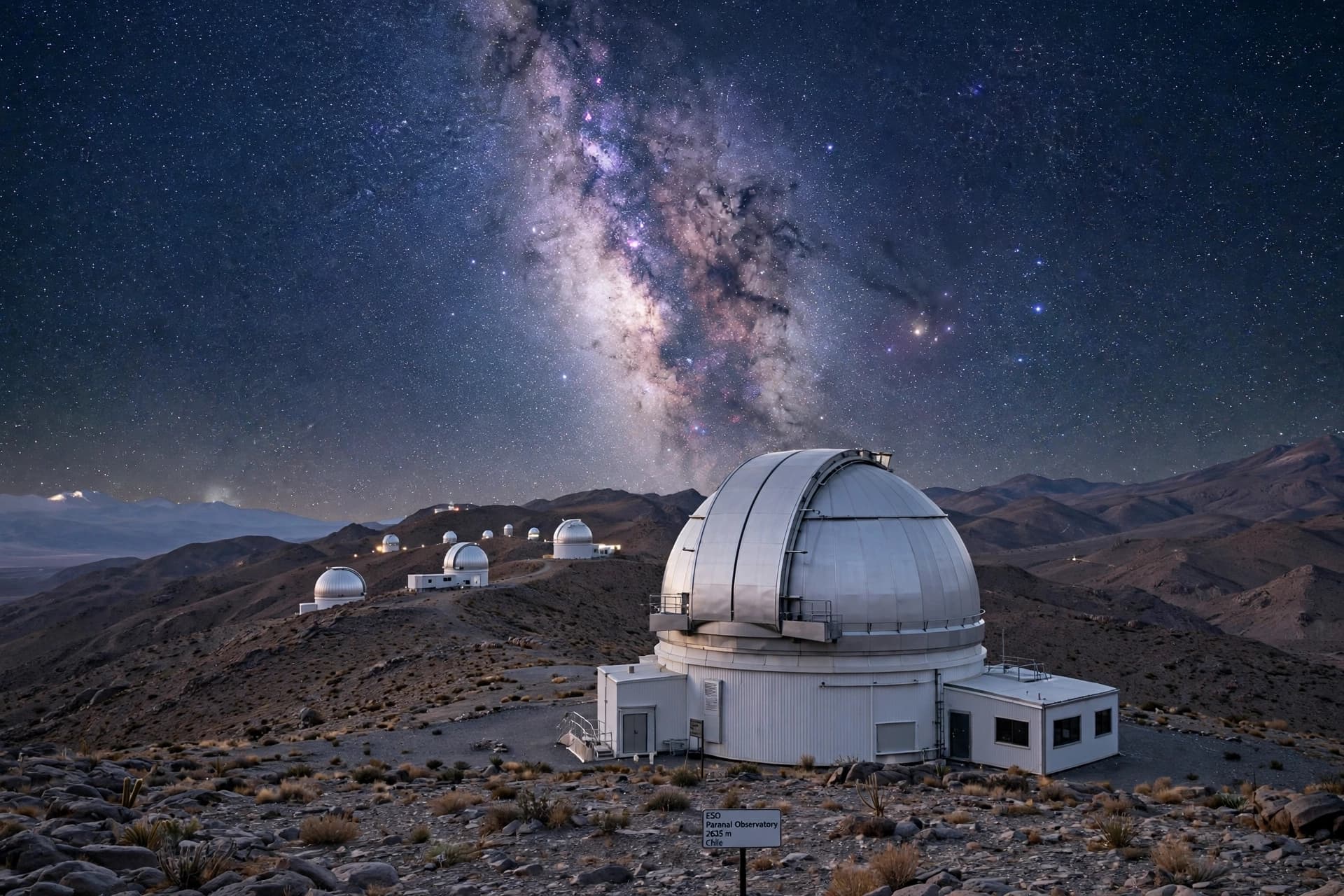
The Multi-Object Optical and Near-infrared Spectrograph, known as MOONS, has already achieved First Light at the European Southern Observatory's Very Large Telescope in Chile. The instrument, built by an international consortium led by the UK Astronomy Technology Centre, marks a new era in cosmic exploration . What makes MOONS extraordinary is its ability to observe nearly 1,000 stars or galaxies simultaneously, using a robotic fibre positioning system that places optical fibres onto celestial targets with micrometre accuracy . Its first observation captured the heart of the Milky Way, peering through the dust that obscures our view toward the galactic center .
"MOONS is the result of an extraordinary international effort," said Dr. Oscar Gonzalez, UK Principal Investigator. "For me, First Light is a celebration of their expertise, dedication and perseverance. It marks the exact moment in which years of work are transformed into discovery" .
Meanwhile, NASA's Nancy Grace Roman Space Telescope reached its own first light milestone in September, activating its Wide Field Instrument—a 300-megapixel infrared camera that will survey the cosmos with a field of view roughly 100 times larger than Hubble's . The telescope, which some experts say brings the power of "200 Hubbles," is now on its way to the second Sun-Earth Lagrange point. Its first images showed blurry stars, a reminder that calibration is still underway. "There is much to do, but we are on our way to groundbreaking science," said Josh Schlieder, an instrument scientist at NASA's Goddard Space Flight Center .
And in the high desert of Chile's Atacama, the Fred Young Submillimeter Telescope is preparing for its own first light. Located at 5,600 meters on Cerro Chajnantor, the CCAT Observatory's instrument will probe the submillimeter universe, addressing questions from Big Bang cosmology to star formation and galaxy evolution . Its Prime-Cam instrument will field over 100,000 kinetic inductance detectors, enabling mapping speeds more than ten times faster than previous submillimeter observatories .
Each of these instruments represents a different window onto the cosmos—optical, infrared, submillimeter—but they share a common purpose: to see what has never been seen, and to ask what has never been asked. As MOONS begins its planned ten-year mission, expected to observe up to ten million objects, and as Roman and CCAT prepare to join it, the next decade of astronomy is already taking shape . The excitement is not merely about new technology. It is about the questions that technology will finally allow us to answer.
AI Image Disclaimer: Visual content accompanying this article is generated by artificial intelligence and does not depict the actual telescopes or their observations.
Sources: UKATC, European Southern Observatory, Gizmodo, Scilit, ESO.org
Published by Banx Network. This article is part of the Banx decentralized media programme, powered by the BXE token on the XRP Ledger.