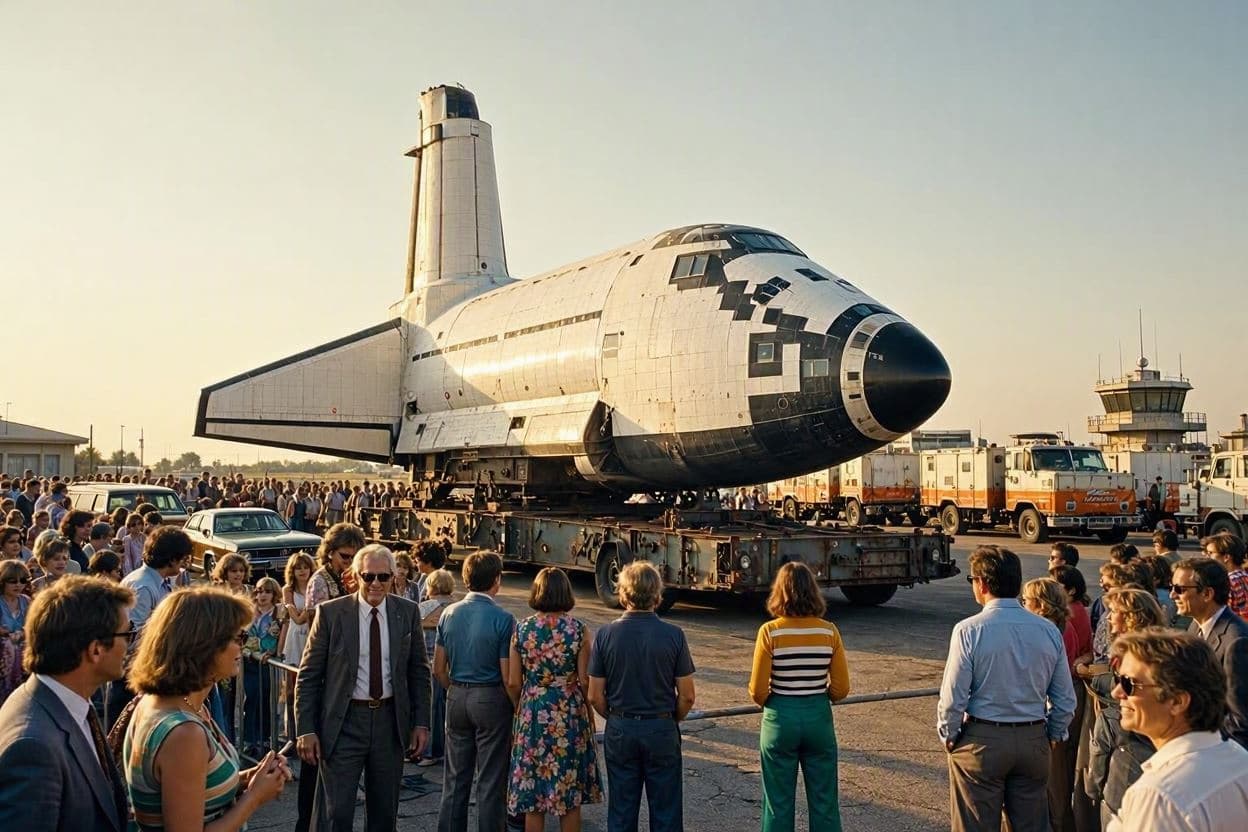
On a crisp September day in 1976, the doors of a manufacturing plant in Palmdale, California, opened to reveal a spacecraft that looked like nothing the world had ever seen. The Space Shuttle Enterprise, the first orbiter built for NASA’s shuttle program, was rolled out to the public, marking a pivotal moment in the history of space exploration. Though it never flew in space, Enterprise paved the way for a new era of reusable spacecraft, capturing the imagination of a generation and inspiring future astronauts to reach for the stars.
Named after the starship from the popular television series Star Trek, Enterprise was a tribute to the power of cultural influence on scientific ambition. The naming followed a massive write-in campaign by fans of the show, demonstrating the deep connection between science fiction and real-world innovation. When it emerged from the hangar, painted in its distinctive black and white thermal tiles, it stood as a symbol of human ingenuity and the desire to explore the unknown. It was a prototype, but it carried the weight of expectation.
Enterprise’s primary role was to conduct atmospheric approach and landing tests, proving that the shuttle design could glide safely back to Earth after re-entry. These tests were crucial for validating the aerodynamics and handling characteristics of the orbiter. Although it lacked engines and a heat shield for spaceflight, Enterprise demonstrated the viability of the shuttle concept, leading to the construction of operational vehicles like Columbia and Challenger. It was the foundation upon which the entire shuttle program was built.
For many, including current International Space Station astronauts, Enterprise was a source of early inspiration. Seeing the shuttle on news broadcasts or in person sparked a curiosity about space that lasted a lifetime. It represented a future where space travel was routine, where humans could fly to orbit and return like airplanes. This vision, though partially realized, left an indelible mark on the public consciousness and motivated countless individuals to pursue careers in science and engineering.
The 50th anniversary of Enterprise’s rollout is a time for reflection on the achievements and lessons of the shuttle era. The program faced challenges and tragedies, but it also delivered monumental successes, including the construction of the Hubble Space Telescope and the International Space Station. Enterprise’s legacy is intertwined with these accomplishments, serving as the quiet predecessor to decades of orbital activity. It reminds us that progress often begins with a single, tentative step.
Today, Enterprise resides at the Intrepid Sea, Air & Space Museum in New York City, where it continues to inspire visitors. Standing on the deck of the aircraft carrier, it serves as a tangible link to the past, inviting people to touch history and dream of the future. Its presence is a reminder of the boldness of the Apollo era transitioning into the practicality of the shuttle age. It is a monument to both technological achievement and cultural aspiration.
As NASA looks toward new frontiers with the Artemis program and commercial partnerships, the spirit of Enterprise lives on. The goal of reusable spacecraft has been revived by private companies, echoing the original vision of the shuttle program. The cycle of innovation continues, driven by the same curiosity that led to Enterprise’s creation. It is a testament to the enduring human desire to explore and understand our place in the cosmos.
In the end, Enterprise was more than just a test vehicle; it was a beacon of hope and possibility. Its rollout fifty years ago marked the beginning of a new chapter in spaceflight, one that emphasized accessibility and reuse. As we celebrate this milestone, we honor not just the machine, but the dreams it ignited. It remains a powerful symbol of what humanity can achieve when imagination meets engineering.
AI Image Disclaimer: The images accompanying this article are AI-generated artistic interpretations of the Space Shuttle Enterprise and historical scenes, not actual photographs of the 1976 rollout event.
Sources: NASA History Office Intrepid Sea, Air & Space Museum Space.com
Published by Banx Network. This article is part of the Banx decentralized media programme, powered by the BXE token on the XRP Ledger.