Key Highlights
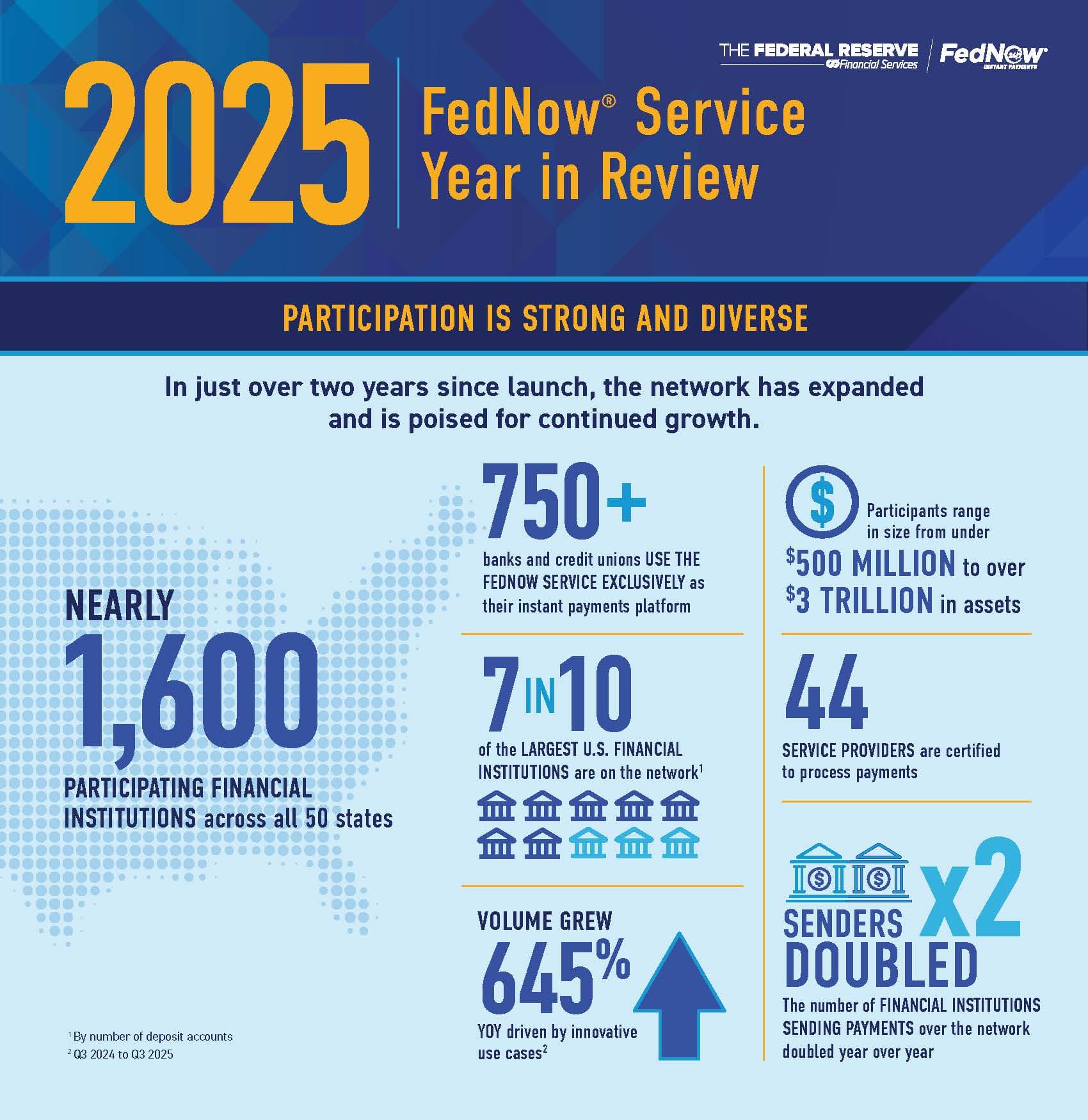
- FedNow Service recorded a 645% increase in payment volumes in 2025.
- Nearly 1,600 financial institutions across all 50 states now participate.
- U.S. Treasury added FedNow to its Digital Payout program for instant government payments.
The U.S. payments landscape reached a significant milestone in 2025 as the Federal Reserve’s FedNow Service recorded its strongest year since its launch. Designed to facilitate instant payments around the clock, FedNow is rapidly transforming how money moves across the American financial system—safely, instantly, and at scale.
In just over two years, FedNow expanded to nearly 1,600 participating financial institutions across all 50 states. This growth signals rising confidence among banks and credit unions that real-time payments are no longer optional infrastructure but a competitive necessity. Participation now spans institutions holding between $500 million and over $3 trillion in assets, showcasing adoption from community banks to major financial players.
Usage growth has been equally striking. Payment volumes surged by 645% year over year, driven by innovative use cases such as payroll, bill payments, account-to-account transfers, and emergency disbursements. As more institutions activate real-time capabilities, FedNow is becoming embedded in everyday financial activity, making transactions faster and more efficient for consumers and businesses alike.
A major breakthrough in 2025 was the U.S. Treasury's decision to add FedNow to its Digital Payout federal disbursement program. This integration allows government payments—such as relief funds or benefits—to reach recipients instantly, eliminating delays that previously stretched into days or weeks. For households and businesses alike, speed now directly translates into financial resilience, allowing for quicker access to essential funds during critical times.
Security and trust remain central to FedNow’s design. In 2025, the Federal Reserve introduced enhanced risk mitigation and fraud controls, strengthening confidence in instant settlement while maintaining regulatory compliance. Additionally, 44 certified service providers now support FedNow integrations, accelerating adoption and simplifying implementation for financial institutions looking to enhance their payment offerings.
Another key trend is scale. Seven in ten of the largest U.S. financial institutions are now connected to FedNow, and the number of sending institutions doubled year over year. This momentum positions FedNow as a foundational payment rail, complementing traditional payment methods like cards and ACH, as well as emerging tokenized money systems. The integration of FedNow into various financial services is expected to continue growing, further embedding instant payments into the fabric of the U.S. economy.
FedNow’s performance in 2025 confirms a broader shift: instant payments are no longer experimental—they are core financial infrastructure. As participation deepens and innovation expands, FedNow is reshaping the U.S. economy with faster liquidity, smarter cash flow, and payments that truly move at the speed of life. The implications of this transformation are profound, as it not only enhances consumer convenience but also supports businesses in managing cash flow more effectively.
Published by Banx Network. This article is part of the Banx decentralized media programme, powered by the BXE token on the XRP Ledger.