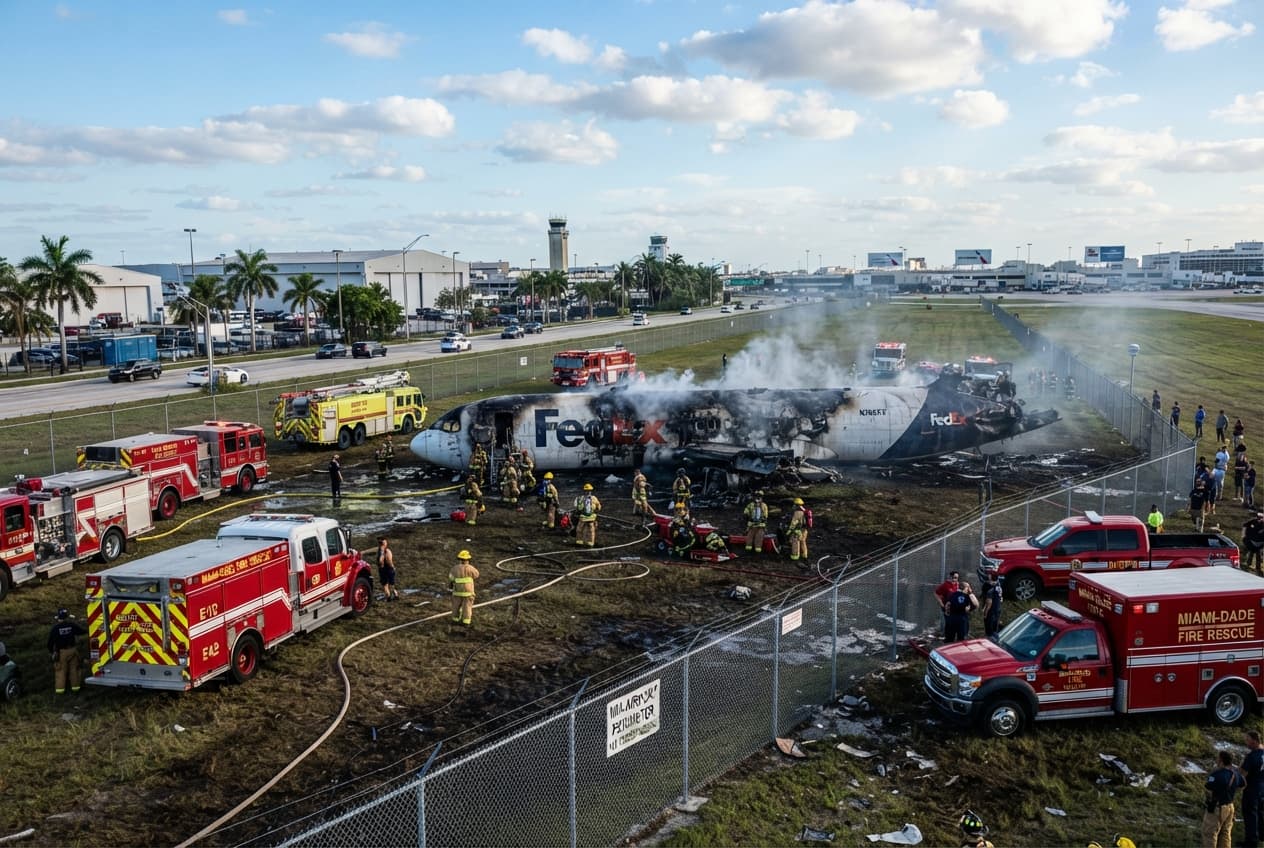
Miami, United States—Federal investigators fanned across the scorched tarmac perimeter early Tuesday morning to document wreckage patterns. The inquiry follows an aviation disaster where a heavy cargo aircraft breached perimeter barriers. Transport safety specialists collected fragmented electronic components from adjacent public roadways. Heavy equipment operators cleared twisted aluminum segments to allow unrestricted access for forensic teams. Local traffic corridors remained partially restricted while technical crews mapped skid marks.
National transportation safety board officials confirmed the successful retrieval of both flight data and cockpit voice recorders. Technicians transported the damaged recording units to a secure federal laboratory facility for immediate readout. Initial analytical efforts focused on mechanical performance metrics during the final approach sequence. Investigators interviewed surviving ground witnesses and reviewed air traffic control audio transmissions from the tower. Representatives from the cargo carrier pledged full cooperation with the ongoing federal administrative review.
Local emergency medical infrastructure transitioned away from immediate mass casualty response to long-term victim support operations. Hospital administrators reported that several critically injured individuals remained under intensive medical observation. Grief counselors arrived at municipal community centers to assist families affected by the tragedy. State transportation agencies faced mounting pressure regarding the proximity of public roadways to active airport zones.
Aviation safety experts debated the adequacy of existing runway safety areas at high-density commercial hubs. Labor organizations representing commercial pilots called for standardized implementation of enhanced overrun barrier systems. Federal regulators promised a transparent public reporting process once initial data decryption concludes. Political stakeholders scheduled preliminary oversight hearings to address national freight operational guidelines.
Specialized recovery teams utilized heavy cranes to lift major fuselage sections onto heavy transport flatbeds. Environmental mitigation units continued pumping residual chemical foams from adjacent drainage canals. Insurance adjusters established temporary staging areas near the airfield to evaluate commercial property damage.
Forensic pathologists finalized preliminary identification protocols for the victims recovered from the site.
Investigators spent the afternoon cataloging thousands of scattered debris fragments across the impacted sector.
Published by Banx Network. This article is part of the Banx decentralized media programme, powered by the BXE token on the XRP Ledger.