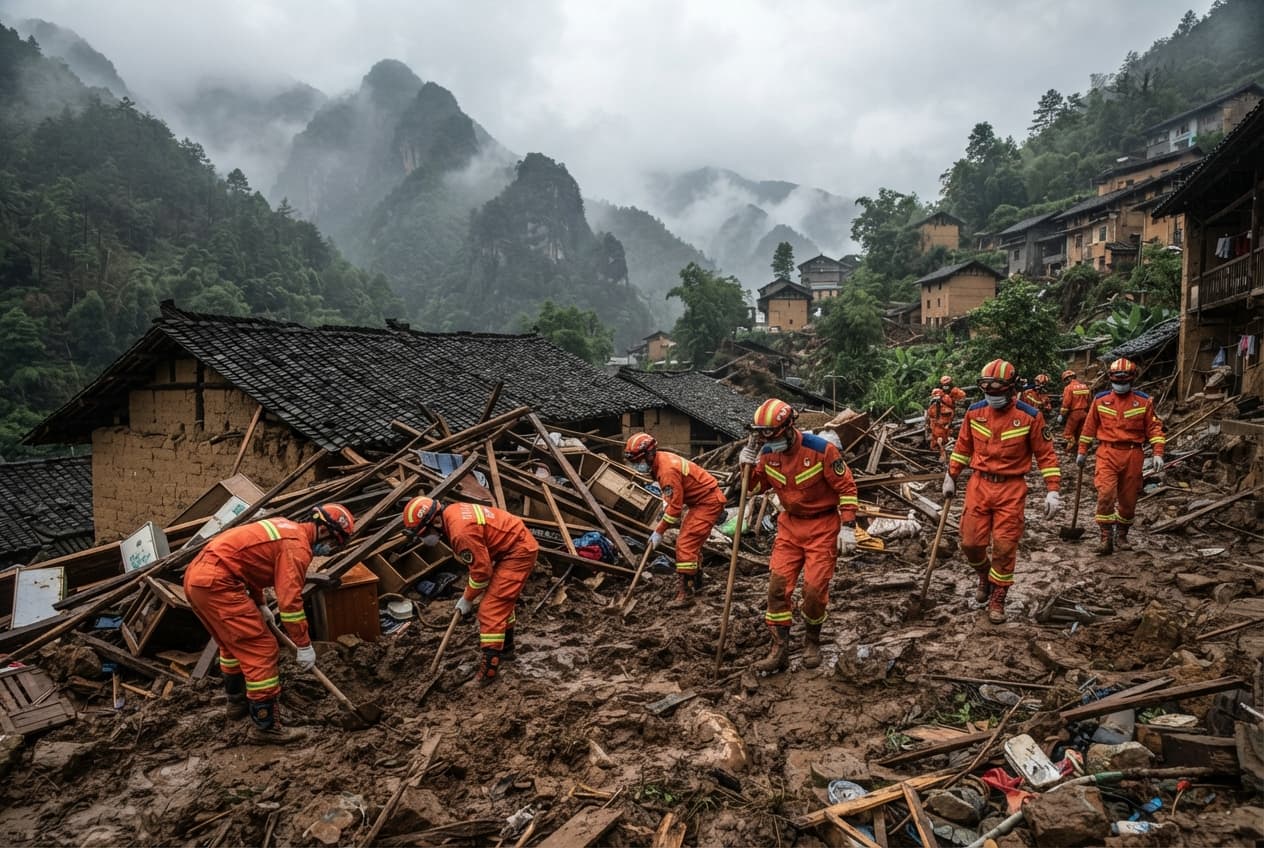
Ji'an, China—A sudden and violent mudslide tore through a remote mountain village in eastern China's Jiangxi province early Saturday morning, leaving a trail of destruction in its wake. Torrential downpours brought by ongoing seasonal storm systems saturated local hillsides until entire earthen slopes gave way without warning. Emergency response teams rushed to the disaster zone before dawn, navigating blocked roads and rising floodwaters to reach trapped villagers. Local disaster management authorities confirmed that initial rescue sweeps recovered at least one fatality while numerous individuals remained unaccounted for beneath tons of heavy debris.
Search operations expanded rapidly as specialized canine units and heavy excavation machinery arrived at the disaster epicentre. Provincial disaster relief agencies activated a high-level emergency response protocol, deploying hundreds of personnel to manage the unfolding crisis. Rescuers pulled two survivors from the wreckage during the morning hours, transporting both individuals to regional medical centers for urgent stabilization. Heavy rainfall continued to pelt the rescue zone, complicating efforts to clear blocked access routes and stabilize unstable surrounding terrain.
Local officials ordered the immediate evacuation of thousands of residents from neighboring settlements vulnerable to secondary slope failures. Temporary shelters established in nearby school gymnasiums filled quickly with displaced families carrying minimal personal belongings. Engineering teams deployed slope-monitoring radar units to track ground movement and protect rescue workers from sudden secondary avalanches. Utility lines snapped during the initial mudslide impact, plunging the affected valley into total darkness and knocking out local communication networks.
National emergency management bureaus dispatched senior coordination officials to oversee field operations and direct resource allocations. Aerial reconnaissance drones flew continuous grid patterns above the disaster area to locate isolated pockets of survivors cut off by washed-out bridges. Community volunteers and local militia members joined forces with professional firefighters to clear mud-choked residential courtyards by hand. Medical tents set up near the command post dispensed preventative treatments for waterborne illnesses and exhaustion among frontline responders.
Hydrological monitoring stations reported dangerously high water levels in local river tributaries draining the rain-swept mountain ranges. Provincial authorities urged downstream communities to remain on high alert as excess runoff threatened to breach local embankment walls. Meteorological agencies predicted additional precipitation throughout the weekend, warning that soil saturation levels remained critically high across the entire prefecture.
Relief supplies, including bottled water, generators, and heavy blankets, arrived via military transport trucks late Saturday afternoon. Village elders gathered near the police command perimeter, exchanging anxious updates regarding missing family members still trapped inside the exclusion zone. Investigative teams from the provincial safety bureau began collecting geological data to determine whether recent nearby construction contributed to the slope failure.
Operations continued under heavy floodlights as night fell over the muddy valley, with rescue crews refusing to halt their search. Heavy excavators clawed slowly through tangled masses of uprooted timber and collapsed masonry in the hunt for survivors. Officials maintained a strict information blackout regarding the exact identity of the missing pending formal notification of next of kin. The rescue coordinator stressed that teams would maintain round-the-clock operations until every unaccounted resident was located.
Published by Banx Network. This article is part of the Banx decentralized media programme, powered by the BXE token on the XRP Ledger.