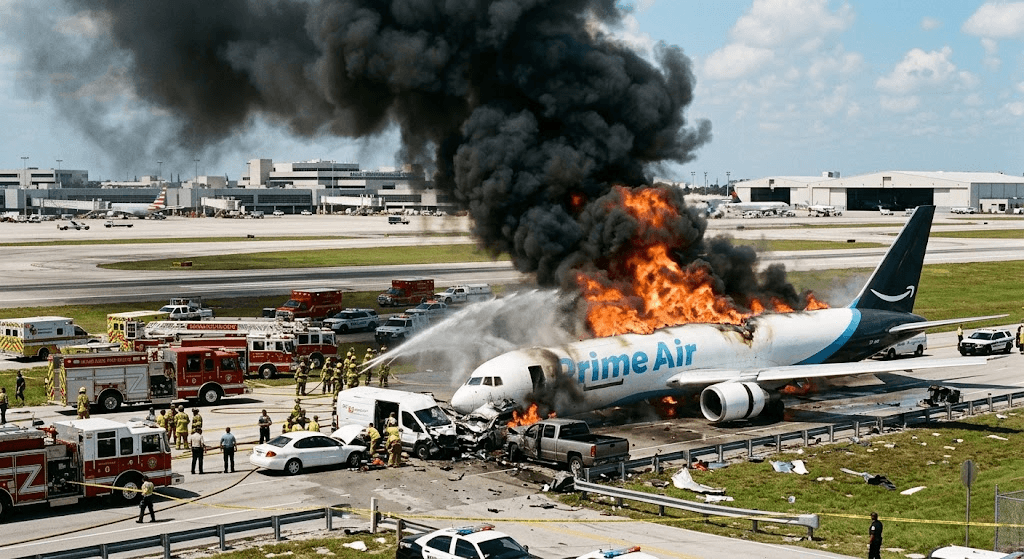
MIAMI, FL — At least five people have been killed and five others injured after an Amazon Prime Air cargo plane overshot the runway during a landing attempt at Miami International Airport on Sunday afternoon, September 6, 2026 smashing into ground traffic before engulfing in flames.
The aircraft, a Boeing 767-300 operated by cargo carrier 21 Air as Prime Air Flight 7598, was arriving from Luis Muñoz Marín International Airport in San Juan, Puerto Rico. Shortly before 2:00 p.m. EDT, the freighter failed to stop on the airport's diagonal runway. Travelling at an estimated 112 knots when it ran off the paved surface, the jet careened past safety buffers and collided with several vehicles operating on a perimeter roadway near an industrial area outside the airport boundaries.
The impact caused the jet to burst into flames, sending massive plumes of thick black smoke into the air. Over 60 Miami-Dade Fire Rescue units and roughly 200 emergency personnel rushed to the crash site to extinguish the blaze and manage an active fuel leak. First responders worked through severe conditions to cut open crushed vehicles and extricate victims.
Miami-Dade County officials confirmed that five people died at the scene, primarily occupants of the vehicles struck by the incoming aircraft. Five additional people were hospitalized, with three listed in critical condition at local trauma centers. Both the pilot and co-pilot were initially trapped inside the heavily damaged cockpit before being freed by rescue crews.
The tragedy triggered an immediate ground stop, shutting down all runways and taxiways at Miami International Airport during a busy holiday weekend travel period. U.S. Transportation Secretary Sean Duffy urged passengers to brace for widespread delays and cancellations as emergency operations secured the site.
Both Amazon and 21 Air issued statements expressing deep condolences to the families of the victims, confirming they are cooperating fully with law enforcement and regulatory agencies. The Federal Aviation Administration (FAA) and a specialized go-team from the National Transportation Safety Board (NTSB) have launched a full investigation into the crash. Federal investigators will examine key operational factors—including severe local weather and wind gusts reported at the time of landing, brake performance, runway conditions, and maintenance records—to determine why the 32-year-old freighter failed to bring itself to a stop.
Published by Banx Network. This article is part of the Banx decentralized media programme, powered by the BXE token on the XRP Ledger.