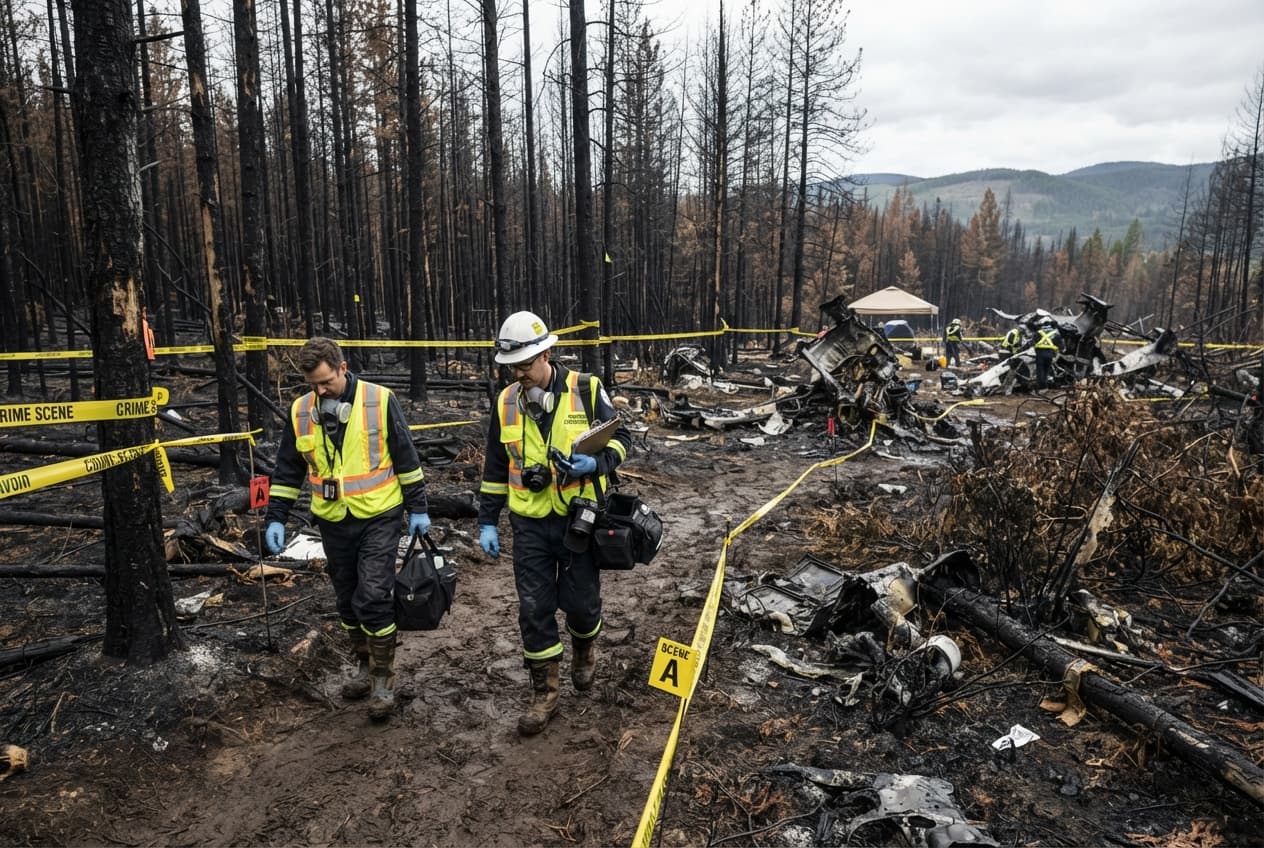
Montreal, Canada—Four people died instantly early Sunday morning when a private helicopter plunged from the sky and burst into flames in a remote section of Quebec province, local emergency responders confirmed. The aircraft went down under heavy cloud cover, leaving a charred debris field scattered across the rugged terrain as firefighters battled intense residual flames for hours. Federal aviation inspectors arrived at the scene shortly after sunrise to secure the perimeter and begin recovering flight data recorders from the charred wreckage.
Emergency dispatch centers received the first automated distress signal from the charter operator at approximately 06:45 local time, prompting an immediate multi-agency response involving provincial police and forest fire services. Dense smoke billowed above the tree line for miles, guiding first responders through difficult access roads that slowed initial rescue efforts. Rescue crews confirmed that all occupants sustained fatal injuries upon impact, rendering emergency medical intervention impossible at the site.
Local residents reported hearing a sudden, sputtering engine whine followed by a sharp drop in altitude moments before the final explosion shattered the quiet morning. Weather conditions in the region featured low visibility and intermittent mist, though transport authorities refused to speculate on whether environmental factors contributed to the steep descent. Investigators spent the morning interviewing eyewitnesses who observed the aircraft banking erratically before it disappeared below the ridgeline.
The National Transportation Safety Board equivalent deployed a specialized rapid-response team to map the debris trail and preserve fragile evidence before approaching evening weather systems could compromise the site. Maintenance logs recovered from the operator's regional hangar will undergo immediate forensic auditing to determine the mechanical condition of the turbine engines prior to takeoff. Officials noted that the aircraft possessed valid certification and had completed routine safety checks earlier in the month.
Provincial transport ministers held an emergency briefing in Quebec City to coordinate investigative protocols with federal safety boards and coroner offices. Coroners began the painstaking process of recovering remains from the heavily burned cabin, noting that positive identification would require DNA testing due to thermal damage. Representatives from the helicopter manufacturer also dispatched technical advisors to assist local authorities with component failure analysis.
Aviation safety advocates immediately pointed to the ongoing lack of mandatory terrain awareness warning systems on older private charter fleets operating in rugged northern territories. Industry observers noted that marginal weather rules frequently place heavy pressure on pilots navigating difficult topography without radar guidance. Transport regulators declined to comment on potential regulatory gaps while active recovery operations remained underway at the site.
Local municipal leaders expressed deep concern over emergency response times in isolated rural sectors where communication towers remain sparse and unreliable. Emergency services confirmed that satellite relay units had to be brought in to maintain contact between ground investigators and headquarters command posts. Further updates regarding victim identities will be withheld pending notification of next of kin through consular and police channels.
Federal investigators continue mapping the final flight path using radar telemetry recovered from regional air traffic control stations in Montreal.
Published by Banx Network. This article is part of the Banx decentralized media programme, powered by the BXE token on the XRP Ledger.