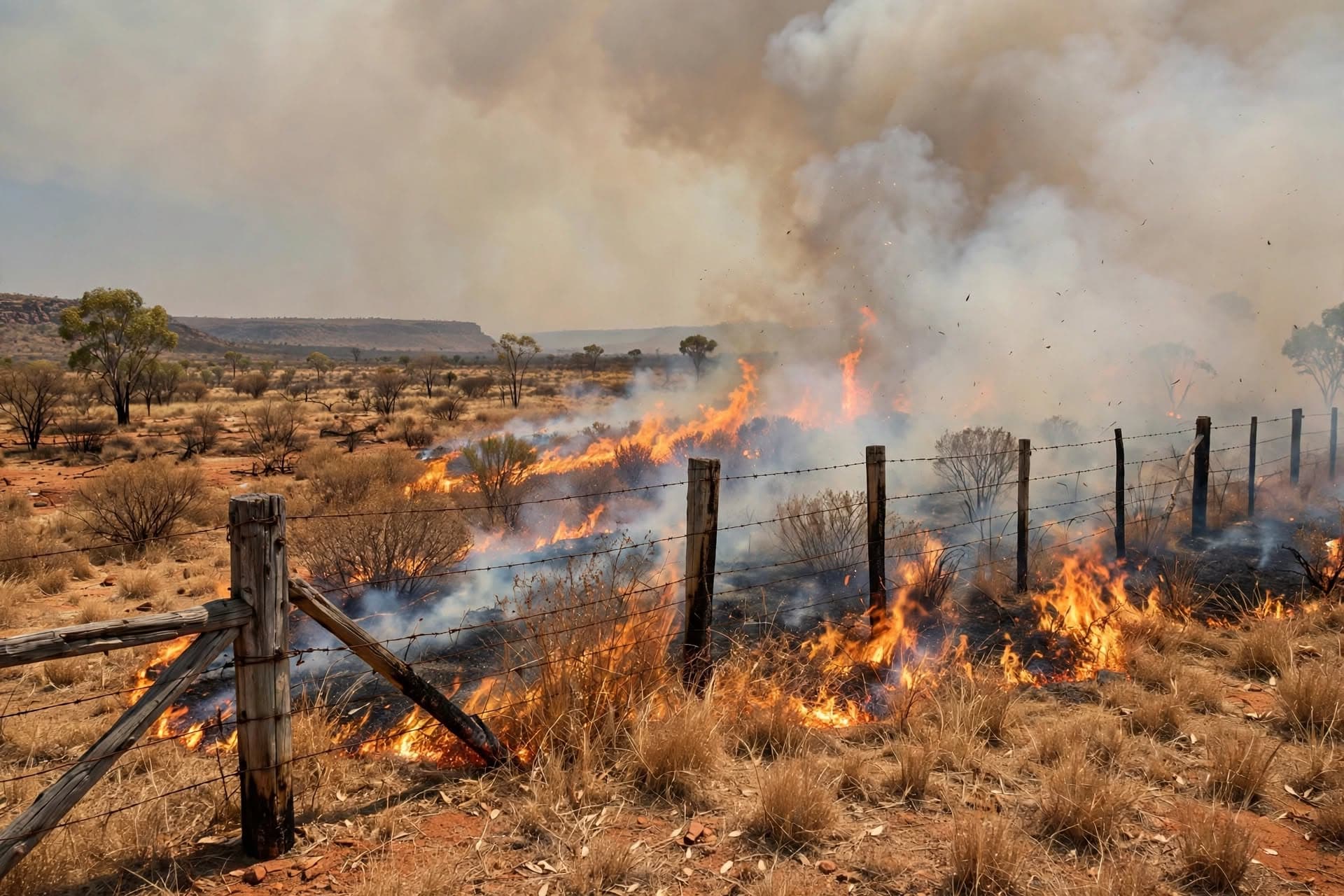
Alice Springs, Australia— The wind shifted at 11 a.m. on October 30, 2026, and the fire ran. Wildfires sweeping through arid brushland in Australia's Northern Territory and western Queensland burned through several ranch properties, scorching spinifex, mulga scrub and dry grass that had not seen rain in months. The 2026-27 bushfire season started in August and has already burned 350,000 hectares.
Fire authorities said the fires moved fast across flat, dry country where fuel loads are high after a warm winter. August 2026 was recorded as the warmest August on record for Australia. Victoria is facing what fire authorities describe as one of its toughest seasons in decades. On October 30, 30 active fires were burning across Victoria alone, with 10 posing significant threat, according to Premier Jacinta Allan.
In the Northern Territory, near Blackmore, a fire reached emergency warning level on September 16 and impacted structures. By late October, ranchers near Alice Springs and Tennant Creek reported sheds, fences and stockyards lost. One station reported 40 sheds destroyed. Another lost 47 homes and three businesses in Ravenswood and Harcourt, while fires in Natimuk razed 30 houses. In Longwood, about 150 structures were lost.
"We saw the smoke at 9 a.m., by 10 the fire was on the fence line," said a cattle station manager near Aitkenvale, where a vegetation fire warning expired October 31 at 05:43 local time. QFES data showed multiple vegetation fires across Queensland grid squares. Smoke affected residents and motorists. Crews used graders to cut breaks, but wind gusts of 50 kmph threw embers hundreds of meters.
The friction is distance. Outback stations are hours from the nearest town. Fire trucks take time. Water is scarce. Many ranches rely on their own bores and private fire units. When a fire jumps a road, there is no one to stop it. A 59-year-old firefighter was killed near Bulahdelah in New South Wales earlier in the season when a falling tree struck him while battling a blaze that consumed 3,500 hectares. In Tasmania, Dolphin Sands lost 19 homes.
ABC News Australia reported that over 300 structures, including more than 80 homes, have been destroyed nationally since August. One person has died and more than 300 buildings are gone across southeastern Australia. PM Anthony Albanese visited ravaged towns as authorities warned the worst may still lie ahead. The Bureau of Meteorology said heat and dry weather build across seven states and territories.
By the evening of October 30, 2026, containment lines were holding on two fires near Alice Springs, but a third to the north was still running uncontrolled. The Northern Territory Fire and Rescue Service said ranchers were told to leave early, not to defend properties when the fire front hit. Stock losses were not yet counted.
Crews were working through the night to protect homesteads. The wind was forecast to ease, but temperatures would stay high.
Published by Banx Network. This article is part of the Banx decentralized media programme, powered by the BXE token on the XRP Ledger.