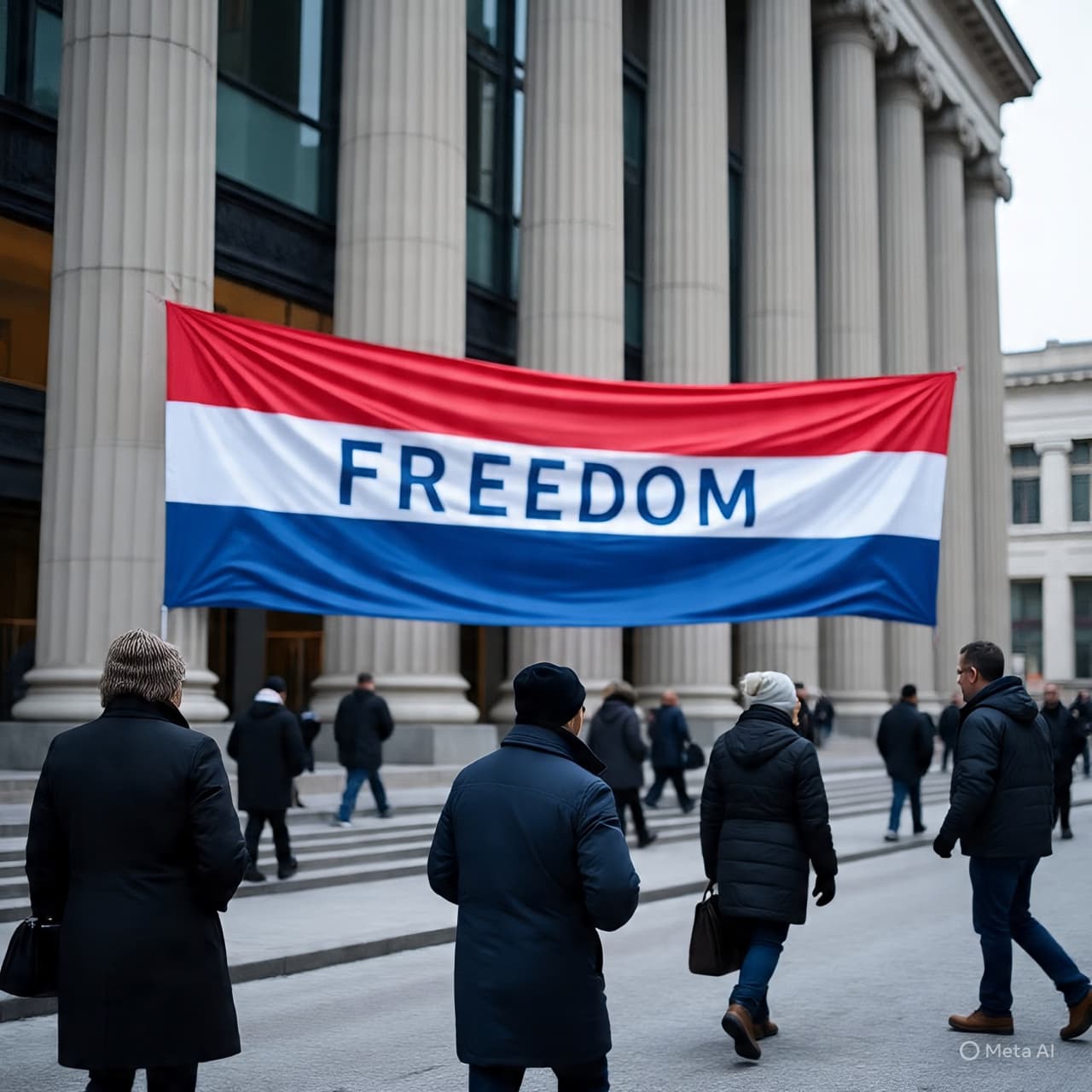
The winter light along Pennsylvania Avenue has a way of flattening everything into silhouette. Buildings stand in pale relief, their columns austere and patient against the slow drift of traffic. On certain mornings, the air feels less like a season and more like a pause — a held breath between one chapter and the next. Outside the headquarters of the Department of Justice, a large banner bearing the image of Donald Trump has come to hang in that quiet, a bright rectangle against stone and sky.
The Department’s building, long a symbol of institutional continuity, rises in measured symmetry not far from the Capitol dome. Its façade has witnessed generations of attorneys general, investigations, reforms, and reckonings. Now, passersby glance upward at the banner — some with curiosity, others with recognition — as if it were another layer in the city’s long conversation with power.
The display appears amid an election year climate that has once again placed Trump, the 45th president of the United States, at the center of public debate. Since leaving office in 2021, he has remained an enduring presence in American political life, navigating both campaign rallies and courtrooms. Federal and state legal proceedings have unfolded in parallel with his bid to return to the White House, turning the spaces of justice into backdrops for a broader national drama.
The banner itself, stretched taut against winter wind, functions less as decoration than as declaration. It reflects how political identity increasingly migrates into public space — on flags, placards, billboards, and screens — transforming architecture into canvas. In Washington, where symbolism often carries as much weight as statute, even a temporary display can seem to echo far beyond its physical dimensions.
Inside the Justice Department, daily routines continue. Lawyers review filings, staff members move between offices, and the machinery of law hums with procedural steadiness. The institution, founded in 1870, was designed to stand apart from partisan tides, its authority rooted in statutes and precedent rather than personality. Yet history has shown that no institution exists entirely outside the weather of politics. The banner’s presence underscores that tension — between permanence and moment, between marble and movement.
For supporters, Trump’s image is emblematic of resilience and grievance, of unfinished agendas and promised returns. For critics, it evokes unresolved questions about accountability and democratic norms. The banner does not answer those questions; it merely reflects them, like a mirror angled toward the street.
Washington has always been a city of images. From wartime posters to civil rights marches, from inaugurations to protests, its avenues have carried the visual language of the nation’s arguments. The Justice Department building, in particular, has been both fortress and forum — a place where law is interpreted even as it is interpreted by the public.
As evening settles and the banner catches the last of the fading light, the building remains what it has long been: an emblem of continuity amid contention. The courts will proceed, the campaign trail will unfold, and the rhythms of civic life will carry forward. The banner, whether it remains for days or disappears with the season, becomes part of that layered narrative — a moment pinned briefly against stone, reminding the city that in Washington, image and institution are never entirely separate.
In the end, the display outside the Justice Department is less about fabric and ink than about the ongoing negotiation between leadership and law. It stands as one more scene in a capital accustomed to spectacle, yet grounded in process — a reminder that even in an age of vivid imagery, the deeper currents of governance move with deliberate, quieter force.
AI Image Disclaimer Illustrations were created using AI tools and are not real photographs.
Sources U.S. Department of Justice The Associated Press Reuters The New York Times BBC News
نُشر بواسطة Banx Network. هذا المقال جزء من برنامج الوسائط اللامركزية من Banx، مدعومًا برمز BXE على شبكة XRP Ledger.