
Key Highlights
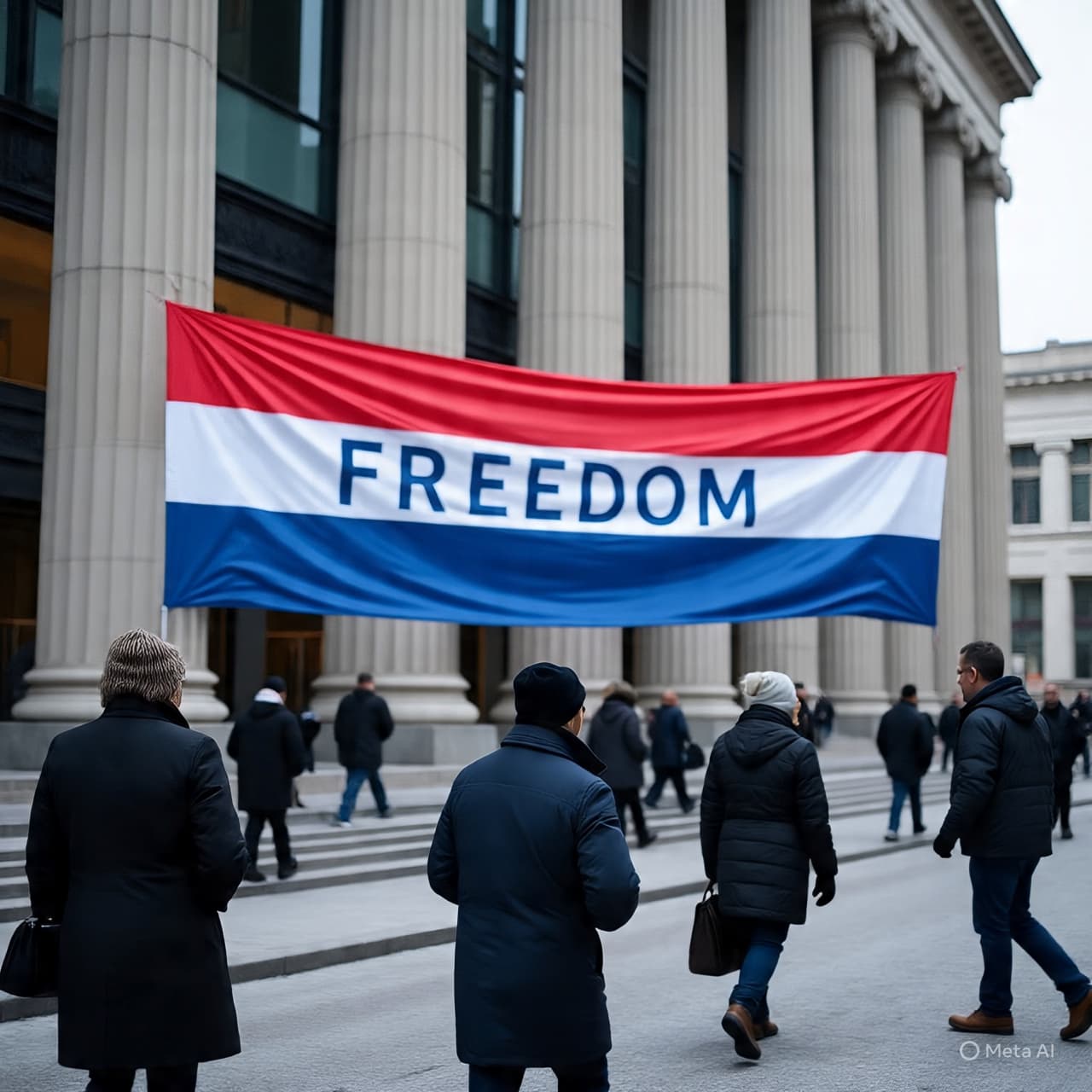
- A banner featuring Donald Trump is displayed outside the Justice Department.
- The banner reflects ongoing political tensions as the 2024 election approaches.
- The Justice Department symbolizes institutional continuity amid political change.
The winter light along Pennsylvania Avenue casts a unique ambiance, transforming the iconic buildings into silhouettes against the backdrop of a bustling city. Among these structures, the Department of Justice stands as a testament to institutional resilience, its façade now adorned with a large banner featuring Donald Trump. This striking display, a bright rectangle against the austere stone and sky, has become a focal point for passersby, drawing a mix of curiosity and recognition.
As the nation gears up for the 2024 election, Trump's image looms large in public discourse. Since leaving office in January 2021, he has remained a significant figure in American politics, navigating a complex landscape of campaign rallies and legal challenges. The juxtaposition of the banner against the Justice Department's historic architecture serves as a reminder of the ongoing interplay between politics and public space, where symbols often carry as much weight as legislation.
The banner, stretched taut against the winter wind, transcends mere decoration; it acts as a declaration of political identity. In a city where imagery plays a crucial role in shaping narratives, this display reflects the broader national conversation about leadership, accountability, and the future of democracy. It highlights how political messages increasingly find their way into public spaces, transforming architecture into a canvas for expression.
Inside the Justice Department, the daily operations continue unaffected by the banner's presence. Lawyers diligently review legal filings, and staff members navigate the corridors, maintaining the institution's procedural integrity. Established in 1870, the Justice Department was designed to operate independently of political fluctuations, its authority grounded in law rather than individual personalities. However, the banner's presence underscores the inherent tension between the permanence of institutions and the transient nature of political movements.
For supporters of Trump, the banner symbolizes resilience and a call to action, while critics view it as a reminder of unresolved issues surrounding accountability and democratic principles. The display does not provide answers but rather reflects the polarized sentiments that characterize contemporary American politics, acting as a mirror to the public's concerns.
Washington, D.C., has long been a stage for visual narratives, from wartime propaganda to civil rights demonstrations. The Justice Department, in particular, has served as both a fortress of law and a forum for public discourse. As evening descends and the banner catches the last rays of light, the building remains a symbol of continuity amid contention, embodying the complex relationship between governance and public perception.
Ultimately, the banner outside the Justice Department is more than just fabric and ink; it represents an ongoing negotiation between leadership and law. In a capital accustomed to spectacle, this display serves as a poignant reminder that, even in an era dominated by vivid imagery, the foundational currents of governance continue to flow with deliberate force, shaping the future of the nation.
Published by Banx Network. This article is part of the Banx decentralized media programme, powered by the BXE token on the XRP Ledger.



