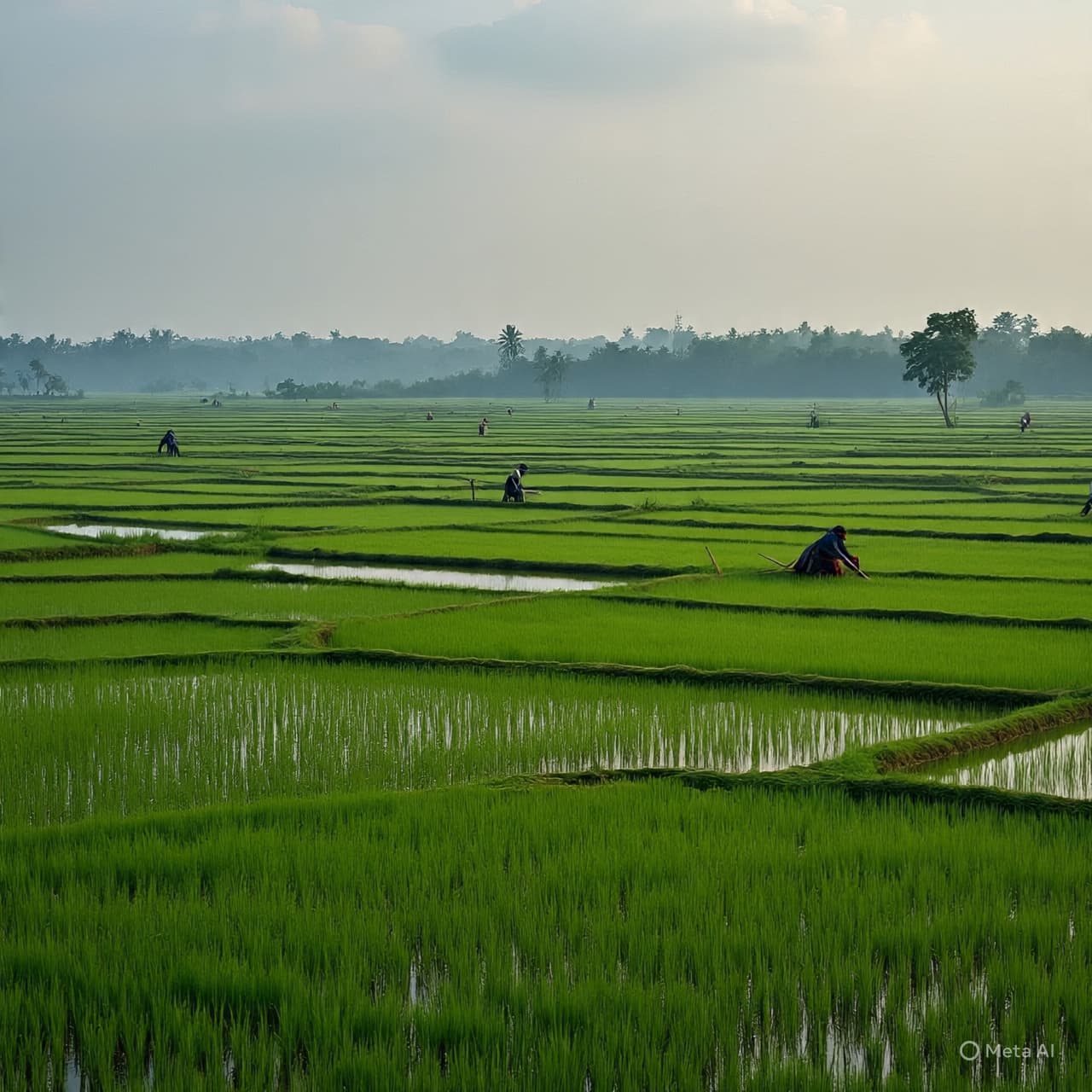
On India’s fertile plains, emerald rice paddies stretch to the horizon — a scene of agricultural abundance that has helped the nation become the world’s largest producer and exporter of rice, surpassing China and commanding about 40% of global rice trade. Yet this hallmark of success now casts a deep, troubling shadow: it is playing a central role in draining precious water resources across parts of the country, threatening livelihoods, sustainability, and even India’s future in feeding the world.
In states like Punjab and Haryana, where rice cultivation is most concentrated, farmers once drew groundwater from relatively shallow depths — around 30 feet a decade ago. Today, borewells must plunge between 80 and 200 feet to reach the same supply, a staggering increase driven by relentless extraction to irrigate thirsty rice fields.
The science behind this strain is stark: producing just one kilogram of rice can consume 3,000–4,000 litres of water, far above global averages. This intensive usage is compounded by heavy government subsidies — including guaranteed minimum prices and cheap electricity — which effectively encourage farmers to favor rice over less water‑demanding crops.
As a result, vast tracts of aquifers have been pushed into “critical” or “over‑exploited” status, with groundwater extraction in certain districts exceeding natural recharge rates by as much as 35% to 57% annually. Even strong monsoon seasons have failed to replenish these reserves adequately, leaving farmers to drill deeper and spend more on pumps, pipes, and labour just to keep crops alive.
For many smallholders, the rising costs pose an existential threat. Those with deeper pockets may continue to make rice profitable by navigating subsidies and affording increasingly powerful equipment, but subsistence and marginal farmers are feeling the squeeze most acutely.
Efforts to reform agricultural support systems have run into political headwinds. Past attempts to reduce dependency on guaranteed procurement of grains triggered mass protests and forced policymakers to retreat from unpopular reforms. This political sensitivity has made it difficult to promote alternatives like millets or pulses, which require far less water and could help ease the pressure on aquifers.
But the implications extend far beyond India’s fields. Because India supplies such a large share of the world’s rice exports, production shifts prompted by water scarcity — whether reductions or policy changes — could reverberate through global markets, affecting prices and food security in countries heavily reliant on imported rice.
The tension is clear: a nation celebrated for feeding millions may be undermining its own environmental foundations to do so. As rivers recede and wells run dry, scientists and policymakers alike ask whether the cost of dominance in global rice trade must be recalibrated for the sake of water sustainability and long‑term agricultural resilience.
AI Image Disclaimer “Visuals are created with AI tools and are not real photographs.”
Sources Reuters — India’s domination of global rice trade stokes looming water crisis Modern Diplomacy — Analysis of India’s rice export boom and groundwater depletion Business Standard — Coverage of groundwater concerns linked to rice cultivation
Published by Banx Network. This article is part of the Banx decentralized media programme, powered by the BXE token on the XRP Ledger.