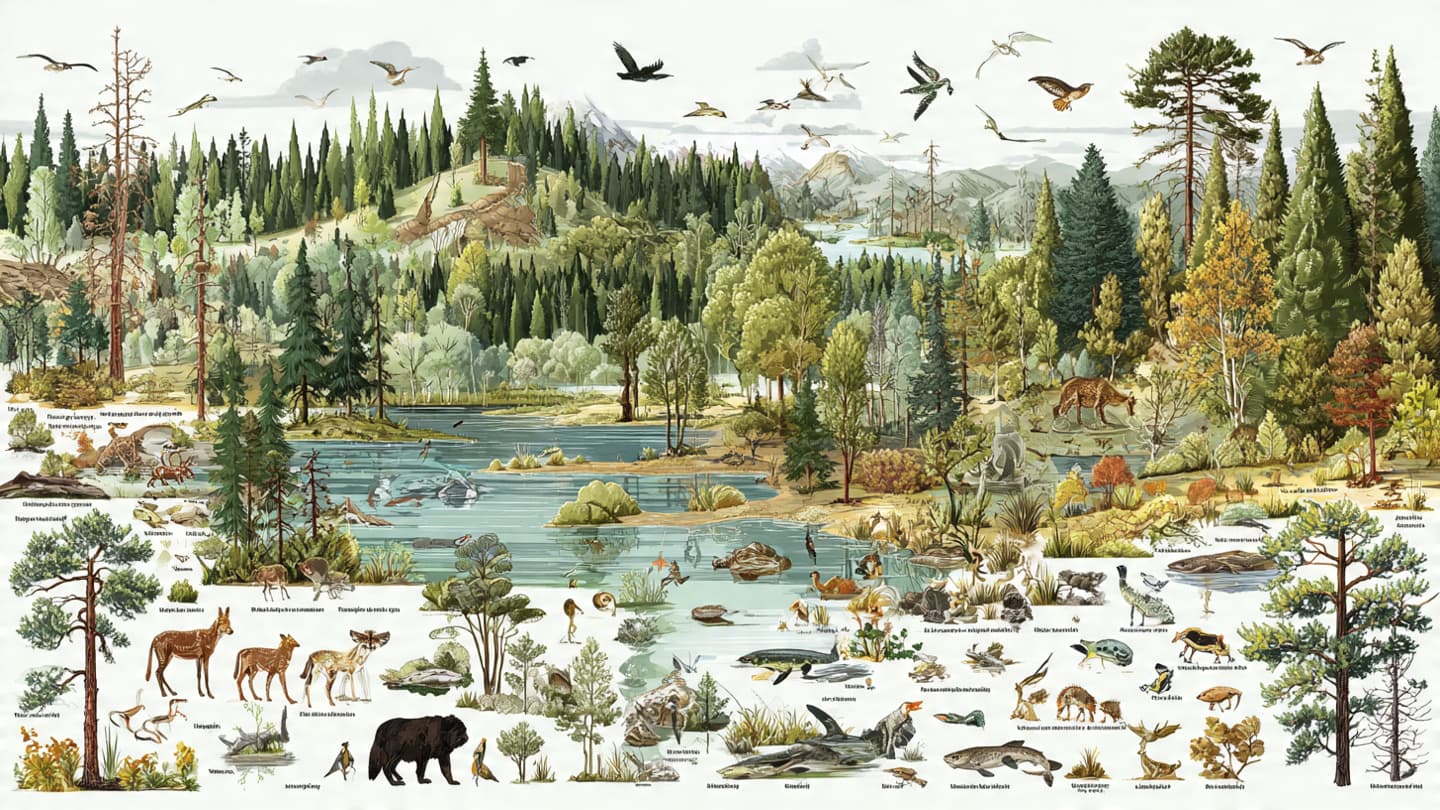
Nature rarely changes in straight lines. Evolution moves quietly through generations, shaped by survival, adaptation, and countless invisible pressures unfolding over time. In Canada, new scientific discussions surrounding natural selection have once again brought attention to one of biology’s most enduring and influential principles.
The recent research highlighted in Canadian science coverage explores how species continue adapting to rapidly changing environmental conditions. Scientists involved in the study examined genetic shifts within animal populations exposed to climate variation, habitat disruption, and altered ecosystems over extended periods of observation.
Researchers say the findings reinforce the idea that natural selection remains an active and observable process rather than merely a historical concept associated with ancient evolution. Certain traits linked to survival and reproduction appear to become more common as environmental pressures intensify, demonstrating how populations gradually respond to external change.
Climate conditions have become a central focus within modern evolutionary studies. Rising temperatures, shifting migration patterns, and changing food availability are influencing how animals interact with their surroundings. Some species appear capable of adapting relatively quickly, while others struggle to adjust to increasingly unstable environments.
Canadian scientists participating in the discussion emphasized the importance of long-term ecological monitoring. Evolutionary changes often unfold slowly, requiring decades of observation to identify meaningful biological trends. Advances in genetic sequencing technology, however, are allowing researchers to detect subtle changes with far greater accuracy than in the past.
The topic also carries implications beyond wildlife biology alone. Understanding adaptation mechanisms may help scientists improve conservation strategies, predict ecosystem responses, and assess how environmental stress affects biodiversity. Researchers argue that evolutionary science remains deeply connected to modern ecological decision-making.
Educational institutions across Canada have used the renewed attention surrounding natural selection to encourage public engagement with science literacy. Biology teachers, museums, and science programs are increasingly presenting evolution not as an abstract theory isolated in textbooks, but as an ongoing process visible within contemporary ecosystems.
Some researchers caution that adaptation has limits. While natural selection can support resilience, rapid environmental disruption may occur faster than certain species can evolve. Conservation experts therefore stress that scientific understanding alone cannot replace broader efforts aimed at habitat protection and environmental stability.
As Canadian researchers continue examining the changing relationship between organisms and their environments, the discussion surrounding natural selection offers a quiet reflection on life itself. Across forests, oceans, and microscopic ecosystems, evolution continues its patient work, often unnoticed until science pauses long enough to observe it carefully.
AI Image Disclaimer: This article contains AI-assisted visual illustrations created for scientific storytelling and editorial presentation.
Sources: Global News Canada, Nature, Scientific American
Published by Banx Network. This article is part of the Banx decentralized media programme, powered by the BXE token on the XRP Ledger.