

Key Highlights
- AI technology enhances medical imaging analysis for disease detection.
- Improved efficiency allows clinicians to prioritize urgent cases.
- Ongoing research ensures safety and effectiveness in healthcare settings.
Advances in medicine often arrive quietly, emerging from years of patient research rather than moments of sudden discovery. Every improvement in diagnostic technology represents countless hours spent refining algorithms, validating clinical evidence, and ensuring that innovation serves patients safely. A newly developed artificial intelligence system designed to assist medical imaging reflects that steady progress, offering researchers another promising tool for earlier disease detection.
Scientists involved in the project reported that the AI model demonstrated an improved ability to analyze medical images and identify subtle patterns that may be difficult for the human eye to recognize during routine examinations. The technology is intended to support healthcare professionals by providing an additional layer of analysis rather than replacing clinical judgment. This collaborative approach aims to enhance diagnostic accuracy and patient outcomes.
Medical imaging has become an essential component of modern healthcare. X-rays, CT scans, MRI examinations, and other imaging techniques help physicians detect illnesses ranging from cardiovascular disease to neurological disorders and various forms of cancer. Researchers believe AI-assisted analysis may improve efficiency by helping clinicians prioritize cases that require immediate attention, thus potentially reducing the time patients wait for critical diagnoses.
Experts emphasize that artificial intelligence should be viewed as a clinical decision-support tool. Final diagnoses remain the responsibility of qualified healthcare professionals, who interpret imaging results alongside medical history, laboratory findings, physical examinations, and other diagnostic information. Human expertise continues to play the central role in patient care, ensuring that AI serves as a complement rather than a replacement.
The researchers also highlighted the importance of rigorous clinical validation before AI systems are introduced into routine medical practice. Large-scale testing across diverse patient populations is necessary to confirm that the technology performs consistently and fairly under different healthcare conditions. This validation process is crucial to building trust among healthcare providers and patients alike.
Hospitals and research institutions worldwide continue evaluating AI applications that could reduce diagnostic workloads while improving patient outcomes. Faster image analysis may shorten waiting times, allowing physicians to begin treatment sooner when early intervention is critical. The integration of AI into medical imaging could revolutionize how healthcare systems operate, making them more responsive to patient needs.
Healthcare regulators are likewise developing standards to ensure that AI-powered medical technologies meet appropriate safety, transparency, and performance requirements. These frameworks aim to encourage innovation while maintaining public confidence in emerging healthcare technologies. As AI continues to evolve, its role in healthcare will likely expand, necessitating ongoing dialogue among stakeholders.
Although further research and clinical evaluation remain necessary, scientists believe AI-assisted medical imaging represents another meaningful step toward more efficient healthcare. Continued collaboration among physicians, engineers, regulators, and researchers will be essential to ensuring that these technologies deliver reliable benefits to patients around the world.
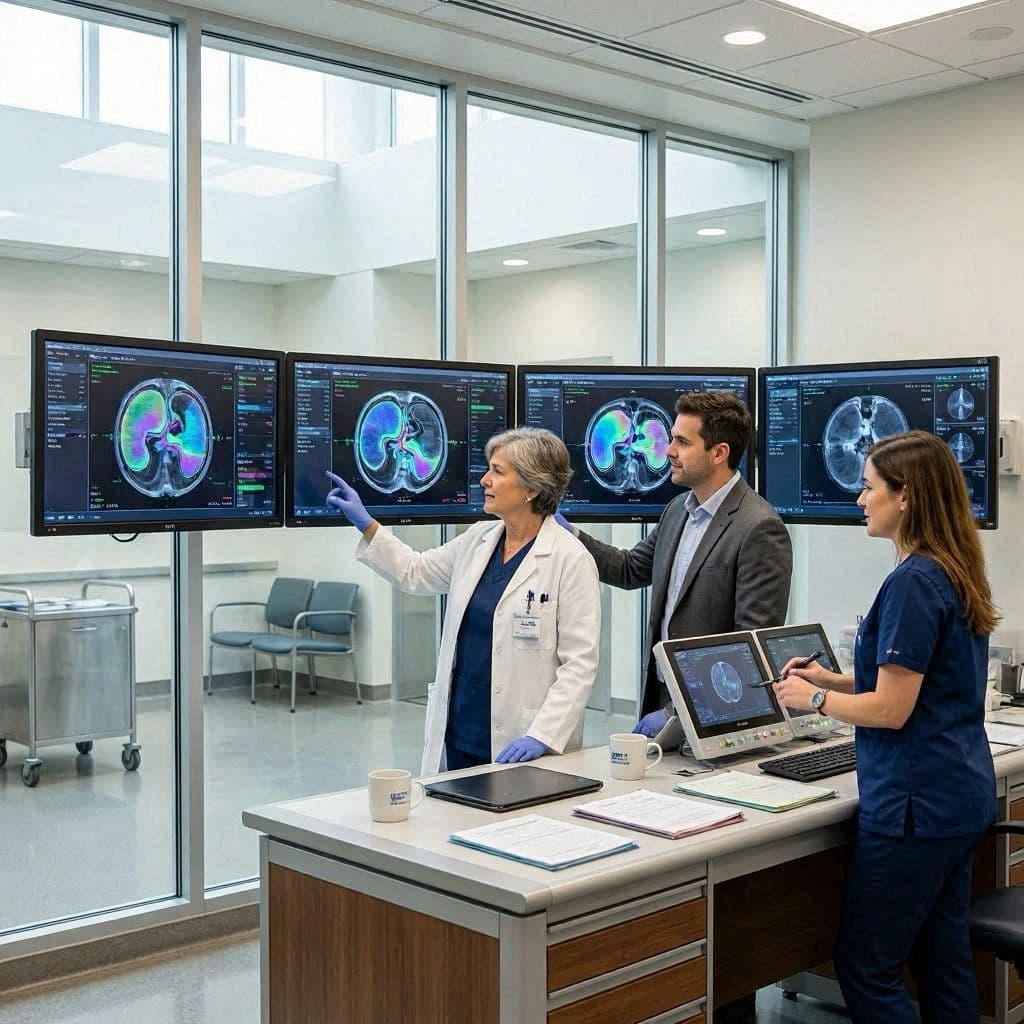
AI-generated image disclaimer: This illustration was generated using artificial intelligence for editorial visualization and does not depict an actual patient or clinical examination.
Published by Banx Network. This article is part of the Banx decentralized media programme, powered by the BXE token on the XRP Ledger.




