The night sky often appears calm, yet beneath its quiet beauty lies a universe filled with extraordinary events unfolding across unimaginable distances. Every new observation reminds scientists that space continues to hold mysteries capable of reshaping human understanding. A recent astronomical discovery has provided another remarkable glimpse into that vast cosmic story.
Astronomers have observed evidence consistent with the birth of a magnetar, one of the most powerful and unusual objects known in the universe. Magnetars are a rare type of neutron star distinguished by magnetic fields that are trillions of times stronger than Earth's.
The observations were made using advanced space- and ground-based telescopes capable of detecting high-energy emissions produced during extreme stellar events. These instruments allowed researchers to study the aftermath of a massive star's collapse with unprecedented detail.
Scientists believe magnetars form when particularly massive stars exhaust their nuclear fuel and undergo catastrophic collapse. The remaining stellar core compresses into an incredibly dense object, packing more mass than the Sun into a sphere only a few kilometers wide.
The newly observed event offers researchers valuable data for understanding how magnetic fields develop under such extraordinary conditions. These findings may also improve theoretical models describing stellar evolution and the life cycles of massive stars.
Magnetars occasionally release intense bursts of X-rays and gamma rays, making them among the most energetic objects in the cosmos. Studying these emissions helps scientists investigate matter and physics under conditions that cannot be recreated on Earth.
International collaboration played an important role in the research. Observatories located in different parts of the world contributed complementary observations, allowing scientists to construct a more complete picture of the event.
Although many questions remain, this discovery represents another meaningful step in exploring the universe's most extreme environments. Continued observation and technological advances are expected to reveal even more about these remarkable celestial objects.
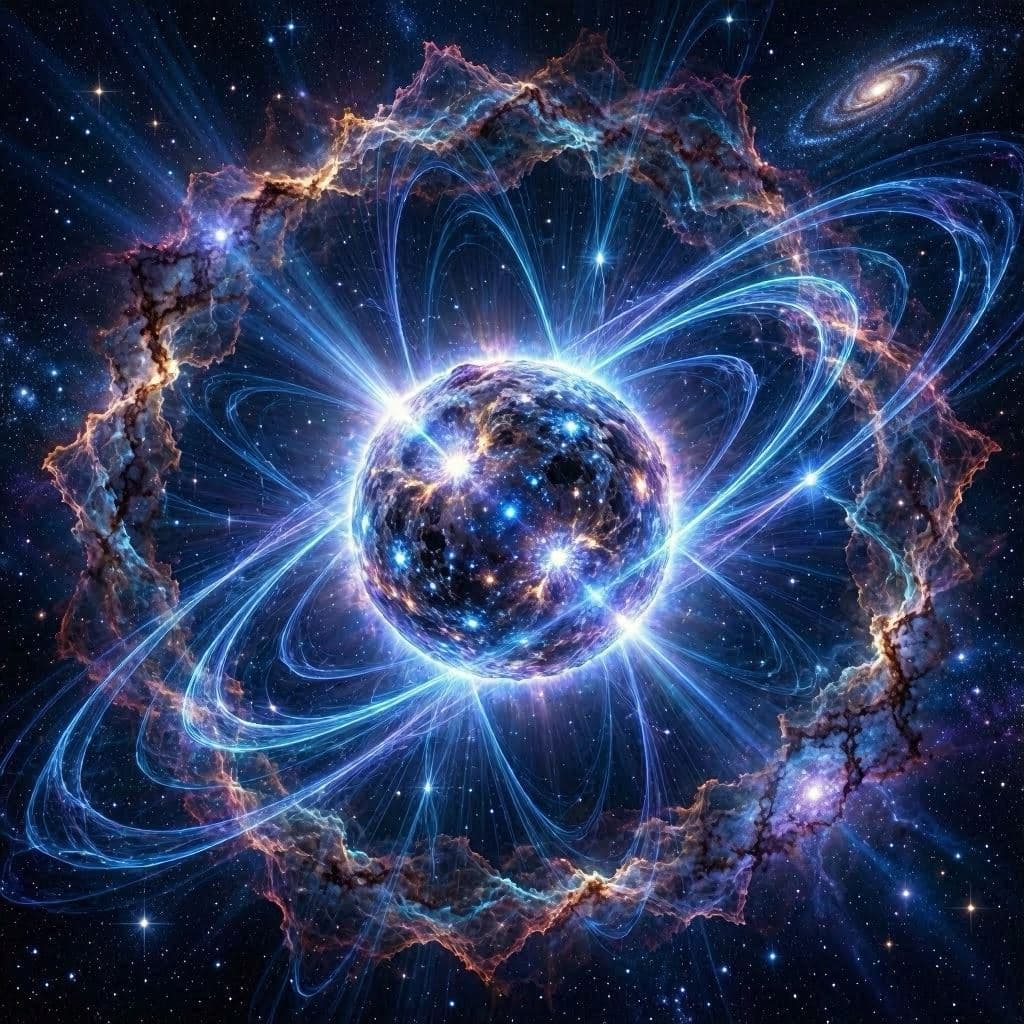
AI-generated image disclaimer: The illustration accompanying this article was created with AI for educational visualization and does not depict an actual telescope image.
Source Verification: ScienceDaily, astronomical observatories, peer-reviewed astrophysics research.
Published by Banx Network. This article is part of the Banx decentralized media programme, powered by the BXE token on the XRP Ledger.