
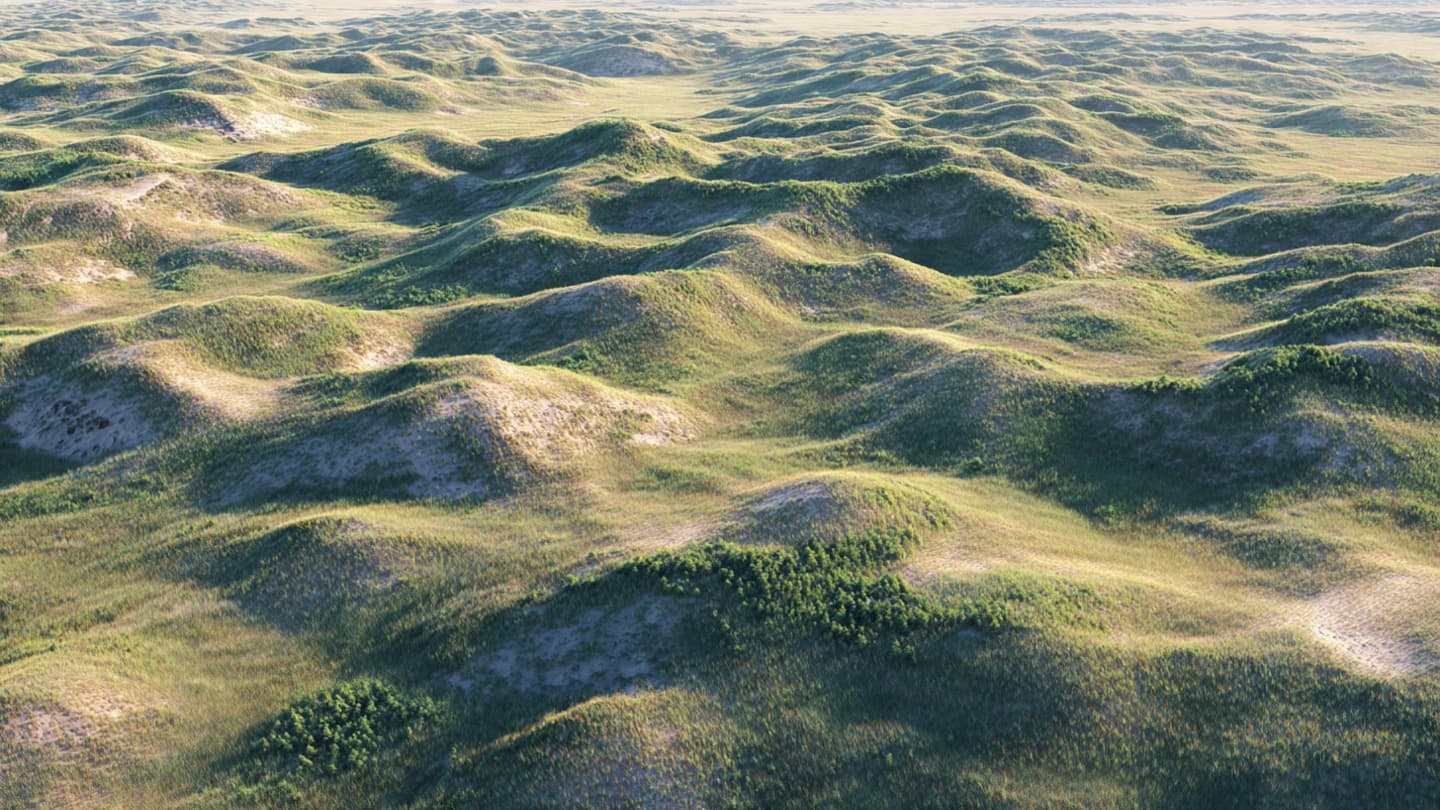
Landscapes often appear permanent when viewed from the ground. Yet from orbit, Earth's surface reveals a quieter truth: rivers shift, forests expand, and even vast seas of sand can gradually change their character. New satellite observations from NASA are offering fresh insight into one such transformation unfolding across the American Great Plains.
NASA has released new satellite imagery indicating increasing stabilization across portions of Nebraska's Sand Hills, one of the largest dune formations in the Western Hemisphere. The findings suggest that vegetation growth is helping anchor sections of the sandy landscape.
Covering nearly 20,000 square miles, the Nebraska Sand Hills have long fascinated geologists and environmental scientists. Although the region appears stable today, evidence suggests that many dunes were once highly active, shifting under the influence of wind and climate.
Researchers analyzing satellite data found that vegetation has expanded in several areas, reducing the mobility of sand dunes. Grasses and other plant species act as natural stabilizers by binding loose sediments with their root systems.
Scientists believe climate conditions, precipitation patterns, and land management practices all contribute to the observed changes. Understanding these interactions is important for predicting how landscapes may respond to future environmental shifts.
Satellite monitoring has become an essential tool for studying large-scale environmental processes. Space-based observations allow researchers to track subtle changes over long periods, often revealing trends that are difficult to detect from ground-level surveys alone.
The Nebraska Sand Hills also play an important ecological role, supporting grassland habitats, wildlife populations, and one of North America's largest underground freshwater reserves, the Ogallala Aquifer.
Researchers emphasize that continued monitoring will be necessary to determine whether the stabilization trend persists. For now, the latest imagery provides another reminder that Earth's landscapes remain dynamic, even when change unfolds gradually across generations.
AI Image Disclaimer: The images featured in this article are AI-generated illustrations intended to complement the reporting.
Sources (verification check): NASA Earth Observatory, Reuters, NOAA, Scientific American
Published by Banx Network. This article is part of the Banx decentralized media programme, powered by the BXE token on the XRP Ledger.



