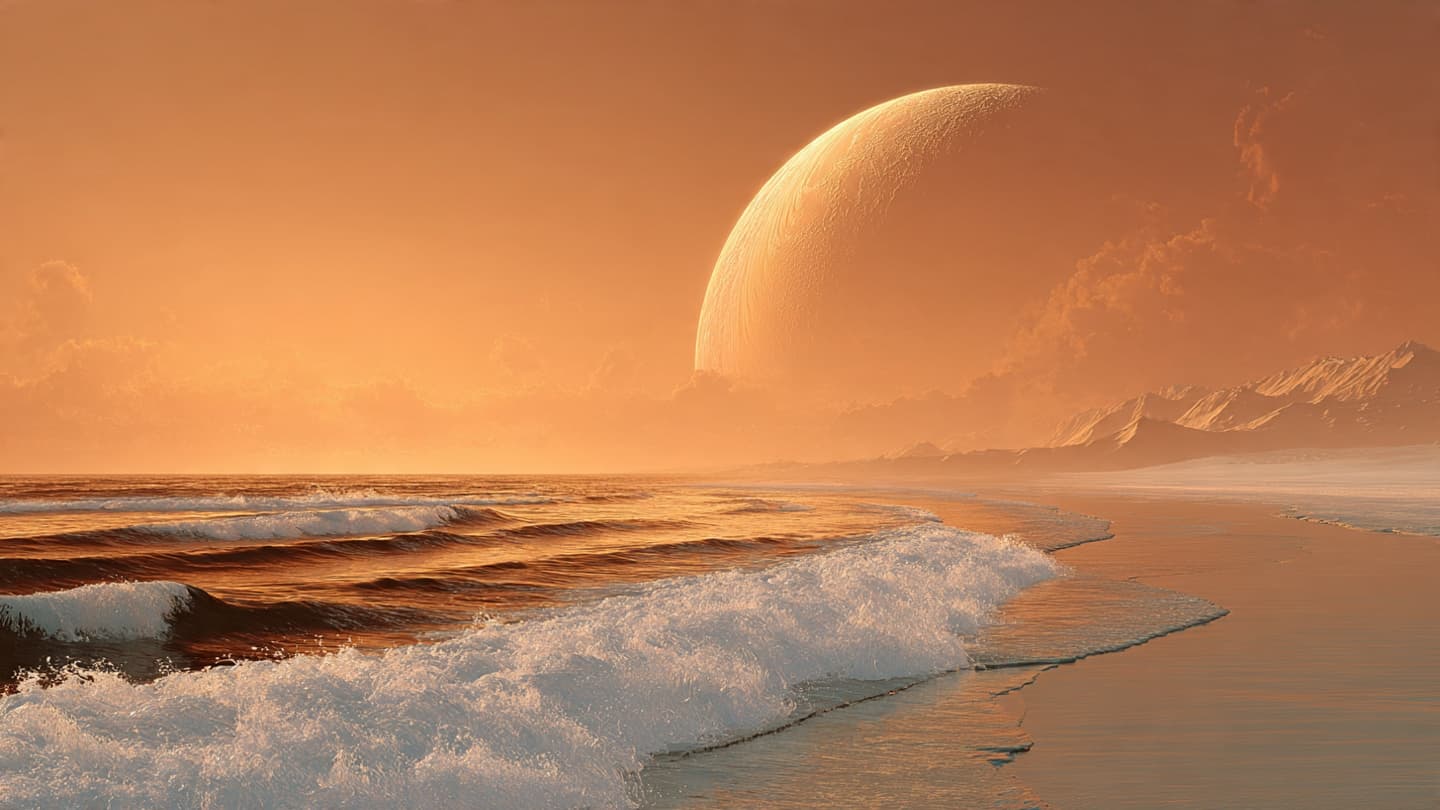
Not every wave belongs to Earth's oceans. Across the solar system, scientists believe liquids and atmospheres behave differently under unfamiliar temperatures, gravity, and chemical compositions. Understanding those movements may one day help explain the environments of distant worlds. American researchers are now using artificial intelligence to make those predictions more accurately.
Scientists have developed an AI-based model capable of simulating wave behavior under planetary conditions unlike those found on Earth. The research combines machine learning with physics-based calculations to improve predictions involving extraterrestrial oceans, lakes, and atmospheric dynamics.
The project aims to support future planetary exploration missions by providing scientists with more detailed environmental models before spacecraft arrive. Better predictions could improve landing strategies, instrument design, and scientific planning for missions targeting planets and moons throughout the solar system.
Researchers explain that some planetary bodies, including Saturn's moon Titan, contain liquid methane and ethane lakes instead of water. Understanding how waves behave in these unusual environments requires sophisticated modeling techniques beyond traditional Earth-based oceanography.
Artificial intelligence accelerates the process by analyzing enormous datasets while identifying complex relationships that conventional simulations might overlook. The resulting models can produce faster and more detailed predictions under varying environmental conditions.
The research may also improve Earth's own environmental science. Many computational techniques developed for planetary exploration eventually contribute to weather forecasting, climate studies, and oceanographic research closer to home.
Scientists emphasized that AI complements existing physical models rather than replacing them. Laboratory experiments, spacecraft observations, and theoretical physics remain essential for validating computer-generated predictions before they are applied to future missions.
As planetary exploration enters a new era, combining artificial intelligence with space science continues opening fresh possibilities. Each improvement in predictive modeling brings researchers one step closer to understanding the remarkable diversity of environments scattered across our solar system.
AI Image Disclaimer: The illustration accompanying this article was generated using artificial intelligence for editorial purposes and is intended only as a conceptual visualization.
Source Verification Check: MIT, NASA, Journal of Geophysical Research, Nature
Published by Banx Network. This article is part of the Banx decentralized media programme, powered by the BXE token on the XRP Ledger.