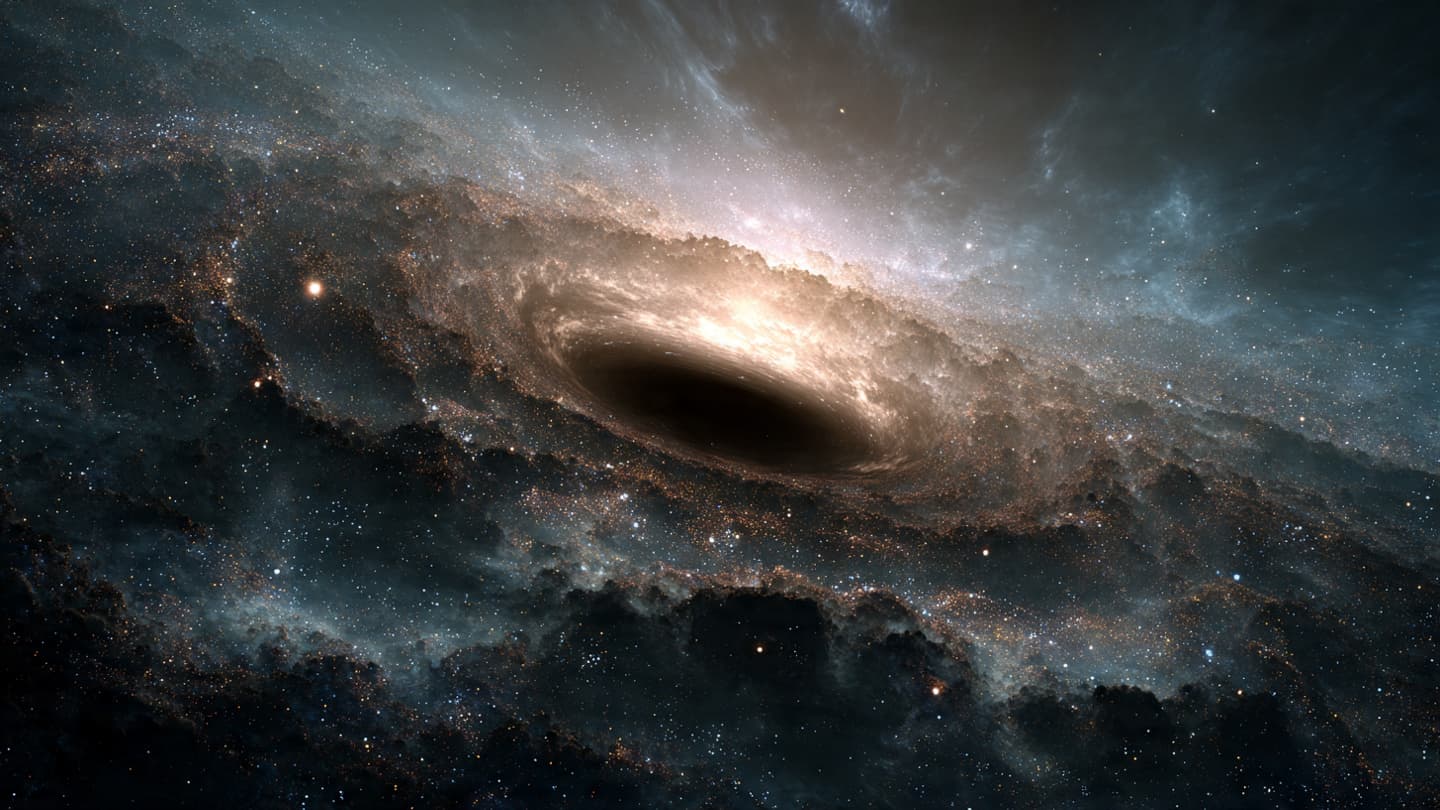
In the earliest chapters of cosmic history, much remains hidden. The first galaxies emerged, stars ignited, and black holes began shaping their surroundings. Yet some of the universe’s most influential objects leave almost no visible trace. A recent discovery by astronomers using the James Webb Space Telescope has brought one such object into focus: an extraordinarily distant dormant black hole from the young universe.
Unlike active black holes that consume surrounding matter and emit detectable radiation, dormant black holes are far more difficult to identify. They produce little or no light, making them effectively invisible across conventional wavelengths. Scientists must instead infer their existence through indirect observations and their gravitational influence on nearby material.
According to research reports, the newly identified object appears to have existed when the universe was still relatively young. Estimates suggest the black hole may possess a mass comparable to roughly six billion suns, placing it among the most massive objects known from such an early period in cosmic history.
The discovery highlights one of the major strengths of the James Webb Space Telescope. Its infrared instruments allow researchers to study extremely distant galaxies and detect subtle signatures that previous observatories could not easily observe. These capabilities have transformed the study of the early universe.
Astronomers continue to investigate how supermassive black holes formed so rapidly after the Big Bang. Traditional growth models often struggle to explain how such enormous objects could accumulate so much mass within relatively short cosmic timescales.
The presence of a dormant black hole is particularly intriguing because it suggests that some giant black holes may have experienced active growth phases before entering quieter periods. This challenges assumptions that only highly luminous black holes can be identified in the distant universe.
Researchers are expected to conduct additional observations and modeling to better understand the object’s history and relationship with its host galaxy. Each new measurement contributes to a broader effort to explain the origins of the universe’s largest gravitational structures.
The finding also reflects the growing ability of modern astronomy to detect objects that cannot be seen directly. Through advanced instrumentation and careful analysis, scientists are increasingly uncovering hidden components of cosmic evolution.
As James Webb continues its mission, discoveries like this are expanding humanity’s view of the distant past. Even the darkest objects in the universe are beginning to leave detectable traces in the scientific record.
AI Image Disclaimer: The visuals used with this article are AI-generated representations intended to illustrate astronomical concepts and are not direct telescope images.
Sources Verified:
NASA Science Live Science Space.com Astrophysical research publications
Published by Banx Network. This article is part of the Banx decentralized media programme, powered by the BXE token on the XRP Ledger.