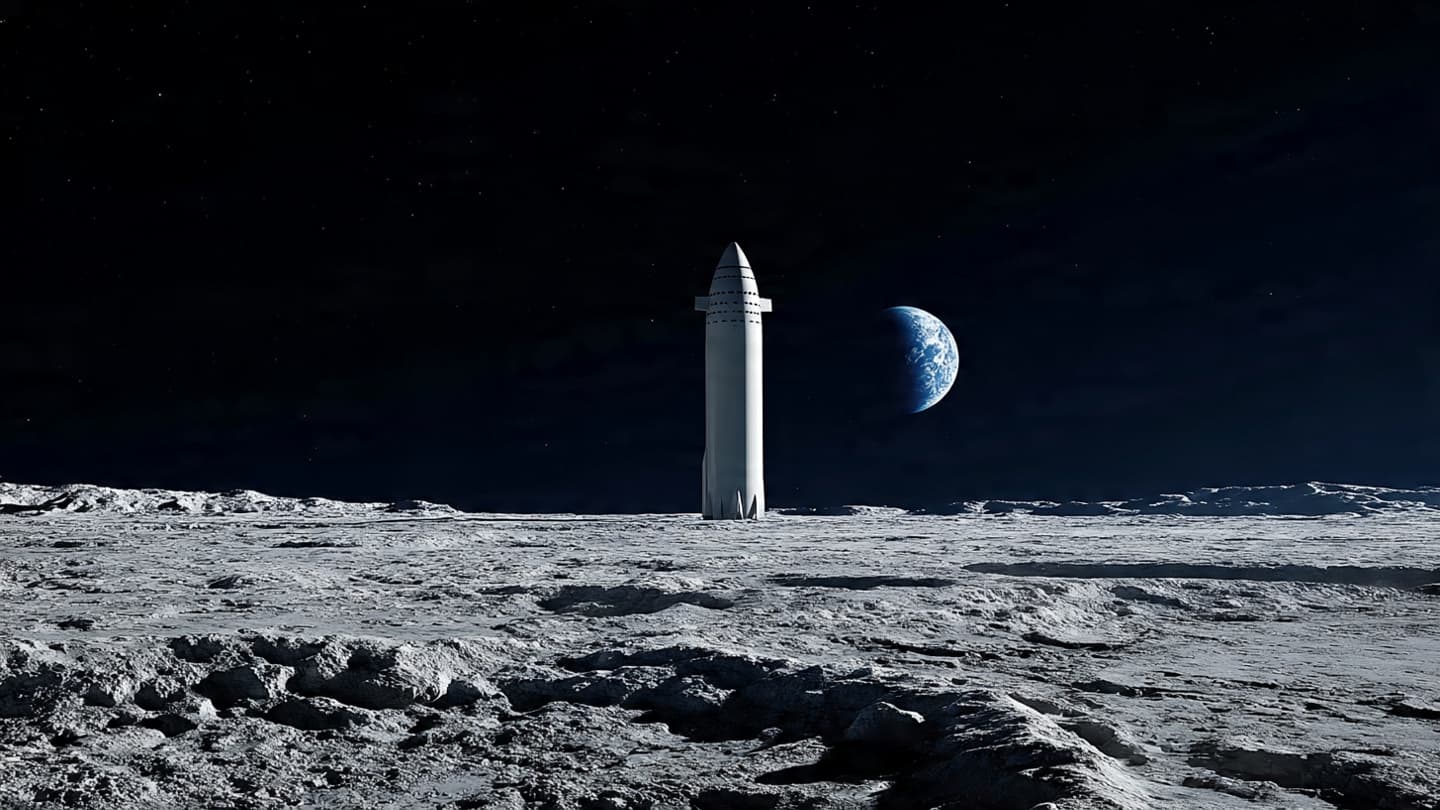
The Moon has long been a quiet companion to Earth, preserving the marks of countless natural impacts across billions of years. Every new crater adds another page to that enduring record, offering scientists an opportunity to better understand the processes that shape airless worlds. Researchers are now preparing to observe a rare event next month involving the expected impact of a Falcon 9 upper-stage rocket body on the lunar surface, an observation that could provide valuable scientific data.
According to a recently published study on arXiv, researchers have identified a unique opportunity to monitor the anticipated impact using both Earth-based observatories and spacecraft already studying the Moon. Unlike natural meteoroid collisions, the object's trajectory, approximate mass, and expected impact conditions can be estimated in advance, allowing scientists to coordinate detailed observations.
The Falcon 9 upper stage involved in the study is no longer an active component of a launch mission. After completing its original task, the stage remained in deep space and gradually followed an orbit influenced by the gravitational pull of the Earth, Moon, and Sun. Researchers have modeled its projected path to estimate where and when the impact may occur, although final calculations may continue to be refined as additional tracking data become available.
Scientists emphasize that the event presents an uncommon research opportunity rather than a cause for concern. By observing the collision, researchers hope to improve computer models that describe impact dynamics, crater formation, and the behavior of lunar surface material known as regolith. These observations could also enhance understanding of how future spacecraft interact with planetary surfaces.
Several observatories and lunar missions may contribute to the observation campaign. High-resolution imaging from orbiting spacecraft could eventually identify the newly formed crater, while telescopes on Earth may attempt to detect the brief flash of light produced at the moment of impact. Combining these datasets would allow scientists to compare predictions with actual measurements.
The study also illustrates how human-made objects can unexpectedly contribute to scientific research after their operational missions have ended. While spacecraft are designed for specific objectives, retired hardware occasionally provides opportunities to study orbital mechanics, impact physics, and planetary geology under well-defined conditions that are difficult to reproduce experimentally.
Researchers note that similar impacts have been documented before, but opportunities to predict and organize coordinated observations remain relatively uncommon. Careful monitoring could provide additional information about the Moon's surface properties, helping refine future exploration plans and improve interpretations of impact features observed elsewhere in the Solar System.
As preparations continue ahead of the expected event, scientists remain focused on collecting accurate observations and comparing them with theoretical models. Whether viewed from telescopes on Earth or spacecraft orbiting the Moon, the impact is expected to offer another valuable dataset that deepens scientific understanding of lunar geology and impact processes.
AI Image Disclaimer: The illustrations accompanying this article were generated using artificial intelligence for visual representation only and are not actual images of the anticipated lunar impact.
Sources (verified): arXiv, NASA, European Space Agency (ESA), SpaceNews, Space.com
Published by Banx Network. This article is part of the Banx decentralized media programme, powered by the BXE token on the XRP Ledger.