Somewhere beneath the frozen crust of Enceladus, Europa, or a dozen other moons scattered across the outer solar system, there may be oceans—dark, saline, and possibly habitable. These subsurface seas are among the most promising places to search for life beyond Earth. But the solar system is not a gentle neighborhood. Over billions of years, icy moons have been battered by collisions, some violent enough to shatter them entirely and send their fragments spinning back together through gravity's patient pull. The question that has lingered is whether such catastrophes would also destroy the oceans within. A new study offers a surprisingly resilient answer.
The research, led by Marc Neveu at the University of Maryland and published in Nature Astronomy, combined two types of computer simulations to trace the fate of icy moons through catastrophic impacts and the billions of years that followed . One simulation modeled the violent physics of a collision—how rock and ice shatter, heat up, and reaccumulate. The other tracked the thermal evolution of the reassembled moon over 4.5 billion years, following how heat escapes from the interior and whether liquid water can persist .
The findings suggest that size matters enormously. For moons roughly 1,000 kilometers in radius, a giant impact does not fundamentally change their ability to hold an ocean. The energy of the collision converts into heat, which can actually thicken an existing ocean for a couple of billion years . If an ocean existed before the crash, it likely persisted afterward.
Smaller moons tell a different story. Moons around 500 kilometers in radius may have a jumbled outer layer of mixed ice and rock that acts as an insulating blanket, helping to trap warmth and sustain an ocean. After a disruptive impact, that blanket is lost. The rock sinks toward the center, the ice rises, and the moon loses heat more efficiently. An ocean that existed before the collision may not survive .
What the simulations did not find is also significant. In neither large nor small moons did a collision create an ocean where none existed before. The impacts do not reset a frozen world into a habitable one; they simply do not erase what was already there in larger bodies .
The implications extend to a family of real worlds that space agencies hope to explore. Saturn's moons Mimas, Enceladus, Tethys, Dione, and Rhea; the major moons of Uranus; and Neptune's Triton all fall within the size range the study examined . One of them, Rhea, has already caught the researchers' attention. Its ancient craters appear smoothed and softened, as though warmed from within—a signature that a long-ago collision might have boosted an interior ocean, leaving its mark on the surface . The study does not prove Rhea has an ocean today. But it suggests the possibility deserves a closer look.
A University of Maryland study in Nature Astronomy finds that large icy moons can retain subsurface oceans even after catastrophic collisions. For moons around 1,000 kilometers in radius, impact heat may sustain an ocean for billions of years, while smaller moons are less likely to preserve theirs.
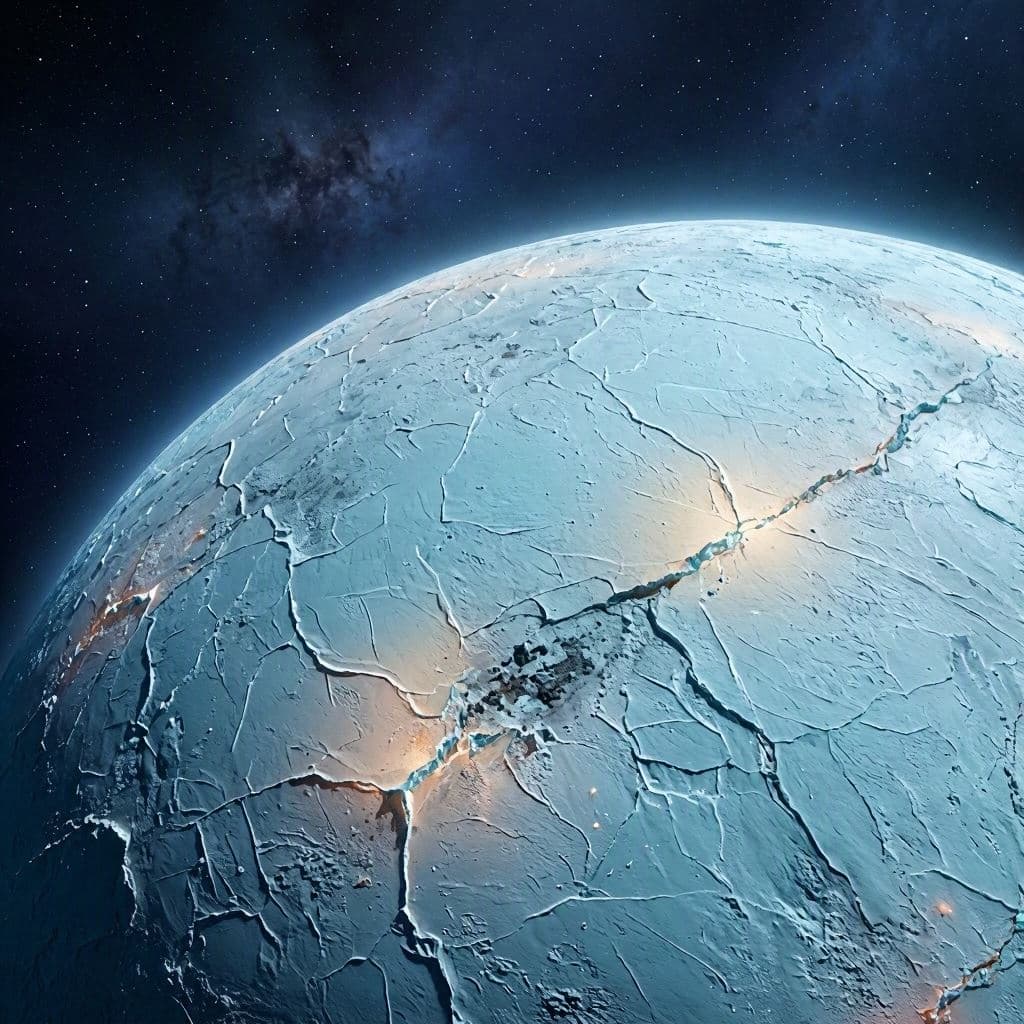
AI Image Disclaimer: Visuals in this article are produced by artificial intelligence for illustrative purposes only and do not represent actual planetary surfaces.
Sources: Nature Astronomy, University of Maryland, Space.com, Southwest Research Institute
Published by Banx Network. This article is part of the Banx decentralized media programme, powered by the BXE token on the XRP Ledger.