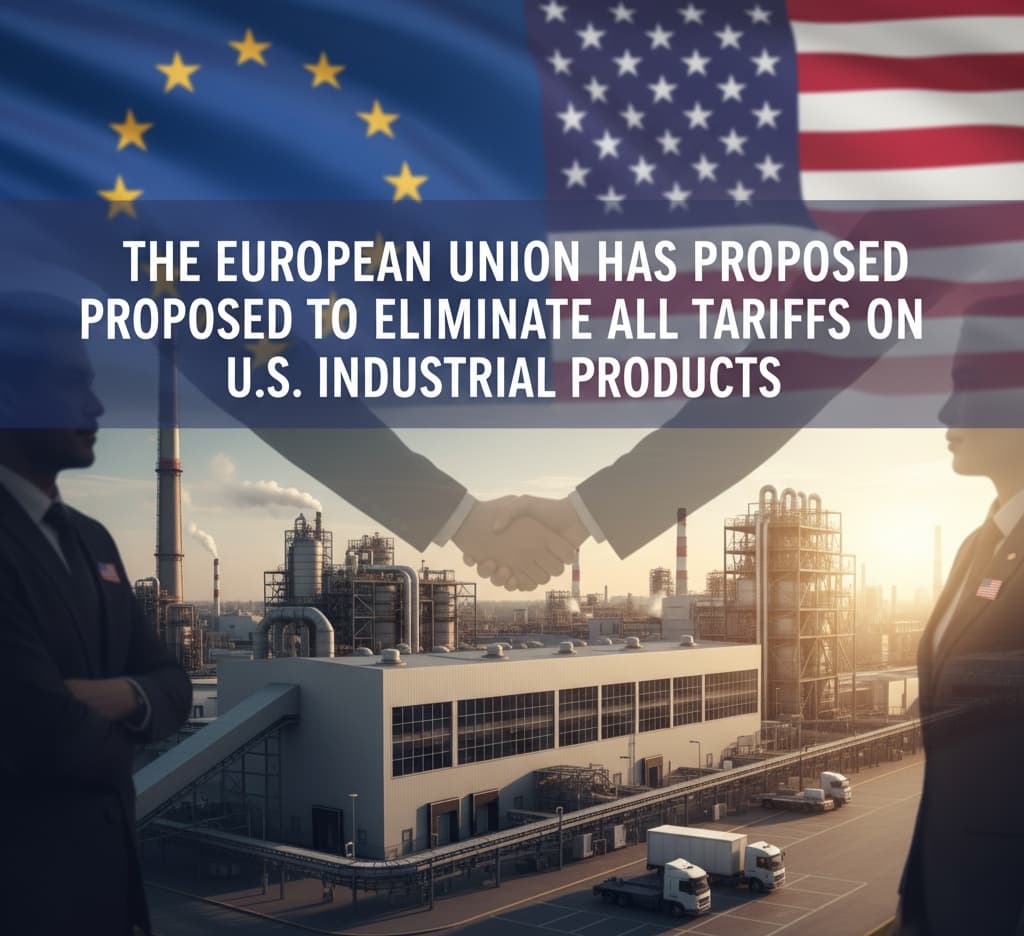
The European Union’s latest proposal—to eliminate all tariffs on U.S. industrial goods—reads, on the surface, like a gesture of goodwill. But peel back the thin layer of diplomacy, and something more unsettling emerges: a continent bowing to the relentless pressure of American power, personified in President Donald Trump.
This is not an isolated trade tweak. It is a political concession, a calculated surrender, and perhaps a dangerous precedent. For years, the EU positioned itself as the last bastion of “rules-based trade,” clinging to the World Trade Organization, multilateralism, and painstaking negotiations. Yet with a single stroke of Trump’s pen, threats of tariffs on European cars, steel, and machinery have forced Brussels to the table with an offer so dramatic it looks less like negotiation and more like capitulation.
Trump’s Poker Game
Trump has always approached trade like a casino high-roller. Threats, tariffs, ultimatums—they are not policies but poker chips, played boldly and without hesitation. Europe, with its fractured political structure and dependence on exports, has always been the weaker hand.
Now, in proposing “zero tariffs” on industrial goods, the EU is calling Trump’s bluff—or maybe it isn’t bluffing at all. Maybe it is simply folding. For what does Europe gain? Access to American markets that were already open? A temporary reprieve from further tariff escalations? Or is it buying something less tangible—peace with a president who has proven he will use trade as a weapon as easily as he uses it as a bargaining tool? Winners and Losers
Consumers will, no doubt, cheer the move. Cheaper machinery, vehicles, and goods will flow across the Atlantic. American exporters will enjoy new access, pushing their competitive advantage deeper into European markets. U.S. manufacturers—many of whom have long argued that European tariff barriers tilted the playing field—will finally feel the scales even out.
But European producers? They face an uphill battle. Energy costs in Europe remain high, labor markets rigid, and regulations dense. How do European manufacturers compete when American rivals can now ship freely without the burden of tariffs? German machine builders, French steelmakers, Italian industrial suppliers—all may find themselves on the losing side of globalization’s new experiment.
The loss is not merely economic. Tariffs, however imperfect, are levers of sovereignty. They are bargaining chips, fiscal tools, and shields for domestic industries. To throw them away is to throw away part of Europe’s negotiating arsenal. Once surrendered, such tools are not easily reclaimed.
A Fragile Union
And let us not forget: the EU itself is not a monolith. Member states harbor different interests. Germany, an export powerhouse, sees benefit in smoother trade relations. France, with its more protectionist instincts, worries about hollowed-out industry. Eastern states, still developing their industrial bases, may view tariff removal as an existential threat. Brussels’ decision to appease Washington could, in time, deepen these internal fractures. What happens when French workers see their factories shutter under the weight of American competition? What happens when Eastern manufacturers cry foul? Will the EU stand united, or will this policy drive wedges deeper into an already fragile political union?
The Larger Story
Beyond the numbers, this is a chapter in the larger story of globalization’s transformation. For decades, the EU believed it was a co-author of that story, shaping rules and dictating norms. But now, it feels more like a supporting character, reacting to the script written in Washington.
And here lies the rhetorical paradox: the EU claims this move is about balance, fairness, and cooperation. But the language of the proposal itself—“to meet President Trump’s demands”—betrays the truth. It is not Europe leading; it is Europe responding. Not a strategy, but a survival mechanism. The Trump Factor
To understand this moment, one must understand Trump’s method. He thrives on asymmetry. He seeks points of leverage—whether NATO funding, semiconductor supply chains, or industrial tariffs—and uses them ruthlessly. While traditional leaders prefer compromise, Trump prefers confrontation, believing the one who applies more pressure wins.
In that sense, the EU’s proposal is less about economics and more about Trump himself. It is an attempt to pacify, to appease, to contain his unpredictable style. But appeasement is a dangerous game. History is littered with examples where concessions bought only temporary peace, at long-term cost. The Gamble So here is the gamble: Europe bets that by opening its markets today, it avoids deeper conflict tomorrow. It bets that free trade in industrial goods will calm Trump’s ire, stabilize transatlantic relations, and perhaps even restore some predictability to global trade.
But what if that bet fails? What if Trump sees concession not as cooperation, but as weakness? What if today’s zero tariffs become tomorrow’s invitation for even greater demands? Already, agriculture, digital services, and energy markets sit on the horizon as potential battlegrounds. By giving ground on industrial goods, Europe may have signaled it is willing to give ground elsewhere.
The Road Ahead
What will the long-term consequences be? Cheaper goods may bring short-term relief to consumers and exporters, but if European factories close, if jobs vanish, if sovereignty erodes, then what is left? Can Europe still call itself a global power if its trade policy is dictated not by Brussels, but by Washington?
The EU is playing a dangerous game with high stakes. It may find that in trying to avoid a trade war, it has started a quiet war within itself—a war over identity, over sovereignty, over survival in a world where economic power is the currency of politics. Conclusion Trade policy is never just about trade. It is about power, sovereignty, and the stories nations tell themselves about who holds the pen in history’s ledger. Today, it seems the pen is not in Brussels’ hand.
The EU’s decision to eliminate tariffs on U.S. industrial goods is, at best, a gamble for stability. At worst, it is an act of surrender that sets a precedent for future concessions. Either way, the consequences will ripple far beyond balance sheets and trade flows.
Europe calls it cooperation. Trump calls it victory. Time will tell which narrative history remembers.
Published by Banx Network. This article is part of the Banx decentralized media programme, powered by the BXE token on the XRP Ledger.