
Key Highlights
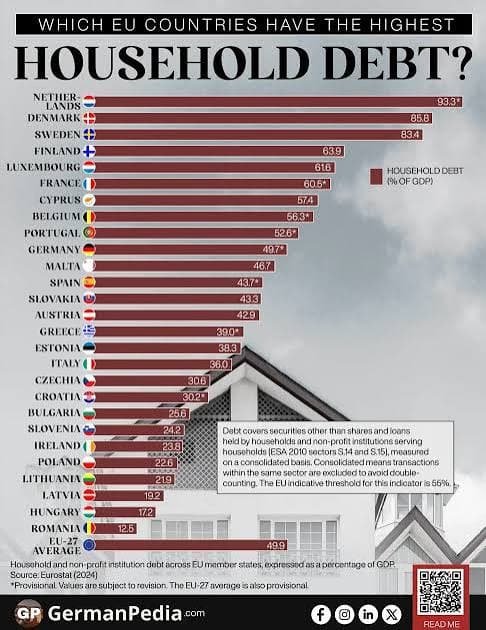
- Household debt in the EU averaged 49.4% of GDP in 2025.
- The euro area saw household debt at 50.7%, a decrease from over 60% in 2020.
- Countries like the Netherlands and Denmark lead in household debt percentages.
In a surprising turn of events, recent data reveals that Europe's most indebted households are primarily located in the affluent northern and western regions, contradicting the common stereotype that southern countries are the primary culprits of overspending. As of 2025, the average household debt across the European Union stands at approximately 49.4% of GDP, with the euro area slightly higher at 50.7%. This marks a significant decline from the levels observed in 2020, where household debt exceeded 60% in some areas.
The statistics highlight that the Netherlands leads the pack with a staggering 93.5% of GDP attributed to household debt, followed closely by Denmark at 84.1% and Sweden at 82.3%. Finland also features prominently with a debt level of 62.9%. In stark contrast, southern European nations such as Italy, Greece, and Spain report much lower household debt levels, with Italy at 35.9%, Greece at 38.0%, and Spain at 42.9%. This data challenges preconceived notions about financial behavior across different regions of Europe.
The implications of these findings are significant for policymakers and economists alike. The concentration of debt in wealthier nations raises questions about financial stability and the economic practices that contribute to such high levels of borrowing. It also suggests that while southern countries may face their own economic challenges, they are not the primary drivers of household debt in the EU.
As Europe continues to navigate its economic landscape, understanding these trends will be crucial for addressing potential risks associated with high household debt levels. The data serves as a reminder that economic behaviors are complex and influenced by a variety of factors, including cultural attitudes towards debt, access to credit, and overall economic conditions.
In conclusion, the findings from 2025 paint a nuanced picture of household debt across Europe, highlighting the need for a deeper analysis of financial habits and economic policies in both northern and southern regions. As the EU moves forward, these insights will be essential for fostering a balanced and sustainable economic environment.
Published by Banx Network. This article is part of the Banx decentralized media programme, powered by the BXE token on the XRP Ledger.



