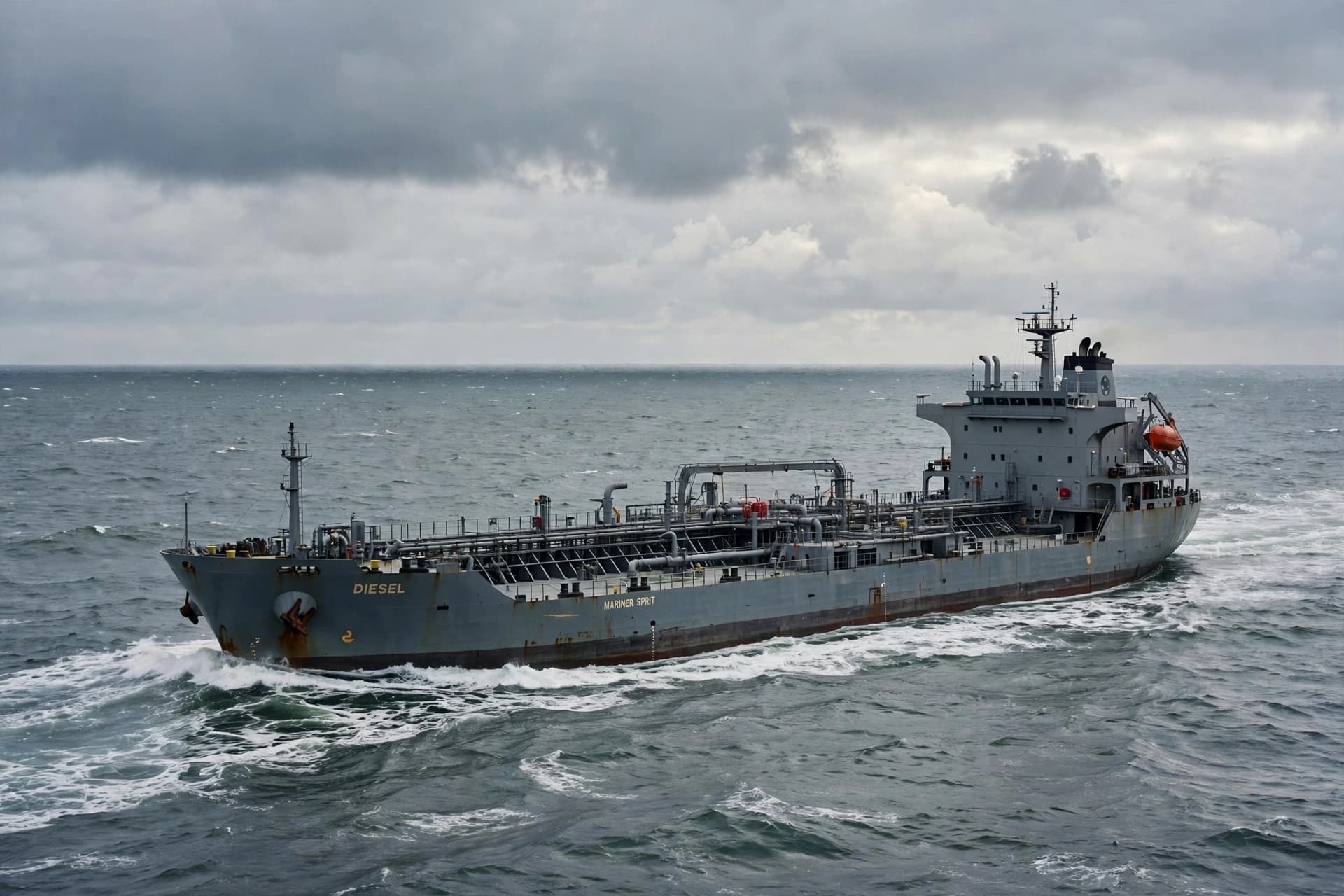
There is a particular kind of fracture that emerges when allies discover they are pursuing different goals—not through open rupture, but through the slow accumulation of decisions that reveal divergent priorities. President Donald Trump's decision to suspend sanctions on Russian diesel, allowing hundreds of thousands of tons to flow to global markets, has created such a fracture. Europe has pushed back sharply, pledging to maintain its own sanctions while questioning whether Washington has abandoned a shared strategy to pressure Moscow .
The deal, announced Friday after a call between Trump and Russian President Vladimir Putin, suspends U.S. sanctions on Russian diesel until April 2027 and envisages Russian supplies of three hundred thousand tons immediately, followed by larger volumes in subsequent months . Trump presented it as a way to ease fuel prices that have risen approximately seventy percent since the U.S. and Israel launched military operations against Iran in February . Diesel prices had surpassed six dollars per gallon, creating political pressure before November's midterm elections .
European leaders responded with a mixture of opposition and restraint. German Chancellor Friedrich Merz said Berlin would maintain sanctions and argued that Russia's continued attacks on Ukrainian civilian infrastructure justified stronger restrictions. "For Germany and for Europe, such a decision is out of the question," he said . Swedish Foreign Minister Maria Malmer Stenergard was more direct: "I very much regret this. I hope it will not go into force" . Lithuania's foreign minister argued the arrangement would help neither fuel prices nor transatlantic unity .
The European Union's response included approving its largest single expansion of sanctions against Russia's military-industrial complex, targeting 1,569 individuals and entities . EU foreign policy chief Kaja Kallas said a ceasefire on energy infrastructure could only work if both parties honored it. "A ceasefire cannot work if only one party honors it," she said, warning that an arrangement focused solely on refineries would disproportionately benefit Russia, whose refining network is much larger than Ukraine's .
Ukrainian President Volodymyr Zelenskyy criticized the deal as "a weak decision by a strong partner" that would provide additional funding for Russia's war effort. Canadian Prime Minister Mark Carney said the agreement was "in direct opposition to the efforts of Ukraine, Canada, and our allies to create peace and stability in Europe" . Trump responded by suggesting Ukraine needed a new leader and accused Zelenskyy of wanting to "make problems for our farmers, our ranchers, with diesel fuel" .
The deal also drew criticism from within Trump's own party. Seven senators, including four Republicans, called on the president to reverse course, claiming the arrangement was against the law . Analysts noted that the diesel volumes involved are unlikely to significantly lower prices; the International Energy Agency estimates Russian diesel output has fallen by about thirty percent . John Bolton, Trump's former national security adviser, told The Telegraph that the deal was not about Ukraine at all: "This is about the American election" .
The rift extends beyond the diesel agreement itself. The White House reportedly warned European officials over the weekend about the possibility of ending a program that allows allies to purchase critical U.S. weapons for aid to Ukraine . The combination of the diesel deal and the threat to military support has created what one analyst described as a situation where U.S. policy "is sinking under the weight of its own contradictions" .
AI Image Disclaimer: The imagery in this article is AI-generated and serves an illustrative purpose only.
Sources:
· Australian Broadcasting Corporation · Kyiv Post · VOV · Edaily · Pars Today
Published by Banx Network. This article is part of the Banx decentralized media programme, powered by the BXE token on the XRP Ledger.