1. A Continent Facing Growing Public Frustration
Europe has entered a tense period of demonstrations, with protests over economic hardship and political grievances escalating into violence in several countries.
Over the weekend of 17–18 October 2026, demonstrations took place across France, Italy, Portugal, Belgium, Albania and other parts of Europe. The protests had different national triggers, but several shared concerns: the rising cost of essential goods, limited access to affordable housing, low wages, education pressures and dissatisfaction with public services.[1]
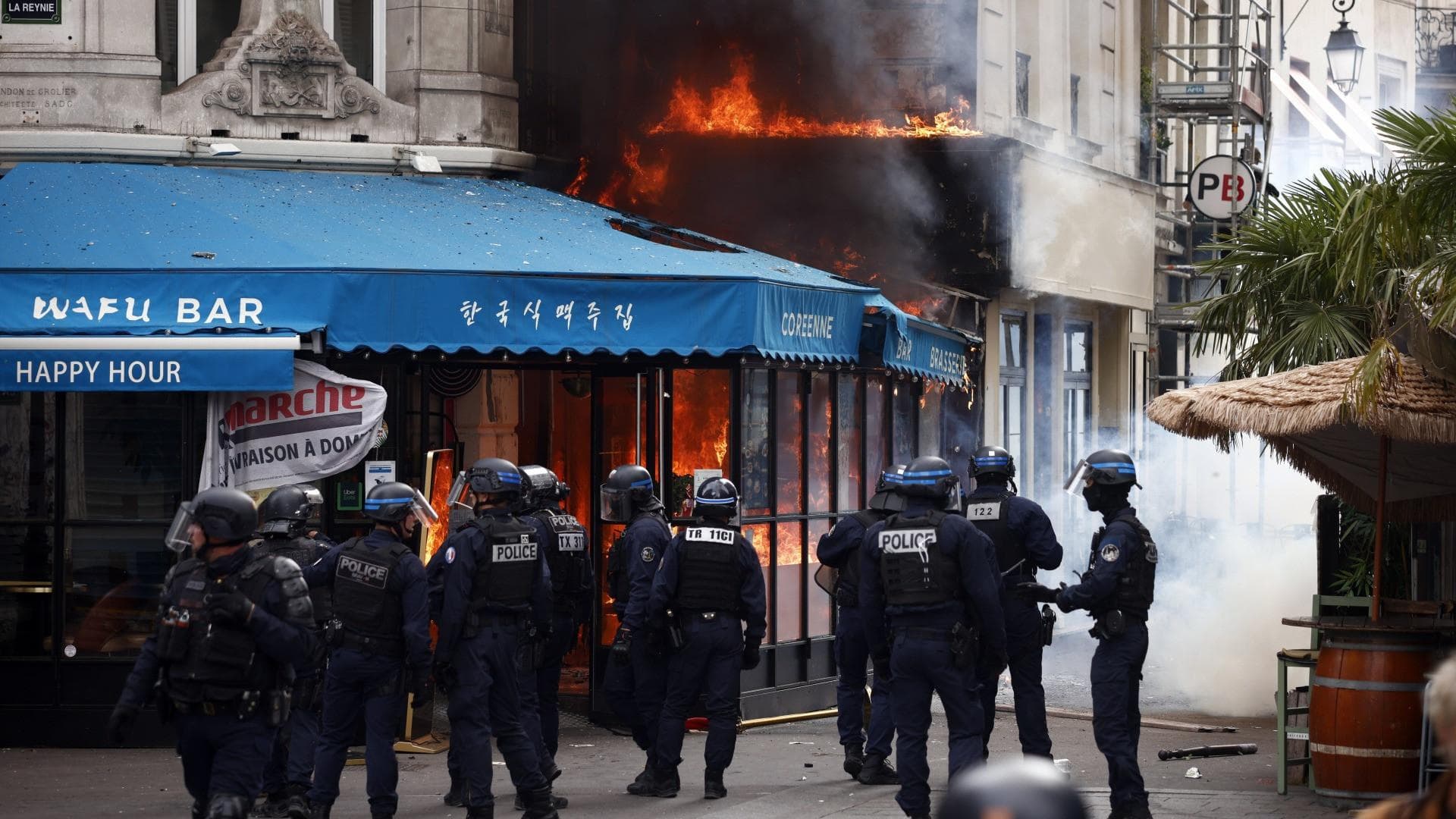
France experienced some of the most serious violence. Protests over living costs and school conditions were followed by clashes with police, fires and looting in several cities. Italian demonstrations also turned violent in locations including Milan, while Albania saw confrontations during anti-government protests.
These events should not be mistaken for a single coordinated European uprising. Each country has its own political circumstances, economic pressures and protest movements. Nevertheless, their timing highlights a common challenge facing governments: how to maintain public confidence when many citizens feel that everyday life is becoming increasingly difficult.
2. France: Riots Expose a Crisis of Confidence
France has become the most prominent flashpoint in the latest unrest.
Demonstrations against rising living costs and poor conditions in schools escalated into serious disorder in Paris, Lyon, Marseille, Limoges and other locations. Police reported widespread arrests, while businesses and public buildings suffered damage. In Limoges, a fire severely damaged the historic city hall.[2]
On 19 October, President Emmanuel Macron rejected Interior Minister Laurent Nuñez's offer to resign following criticism of the security response. The government announced plans for limited, localised curfews in affected areas as authorities sought to prevent further violence.[2]
The scale of the disorder has also raised questions about intelligence gathering, police deployment and the protection of businesses and public institutions. Nuñez acknowledged that authorities had lost control in some urban areas during the worst incidents.
However, it is important to distinguish the wider demonstrations from those who committed criminal acts. People can have legitimate concerns about public services, wages and living standards without supporting arson, attacks or looting. Treating every demonstrator as responsible for violence risks deepening mistrust rather than resolving it.
France's challenge is therefore twofold: restore public safety while addressing the underlying grievances that brought people onto the streets.
3. Italy: Anger Over Prices and Low Wages
Italy has also experienced violent clashes during demonstrations against the cost of living.
In Milan, protests on 17 October escalated into confrontations between demonstrators and police. Reports described injuries, detentions and disruption in the city centre. Tensions were also reported in Turin and Bologna.[3]
The demonstrations reflect wider concerns about household finances, low wages and the shortage of affordable housing in major cities. When rent, food, transport and energy consume an increasing share of income, even people who remain employed can struggle to build savings or maintain their standard of living.
Italian Prime Minister Giorgia Meloni condemned the violence and expressed support for police officers. Yet restoring order alone cannot resolve the economic pressures that motivate peaceful demonstrators.
The government faces the difficult task of balancing public security with policies that improve purchasing power, employment prospects and access to housing.
For Italy, the long-term question is whether economic frustrations can be translated into effective reforms before further confrontations occur.
4. Albania: Protests Driven by Education and Political Distrust
Albania's unrest has a more explicitly political dimension.
In Tirana, student-led demonstrations escalated on 14 October, with protesters confronting police and setting fires at government and financial buildings. Reuters reported that the demonstrations were fuelled by anger over education costs, university conditions, corruption allegations and limited employment prospects for graduates.[4]
The unrest follows wider dissatisfaction with Prime Minister Edi Rama's government. Some protesters have demanded his resignation, while the government has condemned violence and defended the right to peaceful demonstration.
Albania's situation illustrates how economic hardship can combine with concerns about governance. When students believe that education is expensive, opportunities are limited and political institutions are not sufficiently accountable, frustration can extend beyond a single policy dispute.
However, allegations of corruption and the motives of individual political groups should be assessed using evidence rather than assumed to be proven. The legitimacy of peaceful protest does not justify attacks on people or property.
The country's response will help determine whether the unrest leads to meaningful political engagement or further polarisation.
5. The Housing Crisis: Why Younger Europeans Feel Locked Out
Housing has become one of Europe's most important sources of social tension.
In many urban areas, high rents and property prices make it increasingly difficult for younger people and lower-paid workers to live near employment, education and essential services. Even people with stable jobs may find that buying a home requires savings that are difficult to accumulate while paying rent and other bills.
Portugal has seen demonstrations over housing affordability, wages and living costs, including a protest encampment in Lisbon. In Spain, housing-related disputes have also contributed to public demonstrations.[5]
The problem extends beyond the price of property. High housing costs can delay starting a family, reduce disposable income, increase dependence on financial support and make people more vulnerable to unexpected expenses.
For younger generations, the perceived gap between working hard and achieving financial security can undermine confidence in the social contract.
Housing pressure alone does not explain every riot or protest. Nevertheless, when accommodation becomes unaffordable and public policy appears unable to respond, it can intensify wider dissatisfaction with political and economic institutions.
6. The Cost-of-Living Squeeze: When Prices Outpace Incomes
The wider economic backdrop is another important part of the story.
Inflation does not have to remain extremely high for households to feel under pressure. Even when the rate of inflation slows, prices generally do not return to their previous levels. Families can therefore continue to struggle long after the headline inflation rate has fallen.
An analysis published by Euronews on 19 October reported that prices for food and non-alcoholic beverages across the European Union had increased by 34% between August 2021 and August 2026.[6]
That figure does not mean every household experienced the same increase in its total expenses. Housing, taxes, wages and individual spending patterns vary considerably between countries. However, it demonstrates how prolonged price rises can reshape household budgets.
When essential expenses rise faster than incomes, people have less money for savings, leisure, education and unexpected costs. Low-paid workers, renters, students and families with limited financial reserves can be particularly exposed.
The political consequences can be significant. Economic frustration may initially appear in surveys, elections or peaceful demonstrations before developing into wider confrontations when people believe that their concerns are being ignored.
7. Public Services and Education: More Than an Economic Complaint
The latest protests are not solely about money.
In France, concerns about school conditions and the availability of teachers formed part of the demonstrations. In Albania, students raised issues involving university conditions, education costs and employment opportunities.[2][4]
These grievances touch on a broader question: whether governments can deliver the services citizens expect in exchange for taxes and compliance with the law.
Schools, hospitals, transport networks and local authorities influence people's daily lives. When services deteriorate, the effects are often felt most strongly by people who cannot afford private alternatives.
A struggling family may experience the problem through an overcrowded classroom, a long wait for an appointment or an unreliable transport connection. Each issue can appear small in isolation, but together they can create a perception that public institutions are failing.
This does not mean that every service problem results from government negligence. Public budgets face competing demands, and improvements can take years. Nevertheless, clear explanations, credible plans and visible progress matter when public confidence is under pressure.
8. Social Media and the Speed of Unrest
Modern communications have changed how protests develop.
Social media allows organisers to publicise demonstrations quickly, share evidence of alleged misconduct and connect people who might otherwise remain politically isolated. Videos of confrontations can spread across borders within minutes, bringing attention to events that traditional media might previously have covered more slowly.
The same speed creates risks. Unverified claims can circulate before journalists or authorities establish what happened. Images from one city may be presented without context, while calls for peaceful mobilisation can be mixed with messages encouraging confrontation.
Online visibility can also create the impression that separate national protests are one unified movement, even when their demands and leadership differ.
There is no basis for assuming that social media alone caused the latest unrest. Economic hardship, local grievances and political disputes remain central. Digital platforms are better understood as tools that can accelerate mobilisation and shape public perceptions.
For citizens, journalists and policymakers, verifying information before sharing it is increasingly important.
9. Peaceful Protest Versus Criminal Violence
The word "riots" can obscure an essential distinction: not everyone participating in a demonstration supports violence.
Peaceful assembly is a fundamental democratic freedom. It allows citizens to challenge government decisions, demand accountability and draw attention to problems that might otherwise receive insufficient attention.
Violence changes the situation. Arson, looting, assaults and attacks on public buildings can injure innocent people, destroy livelihoods and undermine the rights of other citizens.
Small groups engaging in violence can also damage the reputation of a much larger peaceful movement. At the same time, an excessive or poorly managed police response can deepen distrust and increase the likelihood of further confrontations.
Authorities therefore need to protect public safety while respecting lawful protest. That means proportionate policing, clear communication, accountability for misconduct and evidence-based investigations.
It also means holding individuals responsible for criminal acts without automatically attributing their actions to everyone who shares their political or economic concerns.
A democratic society must be able to tolerate strong disagreement without accepting violence as an ordinary form of political participation.
10. The Economic Cost of Disorder
Violent unrest has consequences beyond the immediate scenes of damaged buildings and clashes with police.
Businesses may lose stock, close temporarily or face higher security costs. Workers can lose income when shops, transport services and workplaces are disrupted. Local authorities must divert resources towards repairs, emergency services and policing.
Tourism can also be affected when international travellers receive warnings about demonstrations or avoid areas where disorder is expected. Reuters reported on 19 October that several European governments had issued or updated advice to their citizens following the unrest in France.[7]
The consequences should not be exaggerated: a period of rioting does not automatically produce a national recession or a continent-wide economic crisis. The impact depends on the duration, geographical spread and severity of the disruption.
Nevertheless, repeated episodes of instability can weaken confidence among consumers, investors and business owners. Companies may become more cautious about expansion in affected areas, while local traders may struggle to recover from property damage and lost revenue.
There is also an opportunity cost. Money and administrative capacity spent responding to disorder cannot be used for other priorities.
Preventing violence is therefore not only a public-safety concern; it is also part of protecting economic activity and local livelihoods.
11. Could the Unrest Spread Further?
The latest developments raise understandable concerns about whether additional demonstrations will take place.
However, it would be premature to predict a Europe-wide wave of riots. The countries involved have different political systems, economic conditions and protest movements. Shared frustrations do not necessarily lead to the same outcomes.
The risk of further unrest will depend on several factors:
Household finances: whether wages and social support keep pace with essential expenses.
Housing affordability: whether governments can improve access to secure, reasonably priced accommodation.
Public services: whether schools, healthcare and local infrastructure receive effective support.
Political trust: whether citizens believe leaders are listening and responding credibly.
Policing and accountability: whether authorities can prevent violence without unnecessarily restricting peaceful assembly.
Government decisions in the coming weeks may influence the next stage. Poorly communicated measures or further economic shocks could intensify frustration. Credible reforms, open dialogue and proportionate enforcement could help reduce tensions.
The direction is not predetermined. It will depend on decisions by governments, protest organisers, police and communities themselves.
12. What European Governments Need to Do
A durable response requires more than emergency security measures.
First, governments need to protect people and property. Police should have the resources and planning needed to respond to credible threats, while investigations should establish responsibility for specific criminal acts.
Second, policymakers need to address the pressures repeatedly raised by demonstrators. Depending on national circumstances, this could include increasing housing supply, improving access to education, strengthening public services, reviewing support for lower-income households and encouraging productivity and wage growth.
Third, governments must explain what they can realistically deliver. Promises that are not followed by visible progress can worsen public distrust.
Finally, political leaders should create channels for meaningful dialogue with students, workers, unions, housing groups, businesses and local communities. Listening does not require accepting every demand; it requires taking legitimate concerns seriously and explaining decisions transparently.
These measures cannot eliminate every grievance or guarantee that protests will remain peaceful. They can, however, help address the conditions in which frustration becomes entrenched.
13. Conclusion: Europe’s Challenge Is Bigger Than the Riots
The events of October 2026 show that economic and political frustration can develop into serious disorder when public grievances collide with weak confidence in institutions.
France's riots, Italy's clashes and Albania's anti-government unrest are not identical crises. Each has its own causes, and the available evidence does not establish a single movement directing events across the continent. Yet concerns about living costs, housing, education and government accountability recur across several countries.[1][4][6]
The immediate priority is to prevent further violence and protect the public. The longer-term challenge is to address the pressures that leave people feeling that secure housing, quality public services and financial stability are increasingly out of reach.
Governments should not dismiss every protest as extremism, just as demonstrators should not treat violence as a substitute for political change. Both public institutions and citizens have a role in preserving democratic debate and the rule of law.
Europe's future stability will depend not simply on how effectively authorities restore order, but on whether political leaders can demonstrate that peaceful demands for change still have the power to produce results.
The key question is no longer just why people are taking to the streets. It is whether governments can respond convincingly before frustration grows further.
Sources
[1] Euronews, “Wages vs prices: The economic pressures behind Europe's protests,” 19 October 2026. https://www.euronews.com/2026/10/19/wages-vs-prices-the-economic-pressures-behind-europes-protests
[2] Associated Press, “Macron rejects interior minister's resignation as rioting and looting expose policing failures,” 19 October 2026. https://apnews.com/article/75825aafc5412ae389c6d41443b4082e
[3] Euronews, “Cost-of-living protests: 50 detained in Milan, clashes in Turin and Bologna,” 18 October 2026. https://www.euronews.com/2026/10/18/cost-of-living-protests-50-detained-in-milan-clashes-in-turin-and-bologna
[4] Reuters, “Banks, buildings burn as Albania’s capital Tirana erupts into student violence,” 14 October 2026, republished by Internazionale. https://www.internazionale.it/ultime-notizie-reuters/2026/10/14/fire-breaks-out-at-albania-s-education-ministry-during-student-protest
[5] The Guardian, “‘We are suffocating’: protests spread to Lisbon and Milan as housing and living cost tensions intensify,” 18 October 2026. https://www.theguardian.com/world/2026/oct/18/lisbon-milan-protests-housing-living-costs
[6] Euronews, “Wages vs prices: The economic pressures behind Europe's protests,” 19 October 2026. https://www.euronews.com/2026/10/19/wages-vs-prices-the-economic-pressures-behind-europes-protests
[7] Reuters, “European governments warn citizens over security in France after riots,” 19 October 2026. https://www.reuters.com/world/european-governments-warn-citizens-over-security-france-after-riots-2026-10-19/
Published by Banx Network. This article is part of the Banx decentralized media programme, powered by the BXE token on the XRP Ledger.