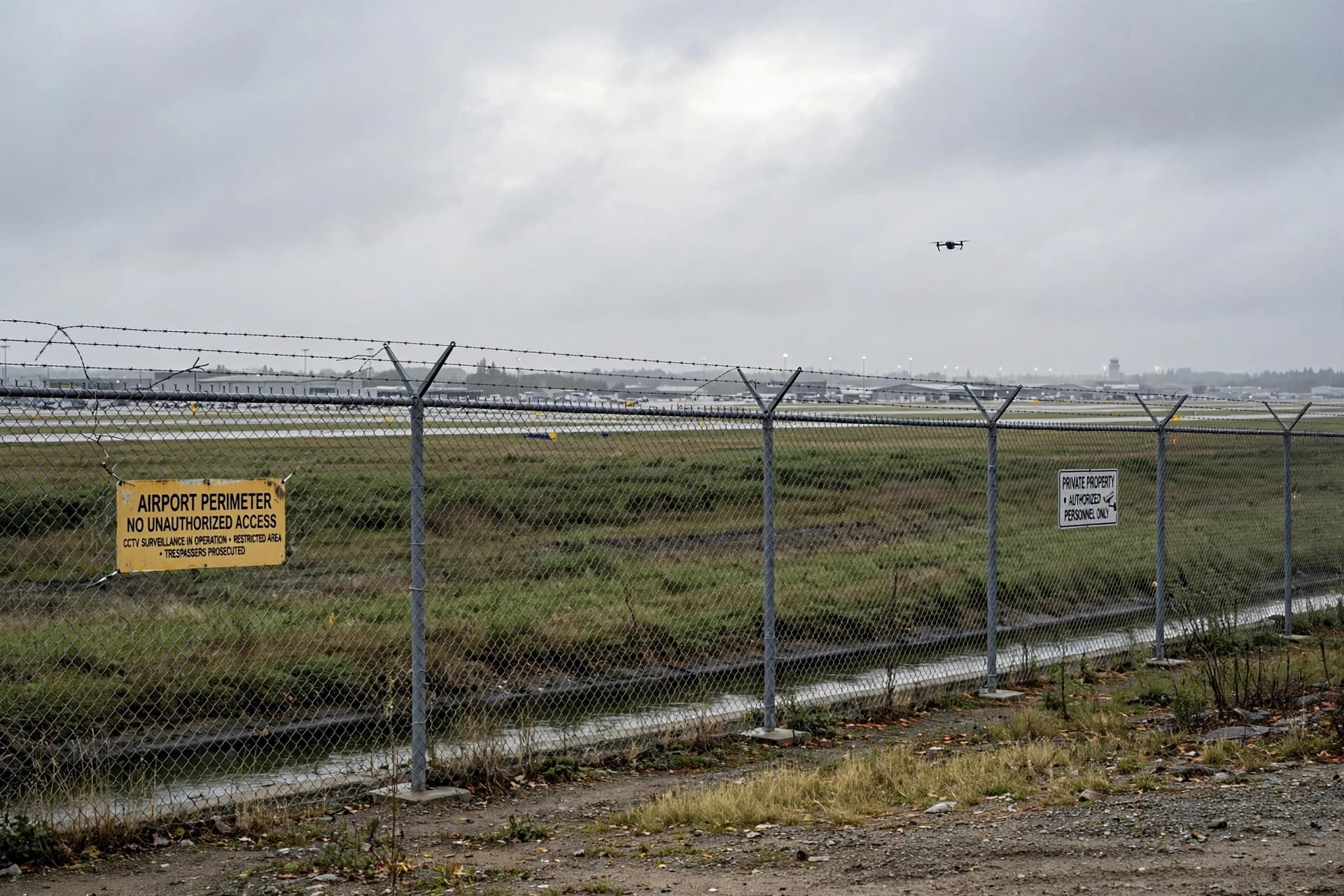
There is a particular danger in mistaking the symptom for the disease. When a drone appears over an airport, the instinct is to look up—to track the intruder, to intercept it, to bring it down. But the deeper problem may not be in the sky at all. It may be in the slow, fragmented machinery of the institutions that are meant to respond.
That is the argument advanced by analysts who have studied Russia's campaign of drone-related sabotage across Europe. The incidents are real: a quadcopter carrying plastic explosives landed near a Ukrainian cargo aircraft at Leipzig/Halle Airport in August, undetected by security systems. Drone sightings have disrupted airports, forced closures, and occupied the time and resources of police and intelligence services across the continent . Each case leaves behind a residue of uncertainty—and it is that uncertainty, analysts say, that makes cheap, deniable operations so effective against institutions that are otherwise highly capable.
The problem, as Megi Benia of the Strategic Security Initiative writes, is that European governments are treating each incident as an isolated event rather than a symptom of a systemic vulnerability. The focus has been on counter-drone technology—sensors, jammers, interception systems—all of which are necessary but insufficient. They cannot compensate for the institutional fragmentation that an adversary is actively exploiting .
Ukraine's experience offers a different model. Against years of Russian drone attacks, Ukraine has progressively connected battlefield reporting, air-surveillance data, acoustic sensors, drone feeds, and intelligence into integrated situational-awareness and command systems. It has combined centralized information with distributed defensive capabilities, allowing units and mobile teams to respond without waiting for decisions to move through a lengthy hierarchy. As a result, Ukraine has streamlined the process of detection, identification, decision, and action .
The lesson for Europe, analysts argue, is not simply to buy more interceptors. It is to reorganize—to create connections between aviation authorities, law enforcement, intelligence services, and armed forces that allow information to be shared across institutional and national boundaries before an incident becomes a crisis. Attribution, too, is a problem: when it takes weeks to establish responsibility, as it did in the Leipzig case, attribution becomes retrospective and ceases to function as a deterrent .
The decisive advantage, Benia writes, is not measured by the number of drones intercepted. It is ensuring that Russia—not Europe—is forced to react, robbed of initiative, denied the ability to dictate the tempo. Only by reclaiming the initiative can Europe shift from a posture of reaction to one of control. For now, the continent is learning, but perhaps not the lesson that matters most.
AI Image Disclaimer: The images accompanying this article are generated by artificial intelligence and are intended for illustrative purposes only.
Sources: The Kyiv Independent, Strategic Security Initiative, European Council on Foreign Relations
Published by Banx Network. This article is part of the Banx decentralized media programme, powered by the BXE token on the XRP Ledger.