There is a particular audacity in proposing reforms that require the consent of the very nations they would bind—a gambit that asks member states to voluntarily cede a measure of the sovereignty they have guarded for decades, in exchange for a union that can act with greater speed and coherence. On Tuesday, the European Commission made that gambit. In a long-delayed pre-enlargement policy review, the Commission proposed far-reaching changes to how the bloc makes decisions and admits new members, including moving away from unanimity voting, cutting the number of commissioners, and imposing safeguards on future member states for up to fifteen years after accession .
The proposals are designed to prepare the EU for a membership of thirty or more countries. Enlargement Commissioner Marta Kos framed the package as both an opportunity and an insurance policy. "The main question has been: is the EU fit for another enlargement? And there is a clear yes, a future enlargement is possible. Our assessment shows that in most policy areas, the EU is already fit for enlargement" . But she acknowledged that the internal reforms would be difficult. "It will not be easy, but it is worth trying" .
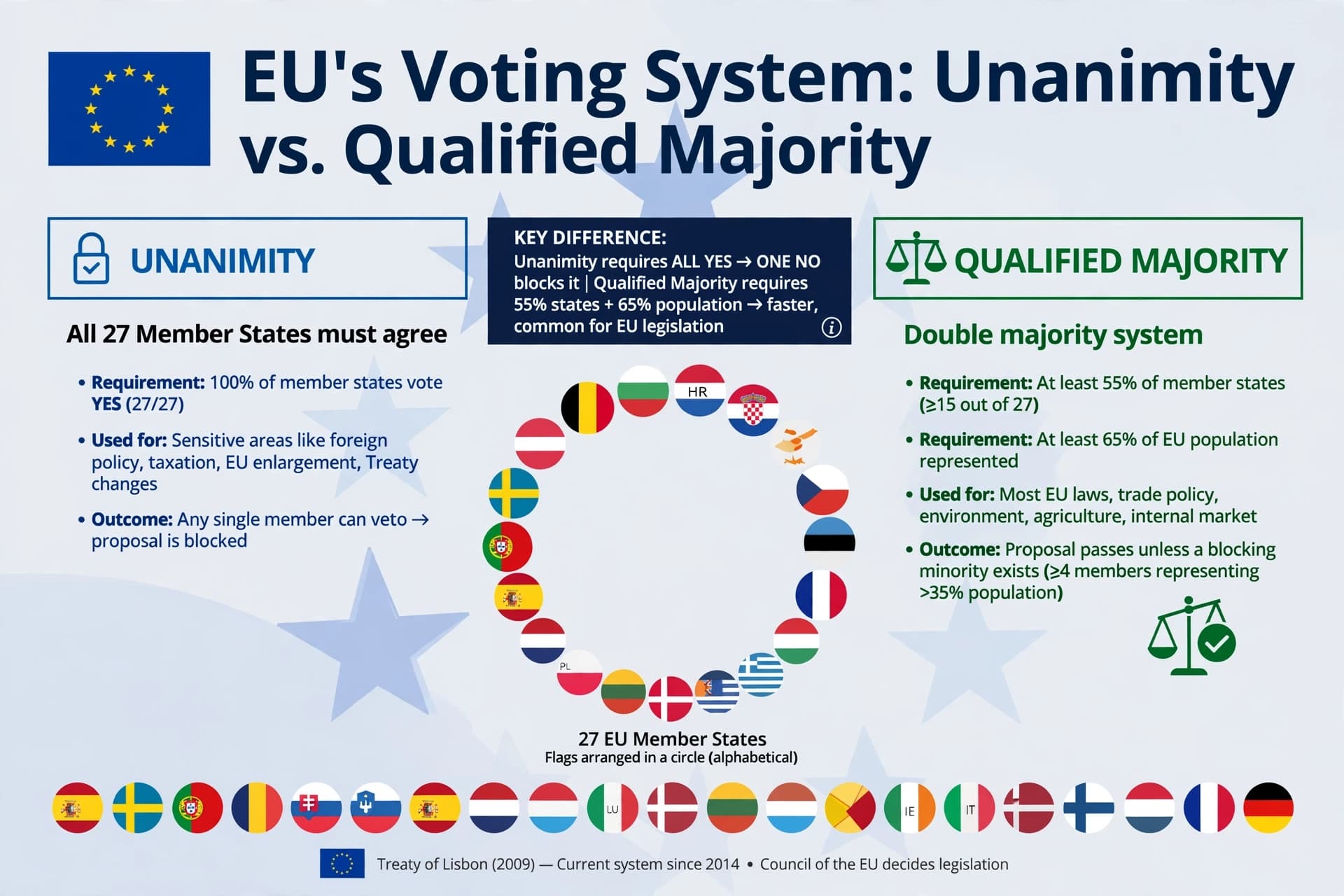
The most contentious element is the push to reduce the reliance on unanimity. The Commission proposes activating "passerelle clauses"—provisions in the existing treaties that allow the Council to move from unanimity to qualified majority voting in specific areas without a formal treaty change . The areas identified include sanctions, tax fraud, and certain fiscal measures in energy policy. The Commission also wants qualified majority voting for intermediate stages of accession negotiations, reducing the chance that a single member state can block a candidate's progress . Unanimity is currently required to grant candidate status and to close negotiations, but in between, any member state can veto 150 steps .
The institutional reforms are equally sensitive. The Commission proposes dropping the principle that every EU country has a commissioner—a principle that has never been formally applied but that was preserved by a unanimous decision in 2013 to secure Ireland's support for the Lisbon Treaty . Under the Lisbon Treaty, the Commission should have a number of members equal to two-thirds of the member states, chosen by equal rotation. Small countries fear losing their voice in Brussels; large countries fear being left out of the College of Commissioners while smaller states are included .
For future member states, the Commission proposes a "probationary" period of up to fifteen years, during which the EU could suspend voting rights or withhold funding if a new member backslides on rule of law or democratic standards . Kos described the safeguards as "an insurance policy" and insisted that they would not create a two-tier EU. "We don't want a two-tier membership. This is about protecting ourselves" . But analysts have noted that the safeguards effectively offer new members a "second-class status" for a decade and a half .
The proposals also include a new approach to "gradual integration," allowing candidate countries to participate in selected EU policies—energy, transport, artificial intelligence, security, and defense—before becoming full members. Kos described gradual integration as "an accelerator for enlargement and a bridge" between the EU's geopolitical objectives and its merit-based accession process . Montenegro, Albania, Moldova, and Ukraine are the four most advanced candidates and will receive indicative roadmaps later this month .
The reception among member states has been skeptical. Four EU diplomats told Euronews that the internal reforms are unlikely to fly . The first test comes next week, when the enlargement reforms land on the table of EU leaders at the European Council on October 15-16 . The Commission has thrown down the gauntlet. Whether the member states pick it up—or leave it lying on the floor—remains to be seen.
AI Image Disclaimer: The visual elements in this article were created using AI generation tools and are intended for illustrative purposes only.
Sources: Euronews, EUobserver, LRT, Anadolu Ajansı, European Western Balkans
Published by Banx Network. This article is part of the Banx decentralized media programme, powered by the BXE token on the XRP Ledger.