KUWAIT CITY — In a volatile expansion of regional hostilities, an Iranian strike directly hit a facility belonging to a Chinese company in northern Kuwait early Thursday morning, July 30, 2026 killing one worker and causing extensive structural damage. The incident marks a significant and dangerous escalation, drawing international corporate assets and non-combatant nations directly into the crosshairs of the widening conflict.
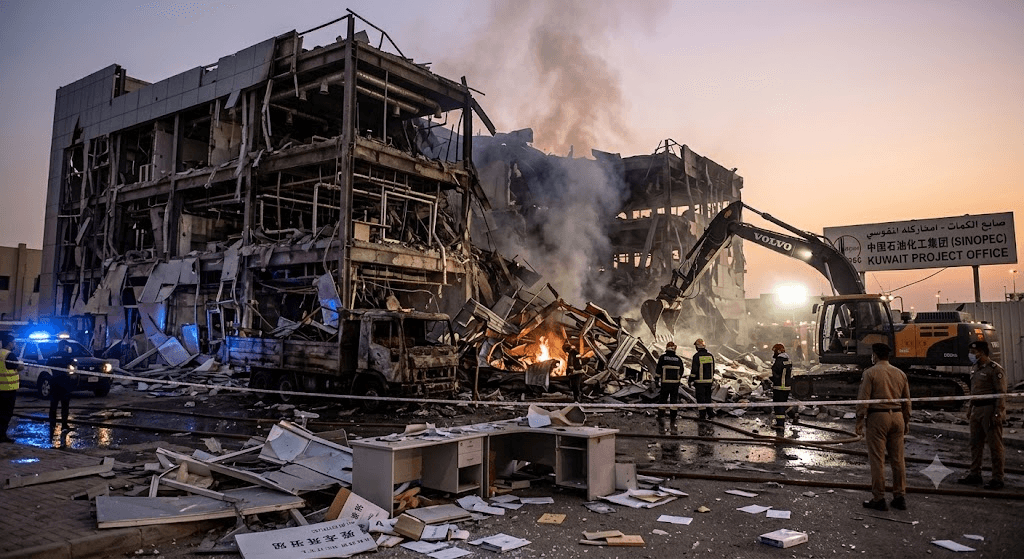
The attack occurred during the early morning hours of Thursday, July 30, 2026, targeting a commercial building operated by an unnamed Chinese firm near Kuwait’s northern border. The Kuwaiti Ministry of Defense quickly issued a statement on its official channels condemning the action.
“The heinous Iranian aggression targeted a building belonging to a Chinese company in the north of the country, resulting in the death of one worker and causing severe material damage to the building,” said Ministry Spokesperson Saud Abdulaziz al-Otaibi.
Emergency response teams and military personnel were deployed to the site to secure the perimeter and clear debris from the heavily mangled facility. Tehran has reportedly launched a broader campaign of missile and drone salvos across the Middle East, asserting that its forces are targeting regional installations hosting U.S. military personnel.
The strike on the Chinese corporate facility followed hours of intense military activity across the region. Just before the attack in Kuwait, Jordanian air defenses successfully intercepted and shot down five Iranian ballistic missiles cross-cutting its airspace. While Jordan's state-run Petra news agency confirmed the interceptions resulted in no casualties, the debris fields highlighted the expansive path of the night's barrages.
This sudden spike in violence follows an announcement by U.S. Central Command (CENTCOM) detailing a massive wave of retaliatory strikes inside Iran. U.S. forces targeted dozens of assets linked to Iran’s Islamic Revolutionary Guard Corps (IRGC), including command centers, coastal defense sectors, and drone facilities, following an earlier Iranian drone strike on an American base in Jordan.
The destruction of a Chinese-operated facility on Kuwaiti soil introduces highly complex geopolitical variables to the conflict. Beijing has historically maintained a delicate diplomatic balancing act in the Persian Gulf, heavily relying on the region for its energy imports while investing billions into infrastructure projects under its global trade networks. The death of a worker at a Chinese firm is bound to pressure international neutral parties to review their stance on the ongoing instability.
Meanwhile, shipping security firms have noted parallel escalations in nearby waters, including drone-induced fires on natural gas vessels near Egyptian ports and renewed closures along the crucial Strait of Hormuz waterway. With regional mediators scrambling to bring factions back to the negotiating table, the direct hit in Kuwait underscores the volatile reality that the conflict is rapidly expanding far beyond its original borders.
Published by Banx Network. This article is part of the Banx decentralized media programme, powered by the BXE token on the XRP Ledger.