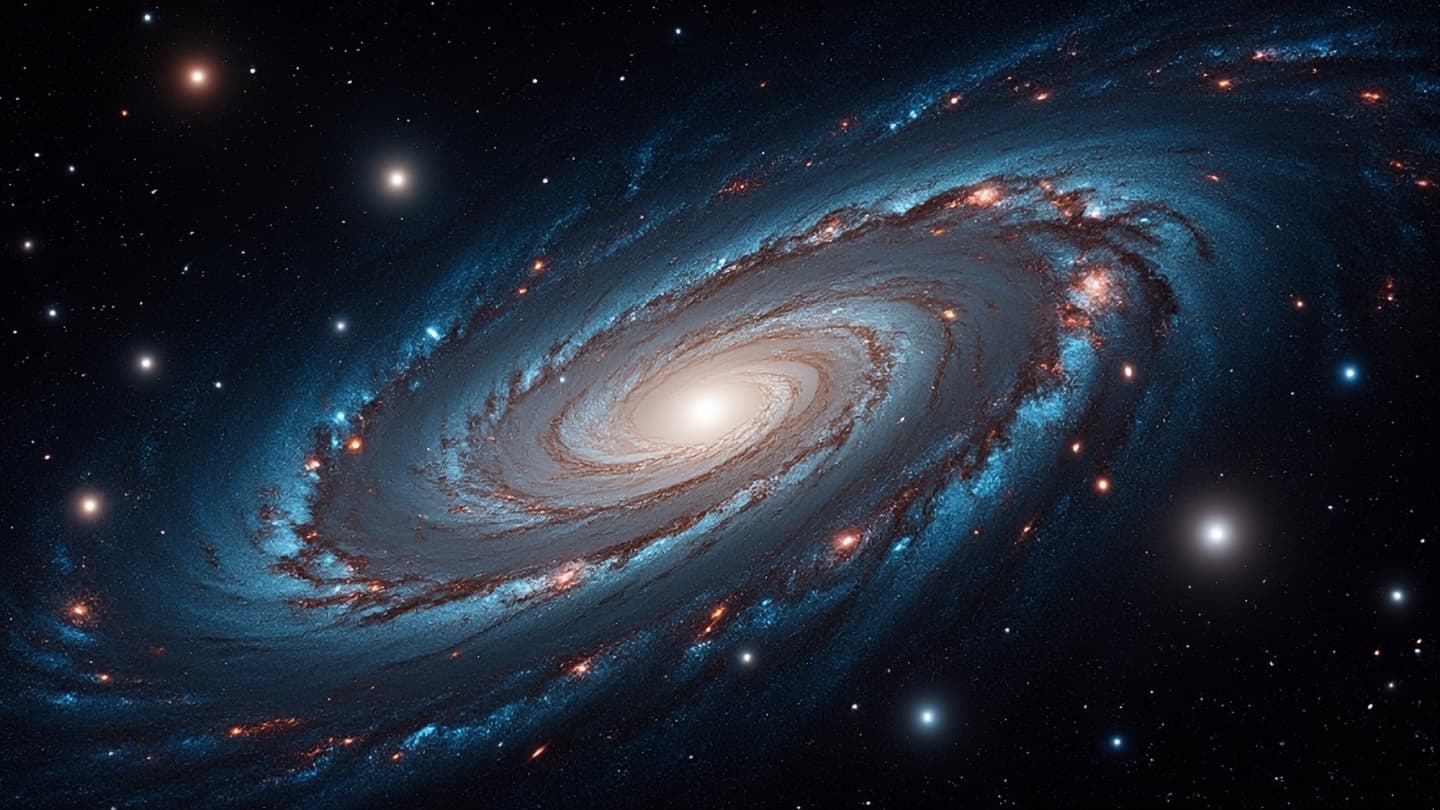
When the James Webb Space Telescope turns its golden eye toward the depths of the universe, it often reveals scenes that challenge our understanding of cosmic history. Recent images of a galaxy located 11 million light-years away have left astronomers intrigued and slightly perplexed. The details captured in these photos suggest processes and structures that do not fit neatly into existing models, inviting scientists to reconsider what they thought they knew about galaxy formation and evolution.
Body: The galaxy in question, though relatively close in cosmic terms, displays features that are unusually complex for its age and size. Webb’s infrared capabilities have peeled back layers of dust and gas, revealing star-forming regions and structural anomalies that were previously hidden. These observations provide a level of detail that earlier telescopes could not achieve, offering a fresh perspective on a familiar neighbor.
Astronomers are particularly puzzled by the distribution of young stars and the presence of unexpected chemical signatures. These findings suggest that the galaxy may have undergone a unique series of events, such as mergers or intense bursts of star formation, that differ from standard evolutionary paths. The data invites new hypotheses about how galaxies interact with their environment and how they grow over time.
The surprise element of these discoveries is a testament to the power of Webb’s technology. By observing in the infrared spectrum, the telescope can see through obscuring dust clouds, revealing the hidden workings of celestial bodies. This capability has transformed astronomy, allowing scientists to study objects with unprecedented clarity and depth. Each image is not just a picture but a dataset rich with information.
The scientific community is now engaged in a lively debate about the implications of these findings. Some researchers suggest that current models of galaxy evolution need to be adjusted to account for such variability. Others propose that the galaxy may represent a rare class of objects that have been overlooked due to observational limitations. This dialogue is essential for advancing our understanding of the universe.
For the public, these images serve as a reminder of the vastness and mystery of space. They inspire wonder and curiosity, encouraging people to look up and think about their place in the cosmos. The perplexity of the scientists is shared by many who marvel at the beauty and complexity of the images released by NASA and its partners.
As analysis continues, more details are expected to emerge. Spectroscopic data will help determine the composition and motion of the gas and stars within the galaxy. This additional information will be crucial for testing the new hypotheses and refining our models. The journey of discovery is ongoing, with each answer leading to new questions.
Closing: New images from the James Webb Space Telescope of a galaxy 11 million light-years away have revealed unexpected features, prompting astronomers to rethink aspects of galaxy evolution. The findings highlight the telescope’s ability to uncover hidden secrets in the nearby universe.
AI Image Disclaimer: Please note that the visuals for this story are AI-generated illustrations inspired by the aesthetic of deep-space imagery and scientific discovery.
Sources: NASA Space.com Live Science The Astrophysical Journal
Published by Banx Network. This article is part of the Banx decentralized media programme, powered by the BXE token on the XRP Ledger.