

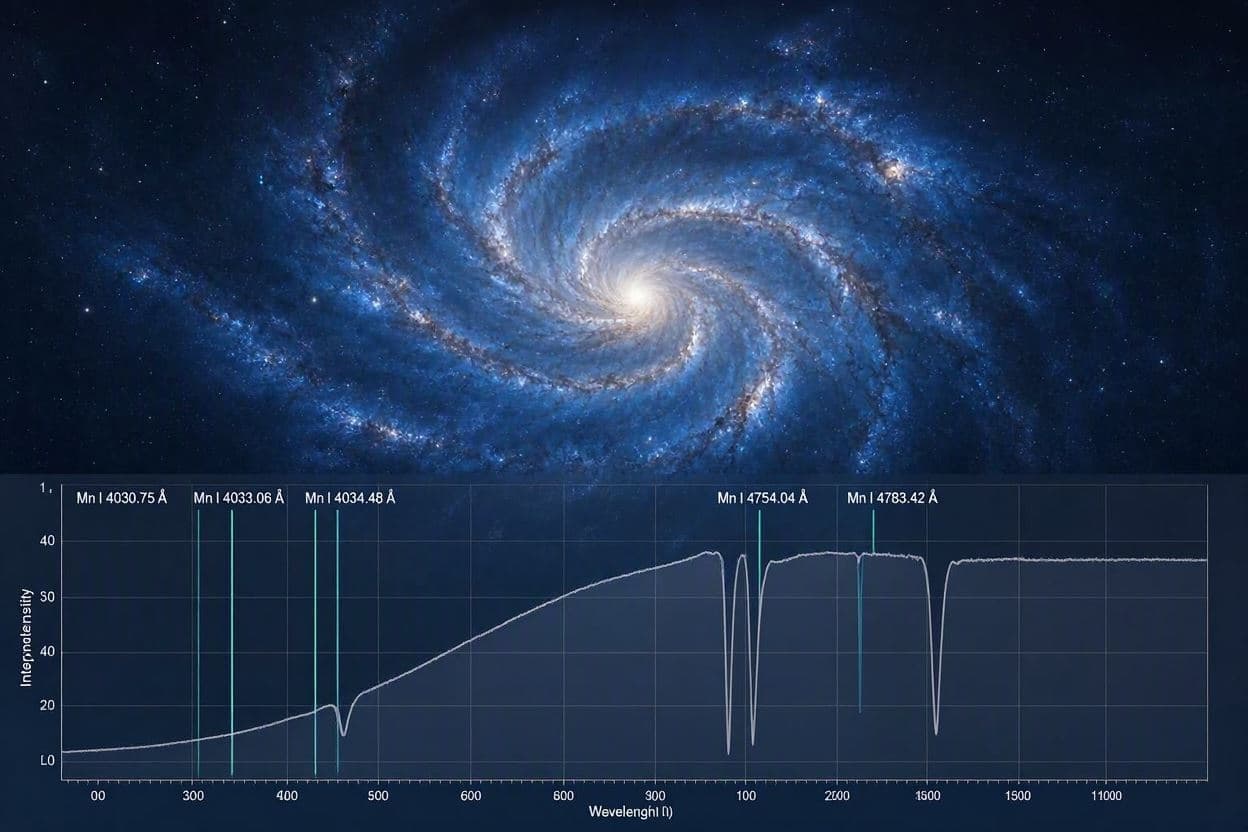
Time in the cosmos is not measured by ticking clocks but by the slow alchemy of stars. As stellar furnaces burn and explode, they forge heavy elements that scatter across the galaxy, leaving behind a chemical record of their history. Among these elements, manganese has emerged as a potential cosmic chronometer. Recent studies suggest that the abundance of this metal could help astronomers determine the age of galaxies with greater precision. This method invites reflection on how the very stuff of stars serves as a ledger of time, marking the epochs of celestial evolution.
Manganese is produced primarily in Type Ia supernovae, explosions that occur when white dwarf stars reach a critical mass. These events are relatively consistent in their brightness and chemical output, making them valuable standard candles for measuring distance. However, their role in producing manganese offers a different kind of utility: a way to track the timeline of star formation and enrichment in a galaxy.
By analyzing the spectral lines of distant galaxies, astronomers can measure the ratio of manganese to iron. Since iron is produced in both Type Ia and core-collapse supernovae, while manganese is more specific to Type Ia, the ratio changes over time as different types of stars die. A higher manganese-to-iron ratio suggests an older population of stars, where Type Ia supernovae have had more time to contribute to the chemical mix.
This technique complements existing methods of dating galaxies, such as observing the redshift of light or modeling stellar populations. Chemical tagging provides an independent line of evidence, helping to resolve discrepancies and refine our understanding of galactic history. It adds a layer of detail to the broad strokes of cosmic evolution.
The application of this method requires high-resolution spectroscopy, available only through powerful telescopes like the James Webb Space Telescope or large ground-based observatories. As technology improves, astronomers will be able to apply this clock to fainter and more distant galaxies, pushing the boundaries of our observable history.
Understanding the age of galaxies is crucial for testing models of the universe’s expansion and structure formation. If galaxies formed earlier or later than predicted, it could indicate new physics or adjustments to our current cosmological models. Manganese dating offers a tool to probe these fundamental questions with fresh data.
The process also highlights the interconnectedness of cosmic events. The death of one star provides the ingredients for the next generation, creating a cycle of creation and destruction that spans billions of years. Manganese is a witness to this cycle, embedded in the gas and dust that will eventually form new worlds.
For the public, the idea that we can read the age of a galaxy from its chemical composition is poetic. It connects the abstract concept of deep time with tangible elements found on Earth. Manganese, used in steel and batteries here at home, becomes a bridge between our daily lives and the ancient history of the stars.
As research continues, the reliability of manganese as a cosmic clock will be tested against other indicators. Each confirmation strengthens our ability to map the timeline of the universe. It is a reminder that even in the vastness of space, there are patterns waiting to be decoded.
Astronomers are exploring the use of manganese abundance as a method to date galaxies, leveraging the element’s production in Type Ia supernovae. This chemical clock offers a new way to understand galactic evolution and refine models of cosmic history.
AI Image Disclaimer: The visual representations accompanying this article are AI-generated interpretations designed to symbolize stellar chemistry and cosmic time, using abstract imagery of spectra and star fields.
Published by Banx Network. This article is part of the Banx decentralized media programme, powered by the BXE token on the XRP Ledger.




