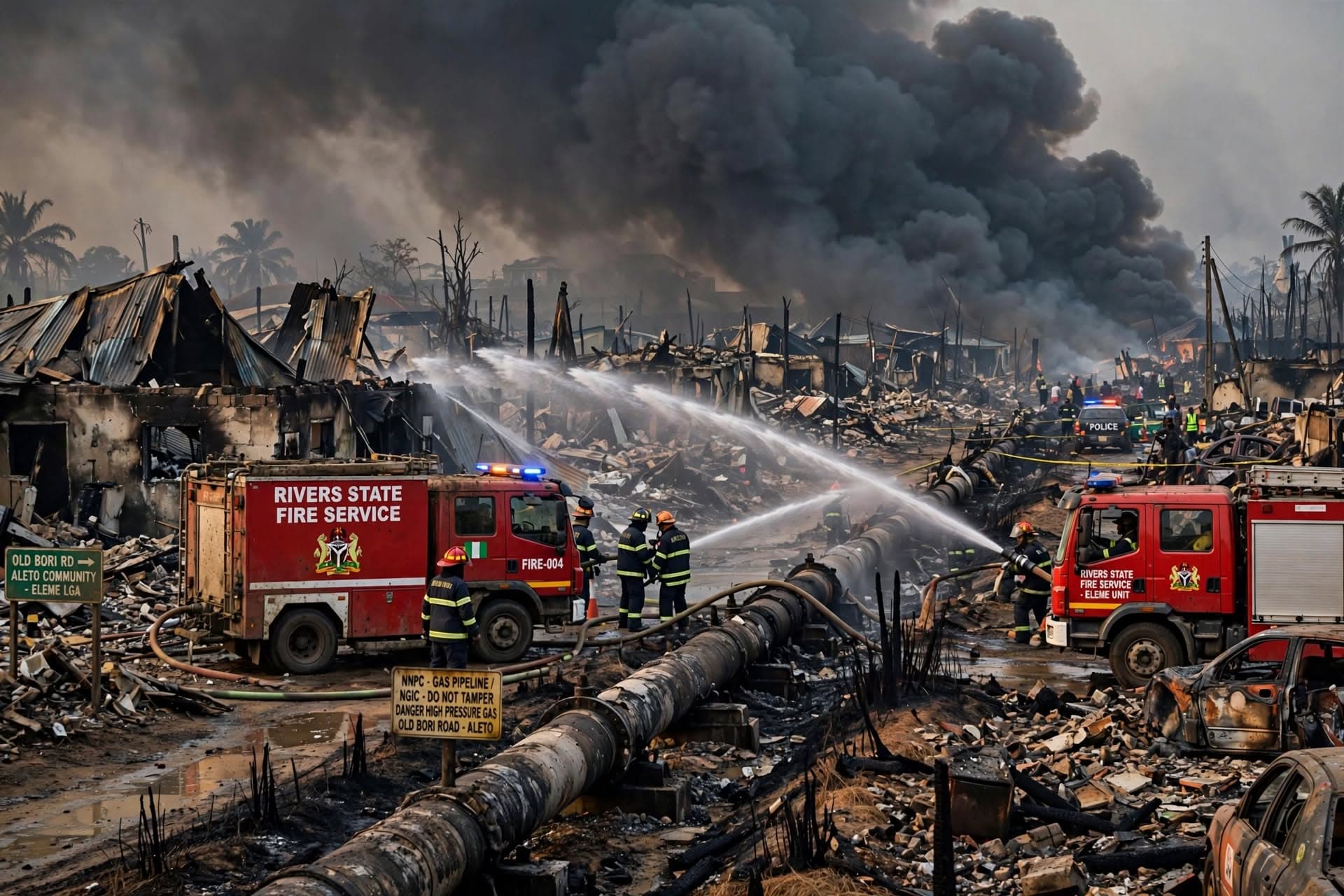
Port Harcourt, Nigeria—A high-pressure gas pipeline exploded in the Eleme local government area of Rivers State today, leveling multiple residential houses and leaving twenty citizens hospitalized with severe burns and blast injuries. Massive fireballs shot hundreds of meters into the air, igniting adjacent residential properties and spreading thick smoke across surrounding communities.
Rivers State Fire Service units, energy sector fire brigades, and emergency response teams rushed to the disaster zone to halt the spread of the inferno. Emergency personnel established a wide safety perimeter while technicians moved to isolate valve stations and depressurize the burning pipeline segment. Medical teams treated twenty blast victims on scene before rushing them to hospitals in Port Harcourt.
Attending physicians confirmed that eight victims suffered severe second and third-degree thermal burns covering major portions of their bodies, while others received treatment for blast concussions and severe smoke inhalation. Emergency crews worked through dense smoke to verify that no residents remained trapped inside burning mud and brick structures.
According to initial reports published by News Diary Online, the explosion occurred near a densely populated settlement built close to the energy pipeline right-of-way. Residents reported hearing a loud pressurized hiss followed seconds later by a deafening roar that shook building foundations across the district.
"The ground vibrated violent right before a towering wall of fire erupted near the houses," said a community youth leader who assisted early evacuation efforts. "People were running down the street with clothes on fire, screaming for help."
Energy ministry officials and pipeline operators shut down high-pressure feed valves upstream, gradually reducing the flame intensity as trapped gas burnt off inside the line. Environmental protection officers conducted air monitoring tests in downwind communities, advising local residents to wear protective masks due to heavy carbon and chemical soot concentration.
The disaster underscores ongoing safety hazards surrounding energy pipeline corridors crossing urban communities in the Niger Delta region. Structural encroachments, corrosion along aging pipe infrastructure, and third-party interference continue to pose catastrophic fire threats to nearby civilian populations.
Rivers State authorities launched an immediate joint technical investigation with energy company engineers to establish whether mechanical failure, structural corrosion, or unauthorized access caused the pipeline rupture.
Emergency responders remained on scene into the night, extinguishing spot fires among ruined structures and securing the perimeter surrounding the ruptured pipeline.
Published by Banx Network. This article is part of the Banx decentralized media programme, powered by the BXE token on the XRP Ledger.