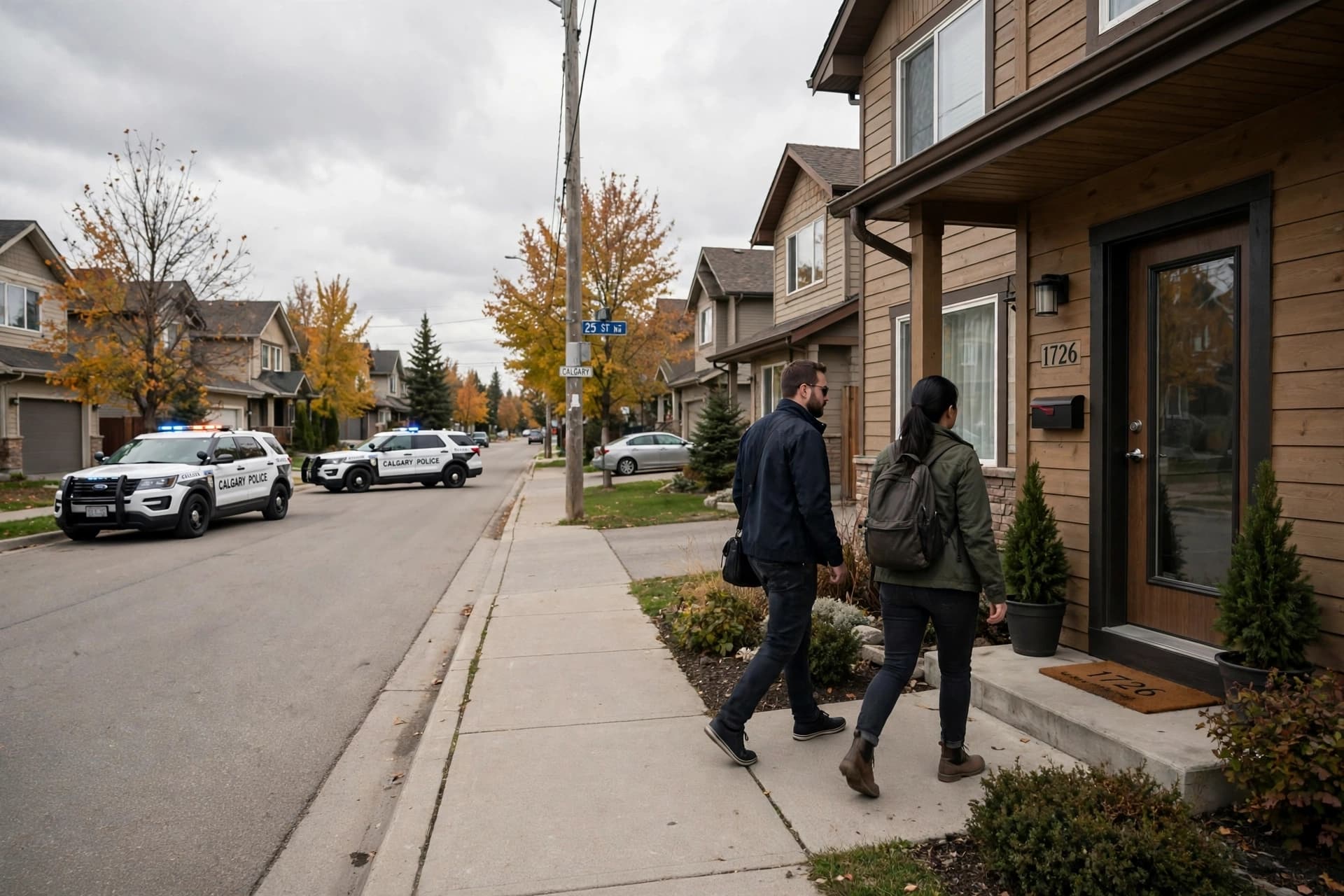
In the quiet calculus of community safety, some work happens not in the flash of a headline but in the patient compiling of names, addresses, and the paper trails of unfinished justice. Over two days in Calgary's District 3, that quiet work took visible form. Nineteen people were arrested and eighty-seven outstanding warrants were executed in a joint operation between the Calgary Police Service and the Alberta Sheriffs, a coordinated sweep that had been planned for weeks before a single door was knocked upon.
The operation brought together officers from the District 3 Community Engagement Response Team, Community Resource Officers, patrol members, and the Fugitive Apprehension Sheriff Support Team. Analysts had spent weeks preparing roughly 130 information packages, reviewing each case before deploying officers to sixty-two residences across the district. The warrants covered a range of charges: possession of dangerous weapons, drug trafficking, possession of stolen property, personation, and fake identification documents. Each name on those warrants represented an open thread in the fabric of public order, waiting to be tied.
What distinguishes an operation like this is not the number of arrests but the method behind it. Warrants are not merely paperwork; they are the accumulated weight of unresolved obligations, the legal system's way of saying that certain matters cannot be left indefinitely unattended. When eighty-seven such matters are addressed in forty-eight hours, the effect is less a dramatic crackdown than a quiet restoration of a baseline—a reminder that the machinery of accountability, however slow, does eventually turn.
Inspector Travis Juska of District 3 described the partnership as a way to "improve community safety by coordinating resources to hold offenders accountable, while addressing ongoing concerns within the district". His counterpart at the Alberta Sheriffs, Inspector Darren Thompson, spoke of shared expertise and combined resources, language that reflects the unglamorous reality of modern policing: most of it is collaboration, logistics, and the careful matching of limited resources to sprawling need.
For the residents of District 3, the visible presence of officers at sixty-two doors over two days may have registered as disruption, or perhaps as reassurance, depending on which side of a warrant one stood. The operation did not target a single neighborhood or a single profile of offense. It moved through the district as a broad, methodical sweep, addressing weapons and drugs and stolen goods and false identities in the same measured rhythm.
There is a temptation, when reading of such operations, to measure success in numbers alone. Nineteen arrests, eighty-seven warrants, sixty-two residences. But the more meaningful metric may be the one that cannot be counted: the investigations that can now proceed, the cases that can move forward, the small closures that allow a community to feel, however incrementally, that its systems are working. The Calgary Police Service extended its thanks to the Alberta Sheriffs for their collaboration, a formality that nonetheless underscores the interdependence at the heart of public safety.
The operation concluded as such things do—without fanfare, without a final press conference announcing the end of anything. Officers returned to their regular duties. The warrants were processed. And in District 3, the ordinary quiet resumed, carrying with it the faint but real assurance that someone, somewhere, is keeping track.
AI Image Disclaimer: Images in this article were produced by artificial intelligence for illustrative purposes and do not represent actual scenes or individuals.
Sources: CTV News, Calgary Police Service Newsroom, CityNews Calgary
Published by Banx Network. This article is part of the Banx decentralized media programme, powered by the BXE token on the XRP Ledger.