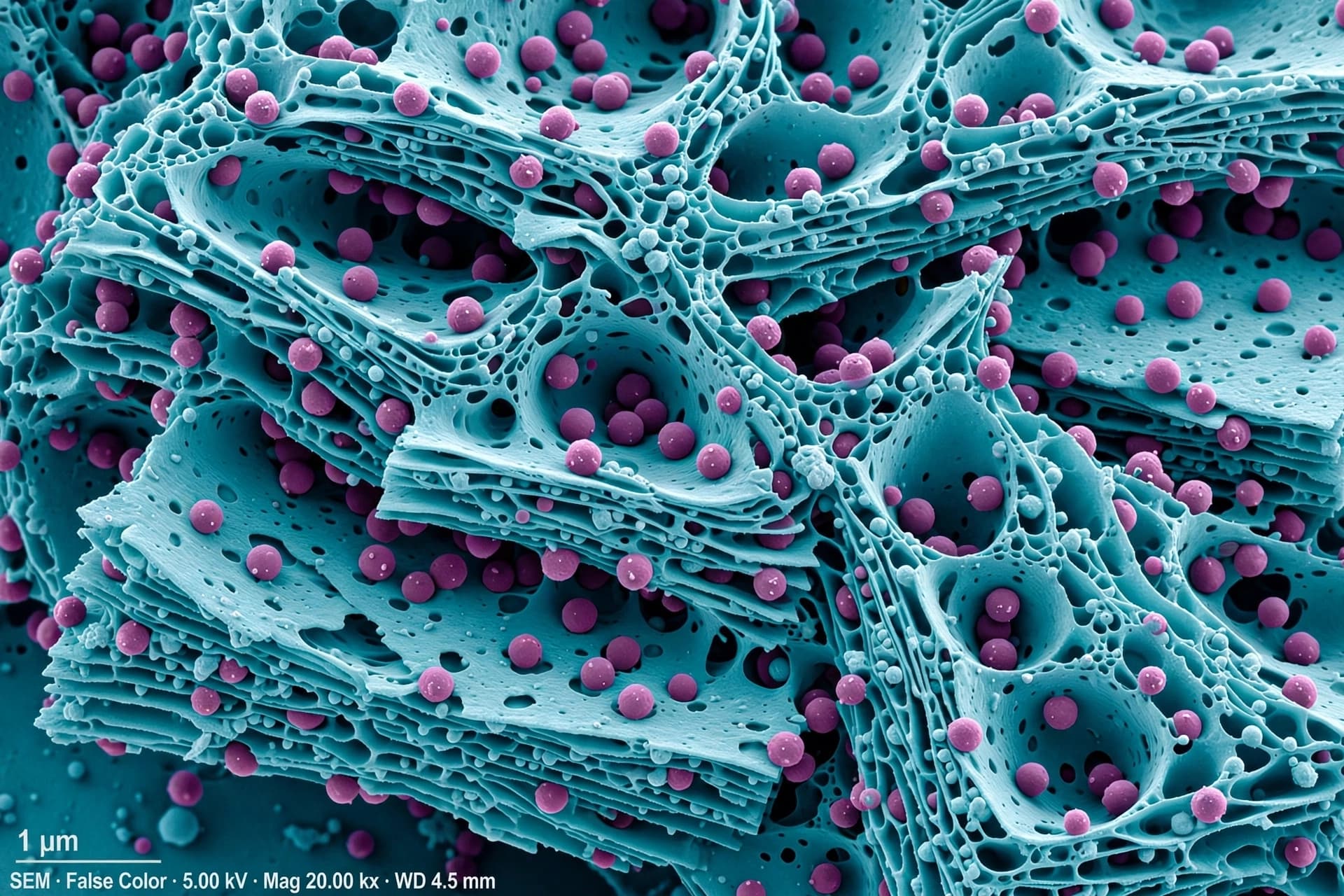
There is an invisible world of electromagnetic waves that surrounds us constantly—signals from phones and satellites, radar pulses, and the interference that modern technology must learn to manage or avoid. Absorbing those waves efficiently, across a wide range of frequencies, has long been a challenge for materials scientists. The ideal absorber must be light, thin, and capable of swallowing electromagnetic energy across the entire X and Ku bands. A new aerogel may have finally achieved that balance.
Researchers at Vali-e-Asr University of Rafsanjan in Iran have developed a hierarchical composite aerogel that demonstrates exceptional microwave absorption across an ultrawide bandwidth. The material combines montmorillonite nanosheets, molybdenum diselenide, activated carbon nanoparticles, and chitosan—a biopolymer derived from shellfish shells—into a porous, lightweight structure .
The results, published in Scientific Reports, show that the optimal sample achieved a minimum reflection loss of -88 dB at a thickness of just 2.6 millimeters. All samples had broad absorption bands covering the entire X and Ku bands, the frequencies commonly used for radar and satellite communications. When the aerogel was used to coat a spherical conductor, it reduced the radar cross-section and scattered far field by 30 to 60 dB and 30 to 33 dB, respectively .
What makes the aerogel effective is its hierarchical architecture. The montmorillonite provides a layered mineral framework, while the MoSe₂ and activated carbon contribute dielectric loss mechanisms that dissipate electromagnetic energy. The chitosan matrix binds these components into a porous structure that is both lightweight and mechanically stable. The synergy between the components enables impedance matching—allowing waves to enter the material rather than reflecting off its surface—and high attenuation, where the energy is converted to heat and absorbed .
The researchers describe the aerogel as demonstrating “promising potential for lightweight microwave absorption applications” . Such materials are of interest for electromagnetic interference shielding, stealth technology, and protecting sensitive electronics from unwanted signals. The combination of ultrawideband performance, low density, and minimal thickness represents a meaningful advance in a field where trade-offs between weight, bandwidth, and absorption strength have long constrained practical applications.
For a world increasingly crowded with electromagnetic signals, the ability to quietly absorb what is unwanted is a form of control. The aerogel offers that control in a form light enough to be carried, thin enough to be applied, and broad enough to matter.
AI Image Disclaimer: Visual content accompanying this article is generated by artificial intelligence and does not depict the actual aerogel material or laboratory experiments.
Published by Banx Network. This article is part of the Banx decentralized media programme, powered by the BXE token on the XRP Ledger.