There is a particular kind of helplessness that settles over a community when a disease outpaces every effort to contain it—when the numbers climb faster than the response, when the sick appear from chains of transmission no one can trace, when the dead are buried before they can be counted. In the Democratic Republic of Congo, that helplessness has become a prolonged condition. This week, the country’s Ebola outbreak crossed a threshold that officials had hoped never to reach: more than 8,000 confirmed cases .
According to the latest situation report from Congo’s public health institute, the cumulative total stands at 8,067 confirmed infections and 3,901 deaths, a case fatality rate of 48.4 percent . The outbreak, declared in May, has become the largest and deadliest in Congo’s history, surpassing even the 2018–2020 crisis. Globally, it ranks as the second-largest Ebola outbreak ever recorded in Africa, exceeded only by the 2014–2016 West African epidemic that infected more than 28,600 people .
What makes this outbreak particularly difficult is the strain of the virus. It is caused by the Bundibugyo species, for which no approved vaccine or treatment exists . The outbreak has spread to 63 health zones across seven provinces, and the World Health Organization has warned that geographic expansion into new areas—including Sud-Ubangi and Haut-Uele—has increased the risk of cross-border transmission into neighboring countries . Weak health infrastructure and ongoing violence along Congo’s borders with South Sudan, Uganda, and Rwanda have further hampered containment efforts .
Perhaps most concerning is the gap between what officials know and what they do not. The head of the Africa CDC has cautioned that contact tracing is falling short, with far fewer people identified than the caseload would suggest . The WHO has estimated that the true number of infections could be two to four times the official count, because many patients die at home without ever reaching a health facility . Approximately 80 percent of new cases are now being detected from unknown chains of transmission—a sign that the virus is spreading beyond the reach of the surveillance system .
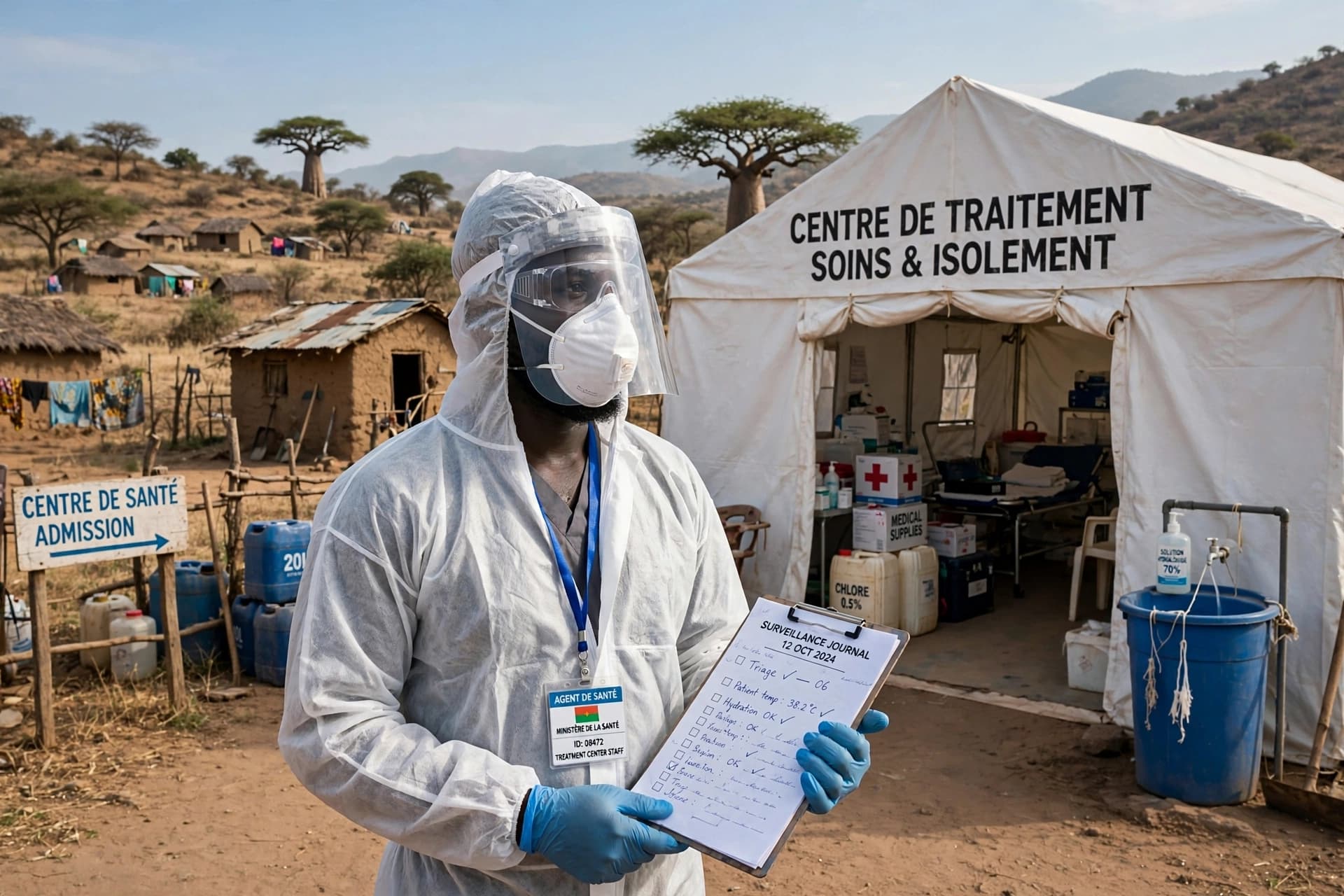
The international response has begun to scale up. Last week, the United States announced an additional $267 million in aid to support the fight against Ebola . Vaccines are being deployed for the Bundibugyo strain, though their efficacy remains uncertain given the lack of approved options. Health workers continue to treat patients, trace contacts, and bury the dead under conditions that are, by any measure, extraordinarily difficult.
For the communities at the center of this outbreak, the numbers are not abstractions. Each case represents a person who fell ill, a family placed under quarantine, a funeral conducted with gloves and masks and distance. The disease has moved through villages and towns with a quiet persistence, appearing in places officials had not anticipated, disappearing from surveillance and then resurfacing elsewhere. The outbreak remains, as health authorities have described it, out of control—a phrase that carries the weight of everything it implies.
AI Image Disclaimer: The visuals accompanying this report are AI-generated and are intended for illustrative purposes only.
Sources: ET HealthWorld, People’s Daily Swahili, Miramar News, Reformatorisch Dagblad, KBC Swahili, Laodong.vn
Published by Banx Network. This article is part of the Banx decentralized media programme, powered by the BXE token on the XRP Ledger.