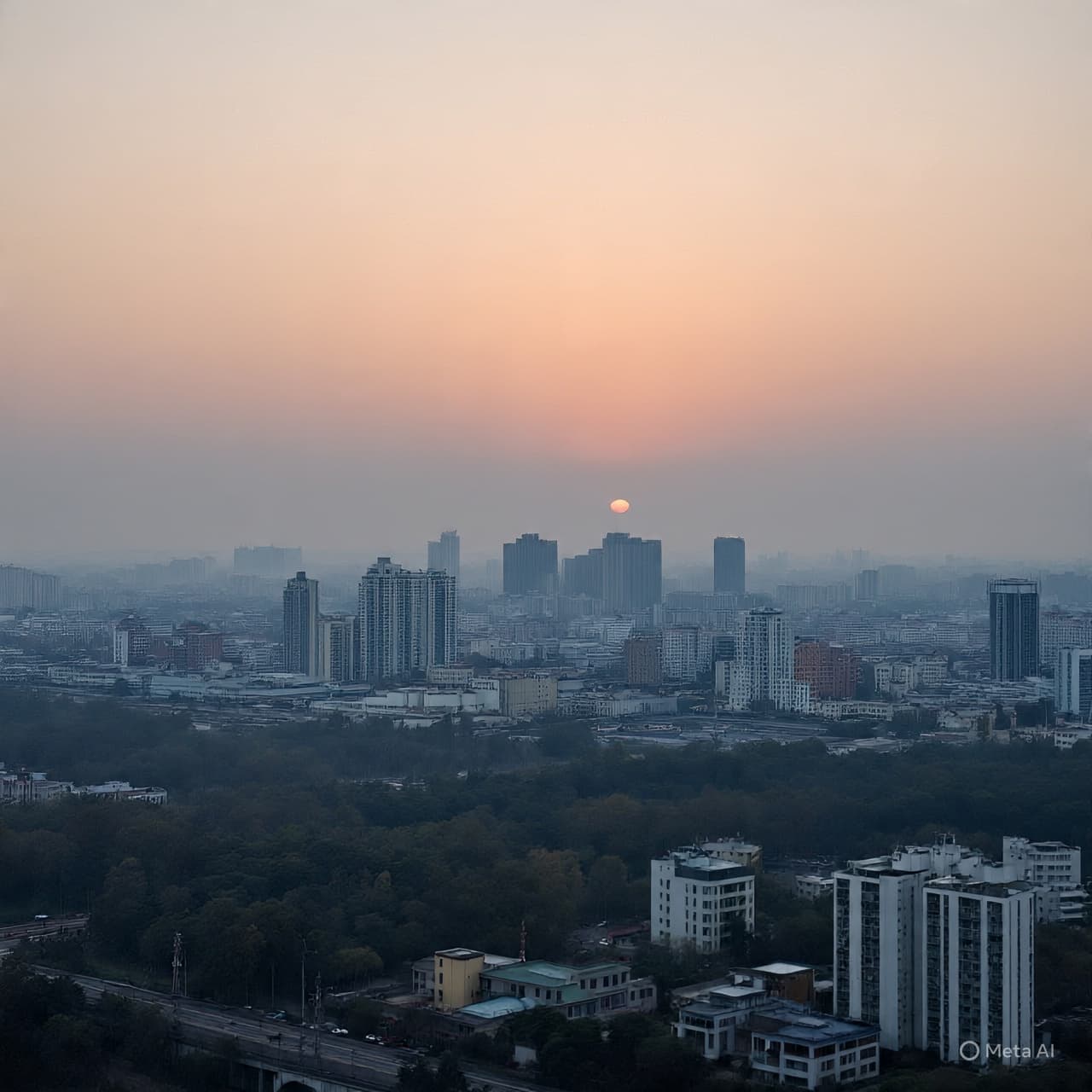
At dawn, the horizon over Pyongyang often appears still, as if the air itself is holding its breath. The city wakes in careful rhythms—trams sliding along familiar tracks, flags stirring in a wind that rarely feels accidental. Beyond the skyline, the wider world hums with a different kind of motion, one shaped by distant conflicts and shifting alliances. News travels across borders like weather, sometimes softened by distance, sometimes sharpened by interpretation.
In recent days, the reverberations of the war involving Iran have found their way into the language of North Korea’s leadership. Kim Jong Un, speaking through state channels, has drawn a line between events unfolding in the Middle East and his country’s longstanding insistence on maintaining its nuclear arsenal. The conflict, framed as a lesson written in fire and uncertainty, has been presented as evidence of what can happen when nations stand exposed.
There is a familiarity to this reasoning, one that echoes through years of statements and policy decisions. North Korea has long described its nuclear program as a shield rather than a sword, a deterrent shaped by memory and anticipation. Yet the invocation of Iran’s current struggle introduces a renewed immediacy, as if distant explosions cast longer shadows than before. In official narratives, the war becomes less a separate crisis and more a mirror—reflecting vulnerabilities that Pyongyang believes it has already addressed.
Observers note that such messaging arrives at a time when global tensions are already layered and complex. The Korean Peninsula remains technically at war, its armistice a pause rather than a conclusion. Military exercises, diplomatic stalemates, and intermittent negotiations form a steady background hum. Within this environment, references to external conflicts can serve both as justification and reinforcement, aligning domestic policy with a broader story of survival in an unpredictable world.
The technical dimensions of North Korea’s weapons program—its missile tests, its claims of advancing delivery systems—have long been scrutinized by international analysts. These developments, often measured in ranges and payloads, take on a different tone when framed through narrative. The idea of deterrence becomes less about capability alone and more about perception: how strength is seen, how vulnerability is avoided, how lessons are drawn from afar.
Meanwhile, the war involving Iran continues to reshape conversations far beyond its immediate geography. It influences oil markets, diplomatic alignments, and security calculations across continents. For some governments, it is a crisis to be managed; for others, it is a signal to be interpreted. In Pyongyang’s case, it appears to have become part of a larger argument—one that ties present danger to longstanding doctrine.
As evening settles again over the Korean Peninsula, the city lights flicker on in quiet succession. The rhetoric, however, lingers beyond the day’s end. North Korea has reiterated that it will not relinquish its nuclear weapons, describing them as essential to its sovereignty and security. In the cadence of official statements, the message is clear: the lessons of distant wars are being folded into decisions made much closer to home, shaping a future that continues to balance between isolation and vigilance.
AI Image Disclaimer Illustrations were created using AI tools and are not real photographs.
Sources Reuters Associated Press BBC News The New York Times Al Jazeera
Published by Banx Network. This article is part of the Banx decentralized media programme, powered by the BXE token on the XRP Ledger.