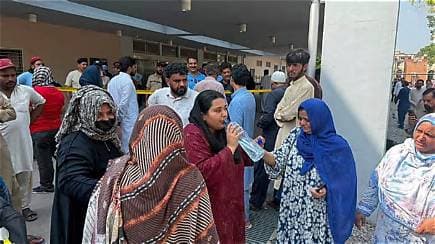
At the edges of the desert, where wind carries dust across canvas shelters and the horizon seems to blur into silence, the rhythm of daily life continues in careful fragments. In camps scattered across Gaza Strip and along the worn roads of Lebanon and Jordan, mornings begin not with certainty, but with quiet calculation—how far supplies might stretch, how long assistance will last.
In recent months, that calculation has grown sharper. Aid organizations, many of them long embedded in the region’s fragile systems of support, are finding themselves constrained not by access alone, but by absence—funds that once moved steadily now arriving in reduced measure or not at all. The effect is not immediate collapse, but a gradual thinning, like a river losing depth until its current begins to slow.
Groups such as the United Nations Relief and Works Agency and the International Rescue Committee have issued increasingly urgent appeals, describing programs scaled back and services strained. Clinics that once operated throughout the day now shorten their hours. Food distributions, carefully scheduled and widely depended upon, face reductions in both frequency and quantity. The language of these appeals remains measured, but beneath it lies a growing sense of urgency that is difficult to disguise.
The causes are layered. Some donor governments have redirected resources toward domestic priorities or other global crises. Others have reassessed their contributions amid political debates, allowing uncertainty to filter into funding pipelines that once seemed more predictable. The result is a landscape where humanitarian work, though still present, moves with greater hesitation.
For those on the ground, the consequences unfold in increments. A mother waits longer for medicine that may not arrive. A child’s education, already disrupted, becomes more fragile as support programs contract. These are not sudden ruptures, but slow adjustments that accumulate over time, altering the shape of daily life in ways that are both subtle and profound.
Across the broader Middle East, the humanitarian situation has grown more complex as ongoing conflicts and displacement intersect with these financial constraints. Aid groups describe a widening gap between needs and available resources, one that cannot easily be bridged through efficiency alone. Appeals for emergency funding have become more frequent, their tone reflecting not alarm, but persistence—a steady insistence that the systems in place require reinforcement to continue functioning at even a basic level.
There is, too, a quiet awareness among these organizations that visibility matters. In a world where crises compete for attention, the absence of headlines can deepen the challenge of securing support. And so, alongside their work in the field, they turn outward, asking not only for funds, but for recognition—that the situation, though not always at the forefront, remains pressing.
As the days move forward, the central reality settles into view. Aid groups are warning that without renewed funding, essential services across parts of the Middle East may face further reductions, even as humanitarian needs continue to rise. It is a moment defined less by a single event than by accumulation—a steady narrowing of capacity set against an expanding horizon of demand, where the balance between them grows increasingly delicate.
AI Image Disclaimer Illustrations were created using AI tools and are not real photographs.
Sources Reuters BBC News Al Jazeera The New York Times The Guardian
Published by Banx Network. This article is part of the Banx decentralized media programme, powered by the BXE token on the XRP Ledger.