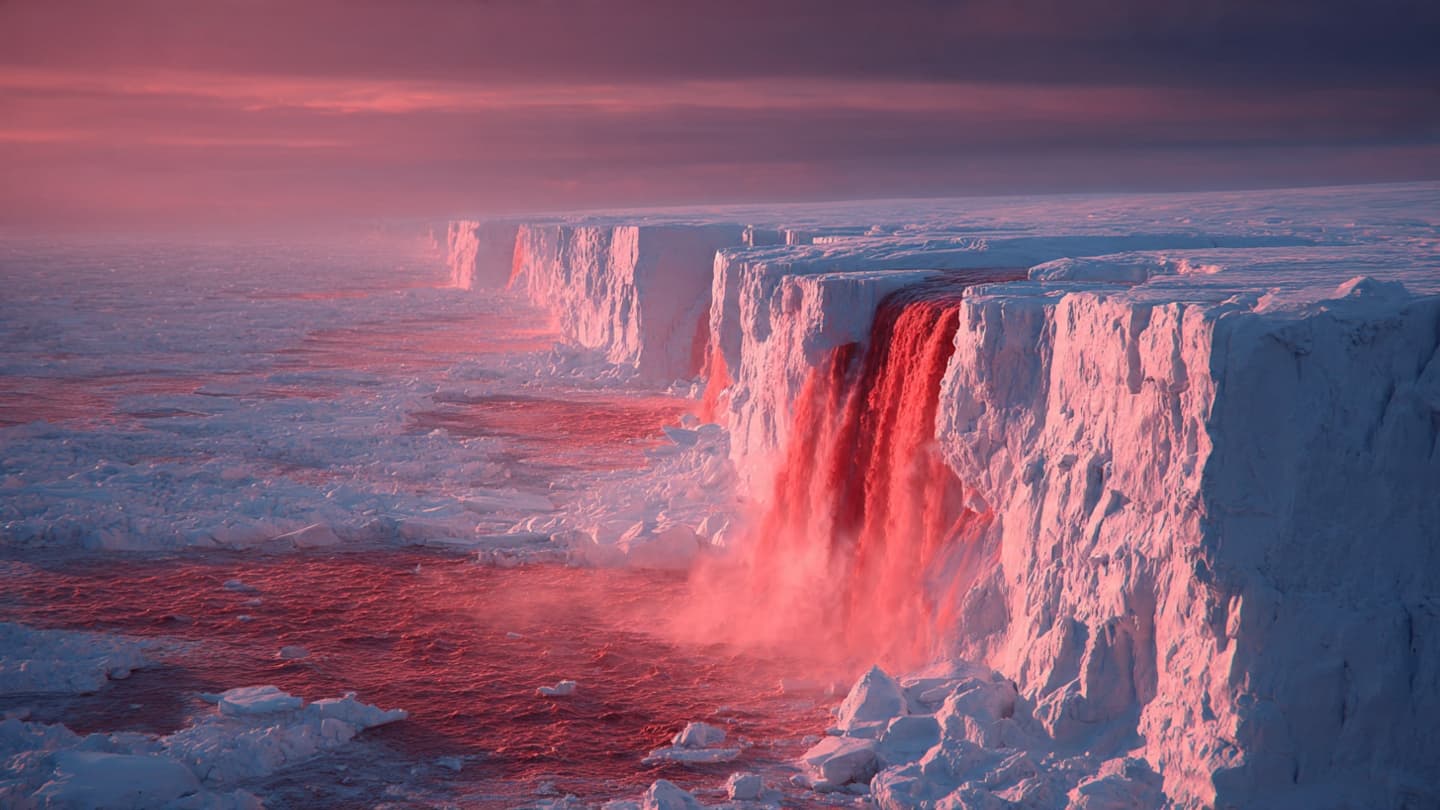
In the stark, frozen landscape of Antarctica, a peculiar phenomenon stains the ice with a deep, rust-red hue. Known as Blood Falls, this outflow from the Taylor Glacier has long intrigued scientists with its mysterious origin and extreme conditions. Recent discoveries suggest that beneath this iron-rich surface lies a hidden world of ancient marine life, preserved in a subglacial reservoir for millions of years. This finding invites reflection on the resilience of life and the secrets locked within Earth’s most remote corners. It is a reminder that even in the harshest environments, nature finds a way to persist.
The water flowing from Blood Falls is hypersaline and rich in iron, creating an environment that would be hostile to most organisms. Yet, genetic analysis has revealed the presence of microscopic eukaryotes, single-celled organisms with complex structures. These microbes share similarities with marine species, suggesting they are remnants of an ancient ocean that once covered the continent. Their survival in darkness and extreme cold challenges our understanding of biological limits.
For researchers, this discovery is a window into the past. The isolated ecosystem beneath the glacier has remained untouched for over a million years, offering a unique opportunity to study evolution in isolation. By analyzing the DNA of these organisms, scientists can trace their lineage back to a time when Antarctica was warmer and wetter. This connection to the past helps reconstruct the history of the continent and its changing climate.
The technology used to access this hidden world is non-invasive, relying on remote sensing and careful sampling to avoid contamination. Protecting the integrity of the site is paramount, as it represents a pristine natural laboratory. The lessons learned here could inform the search for life on other planets, such as Mars or Europa, where similar subsurface environments may exist.
Beyond scientific curiosity, the study of Blood Falls highlights the importance of preserving fragile ecosystems. As climate change accelerates, understanding how life adapts to extreme conditions becomes increasingly relevant. These ancient microbes hold clues to resilience and adaptation, offering insights that could benefit conservation efforts worldwide.
For the public, the image of red water flowing from white ice is striking, but the story behind it is even more profound. It speaks to the enduring mystery of our planet and the endless potential for discovery. Each drop of water carries a history billions of years in the making.
The discovery of ancient marine-like microbes in Antarctica’s Blood Falls reveals a hidden ecosystem preserved for millions of years. As scientists study these resilient organisms, they gain valuable insights into evolution and extreme life. The hope is for continued protection and exploration of this unique natural wonder.
AI Image Disclaimer: Visuals associated with this article are AI-generated to illustrate the themes of extreme environments and microbial life.
Sources: J. Craig Venter Institute Scripps Institution of Oceanography Popular Science
Published by Banx Network. This article is part of the Banx decentralized media programme, powered by the BXE token on the XRP Ledger.