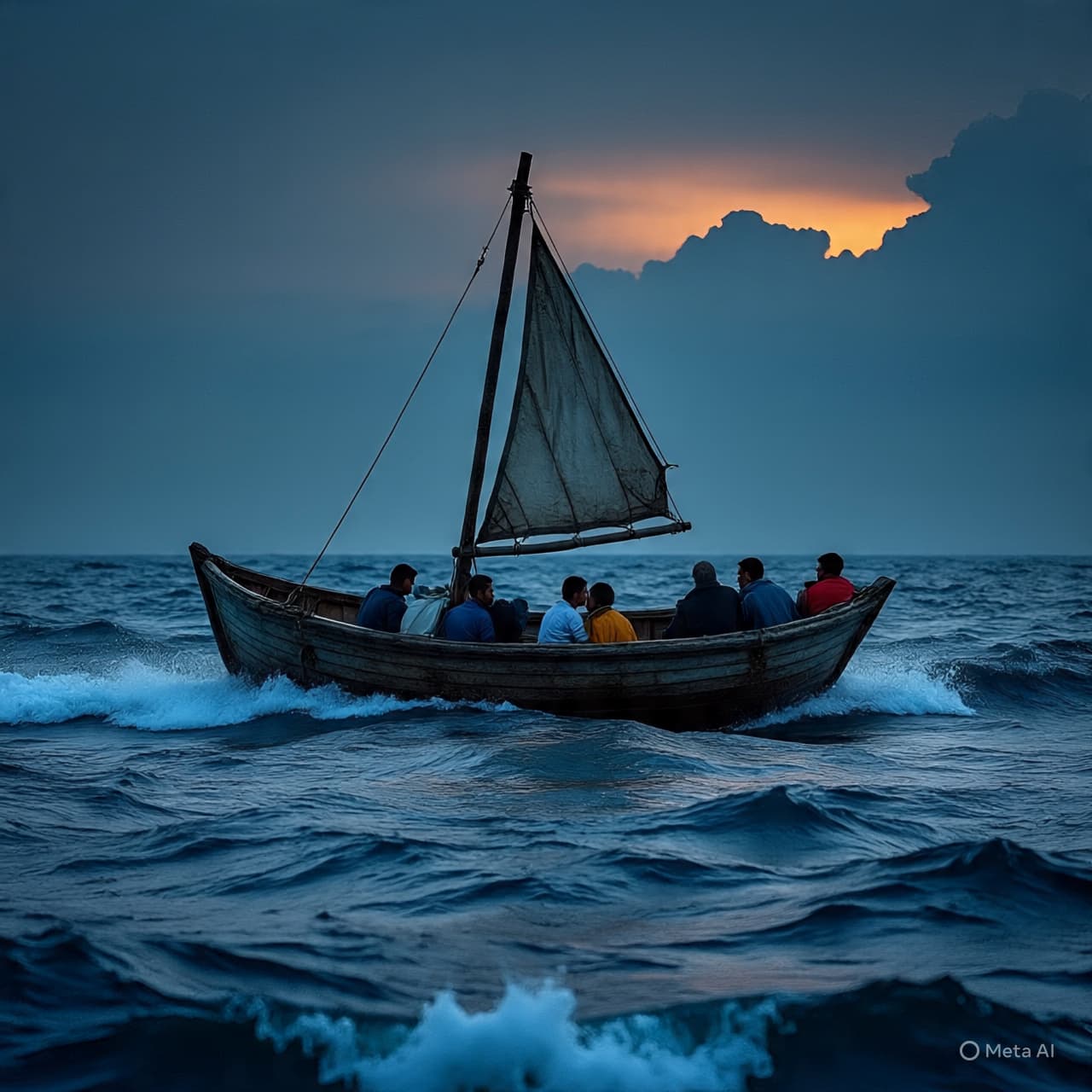
The sea, in its unfathomable breadth, sometimes becomes a canvas of hope — and too often, a stage of despair. Just off the coast of Langkawi, Malaysia, the gentle lapping of waves hides the echo of shattered journeys as the authorities expand their search for the missing. A vessel carrying members of the Rohingya minority capsized near the Thailand–Malaysia maritime border, and at least eleven lives have already been claimed by the sea.
In the still hours of dawn, when the sea glimmers like a mirror reflecting the sky’s uncertain light, the search-and-rescue teams from the Malaysian Maritime Enforcement Agency and their Thai counterparts turned their gaze to the horizon. They spanned hundreds of square nautical miles, seeking fragments of a fragmented hope. According to official statements, the mother ship had departed from Buthidaung in Myanmar’s Rakhine State with around 300 on board, before being divided into smaller boats as they neared Malaysian waters.
The human narrative behind the numbers is silent but piercing. The Rohingya, stateless and persecuted at home, often see the sea as the last stretch of their journey towards dignity or survival. Among the survivors rescued so far, eleven were Rohingya and two from Bangladesh. The fate of the others remains unspoken beneath the waves.
The sea route, once an act of desperation, has become a perilous gamble. Reported data show that more than 5,100 Rohingya embarked on sea journeys this year, with almost 600 dead or missing. Smugglers, over-crowded boats, unstable vessels — the story is all too familiar. The boat that sank had about 70 people aboard; another boat carrying some 230 remains unaccounted for.
Malaysia’s response is two-fold: the search persists, and the broader issue looms. The human-smuggling syndicates, the legal grey zones for refugees, the limited pathways to safe asylum — all converge in this tragic image of people adrift. And yet, for every official statement and rescue asset deployed, there is the silent weight of lives lost in transit, unregistered and perhaps unmarked.
There is a quiet courage in the rescue teams’ efforts, scanning the horizon, deploying aircraft and ships, coordinating across borders. There is a gentle insistence that no one should vanish without remembrance. For the Rohingya whose names will never fully reach the public record, the sea remains both a liberator and a trap.
In this moment, Malaysia’s search is not only for survivors — it is for meaning in a crisis that reflects the limits of refuge, the dangers of displacement, the gaps in international protection. It is a search for how humanity responds when the ocean becomes both safe passage and grave.
AI Image Disclaimer: “Visuals are created with AI tools and are not real photographs.”
Sources: Reuters, Al Jazeera, The Nation (Thailand), Channel News Asia, New Straits Times
Published by Banx Network. This article is part of the Banx decentralized media programme, powered by the BXE token on the XRP Ledger.