
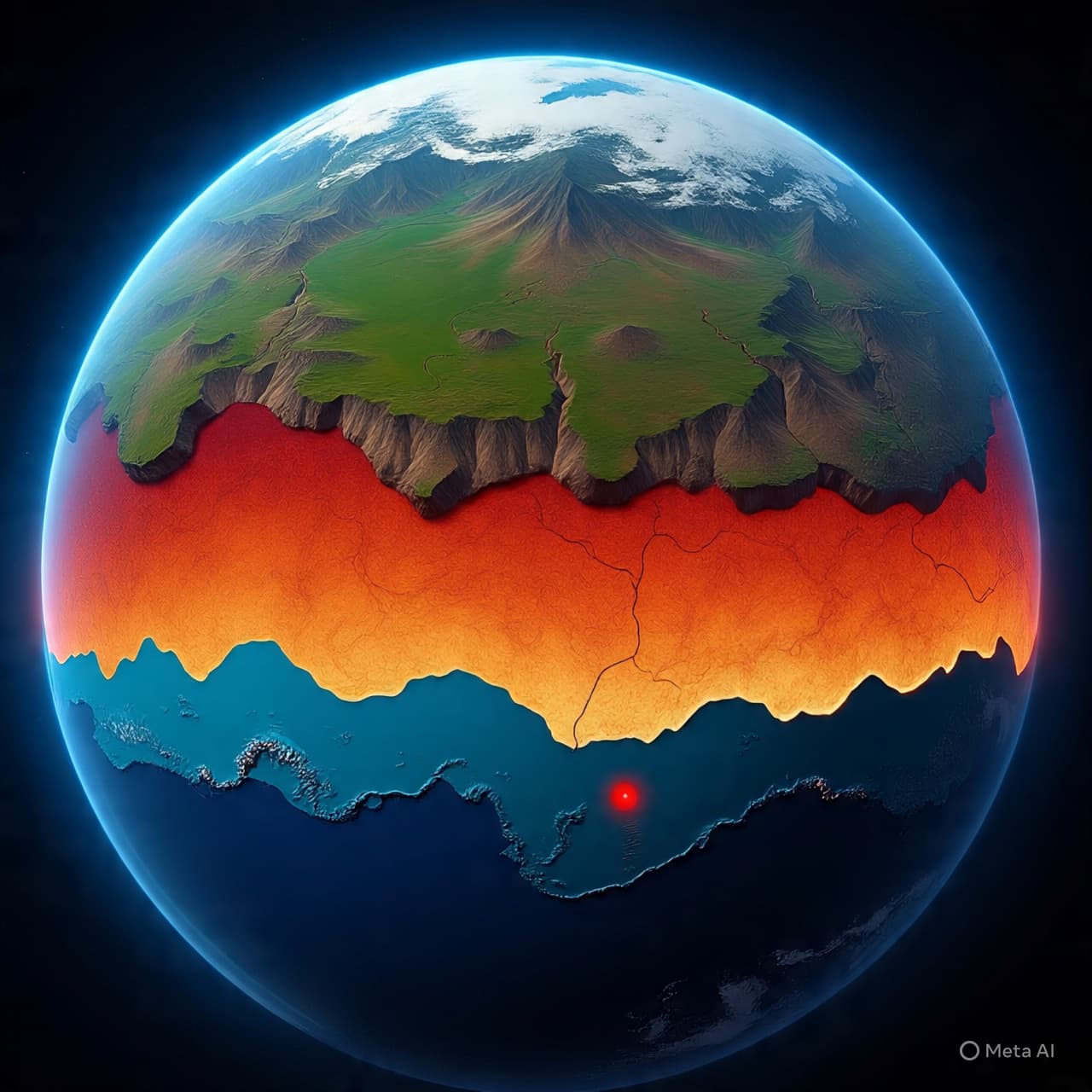
Deep beneath continents, far below the landscapes we recognize and the faults we map, the Earth continues its quiet work. Here, beyond the reach of surface scars and mountain chains, the mantle shifts and strains in ways that rarely announce themselves. These movements do not crack sidewalks or topple buildings, yet they tell a slower, deeper story of a planet that never fully rests.
Continental mantle earthquakes occur far below the crust, sometimes more than 70 kilometers beneath the surface. For many years, they were considered geological curiosities, difficult to explain and even harder to observe directly. Unlike shallow earthquakes, which release stress along brittle faults, these deeper events take place in a realm where heat and pressure were once thought to prevent sudden rupture.
Research now suggests that the mantle is more complex than once assumed. Under immense pressure, certain minerals can suddenly change their internal structure, weakening rock just enough to allow it to slip. In other cases, fluids trapped deep within the Earth may quietly reduce friction, allowing stress to release in a brief, subtle shake. These processes unfold slowly, shaped by temperature, composition, and time.
Because continental mantle earthquakes occur so deep, their signals often feel muted at the surface. Instruments may record them clearly, while people above remain unaware. Yet to scientists, these signals are valuable clues. They help map the hidden architecture of continents and reveal how tectonic forces extend well beyond the crust we see.
Over time, these findings have softened older assumptions about a rigid boundary between brittle crust and flowing mantle. Instead, the Earth appears layered not only by depth, but by behavior—capable of sudden movement even where motion was once believed impossible. Each recorded tremor adds another line to a long geological narrative written far below human reach.
In straightforward scientific terms, continental mantle earthquakes are deep seismic events that reveal unexpected mechanical behavior within Earth’s mantle beneath continents. Ongoing research continues to refine how and why these earthquakes occur, offering deeper insight into the planet’s internal dynamics.
AI Image Disclaimer “Visuals are created with AI tools and are not real photographs.”
Sources Nature Science Geophysical Research Letters Physics Today Scientific American
Published by Banx Network. This article is part of the Banx decentralized media programme, powered by the BXE token on the XRP Ledger.


.jpg&w=3840&q=75 "Convicted War Criminal Ratko Mladić to Be Buried With Full State Honors")