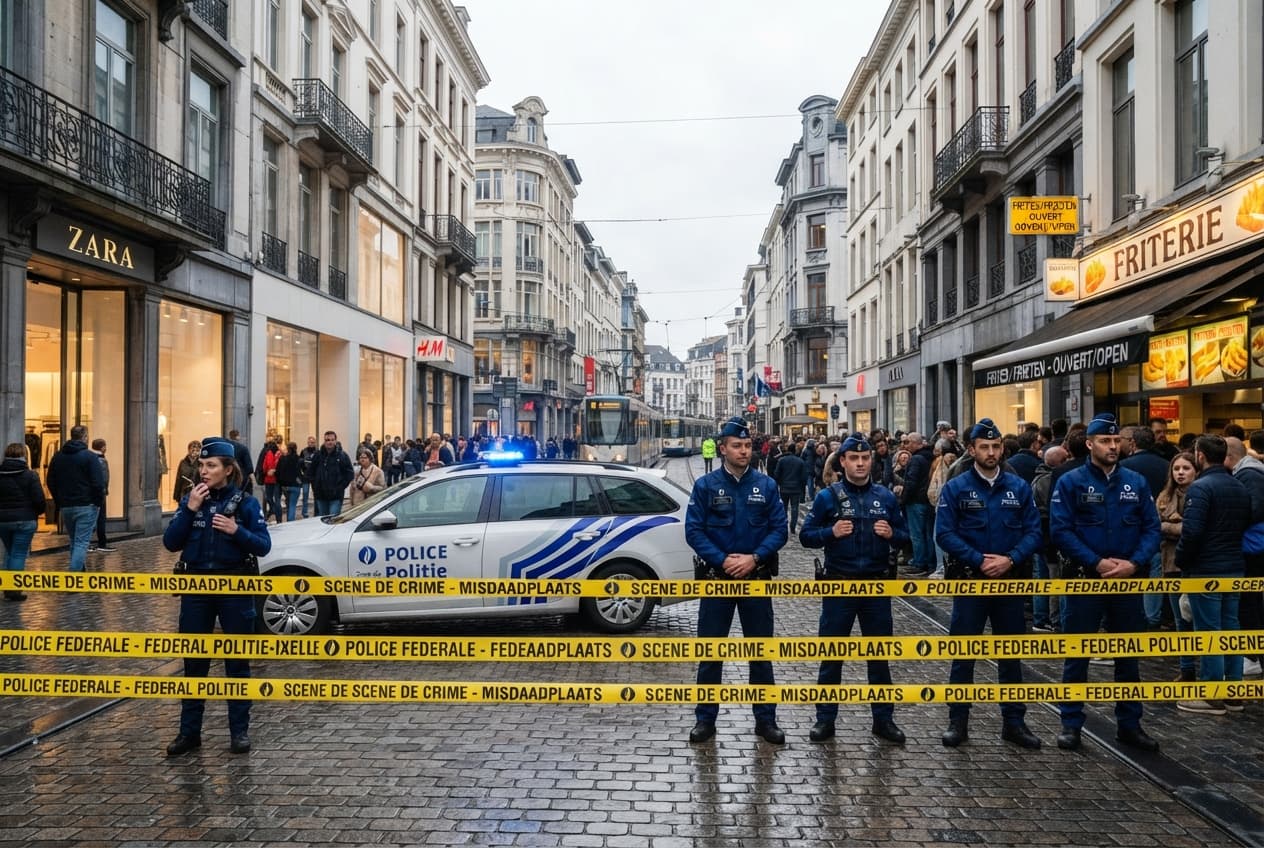
There are moments when geography seems to dissolve, when distant tensions arrive not as headlines, but as echoes in places once defined by calm.
Dubai, long imagined as a city of glass horizons and uninterrupted motion, found itself briefly folded into a wider conflict—one that did not begin at its shores, yet reached them all the same. The question that lingers is not only what happened, but why such places—airports, hotels, symbols of connection—became part of the unfolding response.
The strikes came in the shadow of a far larger rupture. Reports indicate that Iran’s Supreme Leader, Ayatollah Ali Khamenei, was killed during a joint U.S.–Israel military operation, an escalation that altered the balance of an already fragile region. In the hours that followed, Tehran signaled retaliation—not as a single strike, but as a wide-reaching message carried across the Middle East.
Missiles and drones were launched toward multiple देशों, including the United Arab Emirates, Qatar, and others hosting U.S. military presence or serving as strategic transit hubs. Yet the geography of impact tells a more nuanced story. Not all sites struck were military in the traditional sense.
Dubai International Airport, one of the busiest aviation crossroads in the world, sustained damage to part of its infrastructure, with several injuries reported. Nearby, debris from intercepted drones sparked a fire along the outer facade of the Burj Al Arab, a structure more symbolic than strategic.
Why these locations?
Part of the answer lies in proximity—not only physical, but logistical. The Gulf region hosts key air corridors, ports, and facilities that connect global trade and, in some cases, support U.S. military operations indirectly. Airports like Dubai’s are not merely civilian spaces; they are nodes in a network that moves people, goods, and, at times, strategic resources across continents.
At the same time, many of the visible impacts appear to be the consequence of interception rather than direct targeting. Air defense systems across the UAE reportedly destroyed the majority of incoming missiles and drones, with falling debris causing much of the localized damage. In such scenarios, the line between intended target and actual impact can blur, shaped by physics as much as by strategy.
There is also a dimension less tangible but equally significant—the language of symbolism. Striking near globally recognized landmarks or critical travel hubs sends a message that travels faster than any projectile. It signals reach, capability, and willingness to expand the scope of confrontation beyond traditional battlefields.
Yet officials and analysts continue to suggest that Iran’s stated objective remains focused on U.S. and allied infrastructure, even as the consequences ripple outward into civilian domains. The complexity of modern conflict—where military, economic, and civilian systems are deeply intertwined—means that even targeted actions can produce broader disruptions.
The immediate result has been a wave of uncertainty. Airspace closures, grounded flights, and thousands of stranded travelers reflect how quickly conflict can interrupt the rhythms of daily life. What was once a seamless global transit corridor has, for the moment, become a space of caution.
In quieter terms, this episode reveals something enduring about modern geopolitics: that distance offers less insulation than it once did. A decision made in one রাজধান can echo in another, carried not only by intent, but by systems that bind the world together.
For now, officials across the region continue to monitor developments, urging restraint while reinforcing defenses. The situation remains fluid, shaped by responses yet to unfold and decisions still being weighed.
And in cities like Dubai, where the lights still rise each evening against the desert sky, the interruption may prove temporary—but the memory of it will likely linger, as a reminder of how closely the world now moves, even in moments of strain.
AI Image Disclaimer Images in this article are AI-generated illustrations, meant for concept only.
Source Check Reuters Financial Times The Guardian Associated Press NDTV
Published by Banx Network. This article is part of the Banx decentralized media programme, powered by the BXE token on the XRP Ledger.