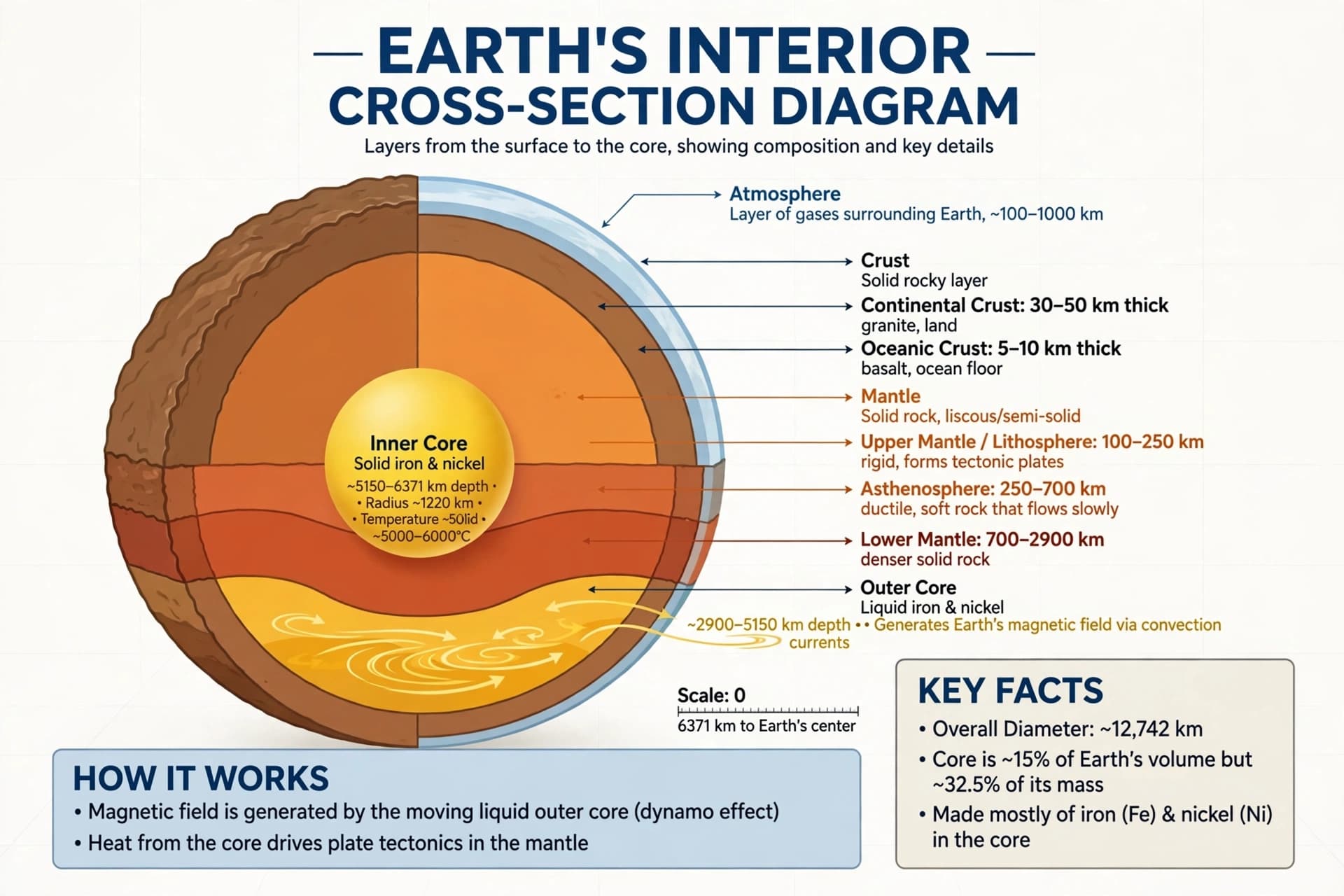
Time, that constant companion of human existence, is not as immutable as our clocks suggest. Deep beneath our feet, in the molten heart of the planet, a subtle gravitational dance is unfolding. Recent studies reveal that interactions between Earth’s solid inner core and its liquid outer core are causing minute fluctuations in the length of our days. This internal tug-of-war, driven by the complex dynamics of our planet’s interior, reminds us that Earth is a living, breathing entity, constantly shifting and adjusting. It is a humbling reminder of the forces that shape our world, even when they remain hidden from view.
For decades, scientists have known that the length of a day varies slightly due to atmospheric winds, ocean currents, and the gravitational pull of the moon. However, new research points to a deeper source: the rotation of the inner core relative to the mantle. As the solid iron sphere spins within the liquid outer core, it creates electromagnetic and gravitational couplings that transfer angular momentum. This transfer speeds up or slows down the Earth’s rotation ever so slightly, altering the duration of a day by fractions of a millisecond. Precision reveals the invisible.
These changes, though imperceptible to human senses, are critical for technologies that rely on precise timing. Global positioning systems (GPS), telecommunications networks, and financial markets depend on atomic clocks synchronized with Earth’s rotation. When the planet’s spin fluctuates, leap seconds are occasionally added or subtracted to keep civil time aligned with astronomical time. Accuracy is the foundation of modern infrastructure.
The study of Earth’s interior has advanced significantly thanks to seismology and satellite data. By analyzing how seismic waves travel through the planet, researchers can infer the movement and density of the core. These insights help build models of geodynamic processes that have been occurring for billions of years. Knowledge builds understanding.
Some recent data suggests that Earth’s rotation may be speeding up slightly, potentially leading to the first-ever "negative leap second." This possibility has sparked debate among timekeepers and technologists about how to manage such an unprecedented adjustment. The implications for digital systems are significant, requiring careful planning and coordination. Adaptation is necessary for progress.
Beyond technology, these findings deepen our appreciation for the planet’s complexity. The core is not a static ball of iron but a dynamic system influenced by heat flow, magnetic fields, and gravitational forces. It connects the deep past with the present moment, linking geological history to daily life. Connection binds all things.
As we continue to monitor these subtle shifts, we gain a better understanding of Earth’s evolution. The interplay between the core and the mantle offers clues about the planet’s magnetic field and its ability to protect life from solar radiation. Protection is a gift of nature.
In the end, the changing length of our days is a testament to the dynamic nature of our home. It invites us to look beyond the surface and appreciate the intricate mechanisms that sustain us. Time flows, but the Earth dances to its own rhythm.
AI Image Disclaimer: The visual representations included here are AI-generated illustrations designed to depict Earth’s internal structure and rotational dynamics, not actual scientific diagrams or photographs of the planet’s core.
Sources: Nature Geoscience BBC Science The Guardian
Published by Banx Network. This article is part of the Banx decentralized media programme, powered by the BXE token on the XRP Ledger.