The Earth often appears calm from above, its mountains and oceans familiar to human eyes after centuries of exploration. Yet beneath the continents and seas lies another world hidden far beyond ordinary reach, where pressure and heat reshape matter into forms difficult to imagine. In recent scientific research, geologists reported evidence suggesting the existence of a vast reservoir of water trapped nearly 700 kilometers beneath Earth’s surface, deep within the planet’s mantle.
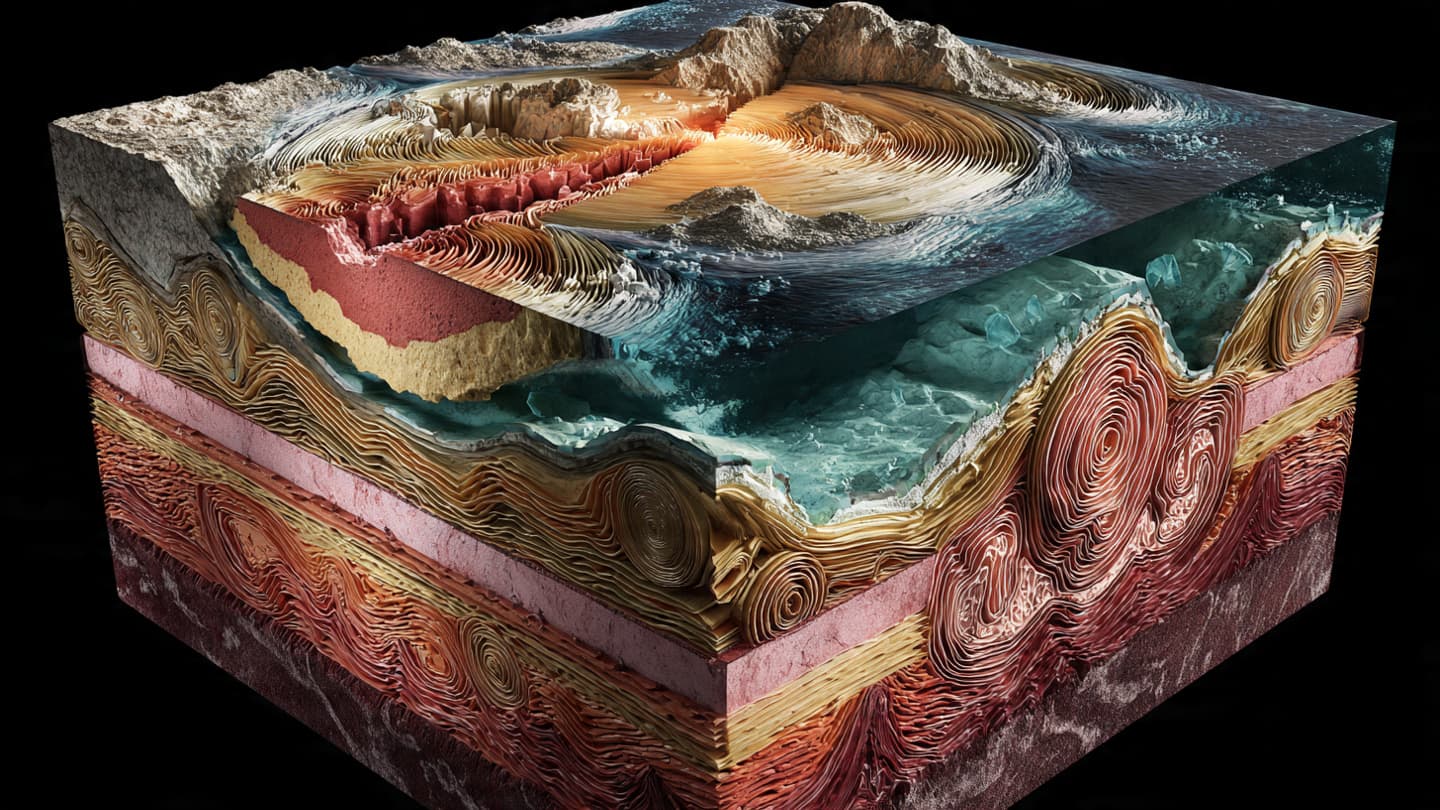
The discovery does not describe an underground ocean in the conventional sense of open water flowing through massive caverns. Instead, scientists believe water molecules are locked inside minerals located within a region known as the mantle transition zone, where extreme pressure alters the structure of surrounding rock.
Researchers identified the evidence by studying seismic waves generated by earthquakes. As these waves travel through Earth’s interior, they behave differently depending on the materials they encounter. Subtle changes in wave movement allowed scientists to infer the likely presence of water-rich minerals deep underground.
The findings support long-standing theories suggesting that Earth’s interior may store enormous quantities of water hidden within crystalline rock structures. Some estimates indicate the total amount could rival or even exceed the volume of water found in surface oceans, though distributed very differently.
Scientists say the discovery could improve understanding of Earth’s geological cycles, including volcanic activity, tectonic plate movement, and the long-term circulation of water between the surface and the deep interior. Water plays an important role in influencing how mantle rock behaves under extreme conditions.
The research also contributes to broader questions about planetary formation. Understanding how water became distributed throughout Earth may help scientists study the evolution of other rocky planets and determine how conditions suitable for life emerge over geological time.
Although the mantle transition zone remains inaccessible to direct exploration, advances in seismic imaging and mineral physics continue allowing researchers to reconstruct hidden layers of Earth with increasing precision. In many ways, scientists now map the deep interior much like astronomers chart distant galaxies — indirectly, through signals and interpretation.
The discovery serves as another reminder that humanity still knows relatively little about the planet beneath its feet. Even after centuries of exploration, Earth continues holding immense structures and processes concealed beneath its quiet surface.
AI Image Disclaimer: Some geological visuals included with this article may be AI-generated illustrations based on scientific models of Earth’s interior.
Sources: Nature, US Geological Survey, Live Science, Scientific American, BBC Science Focus
Published by Banx Network. This article is part of the Banx decentralized media programme, powered by the BXE token on the XRP Ledger.