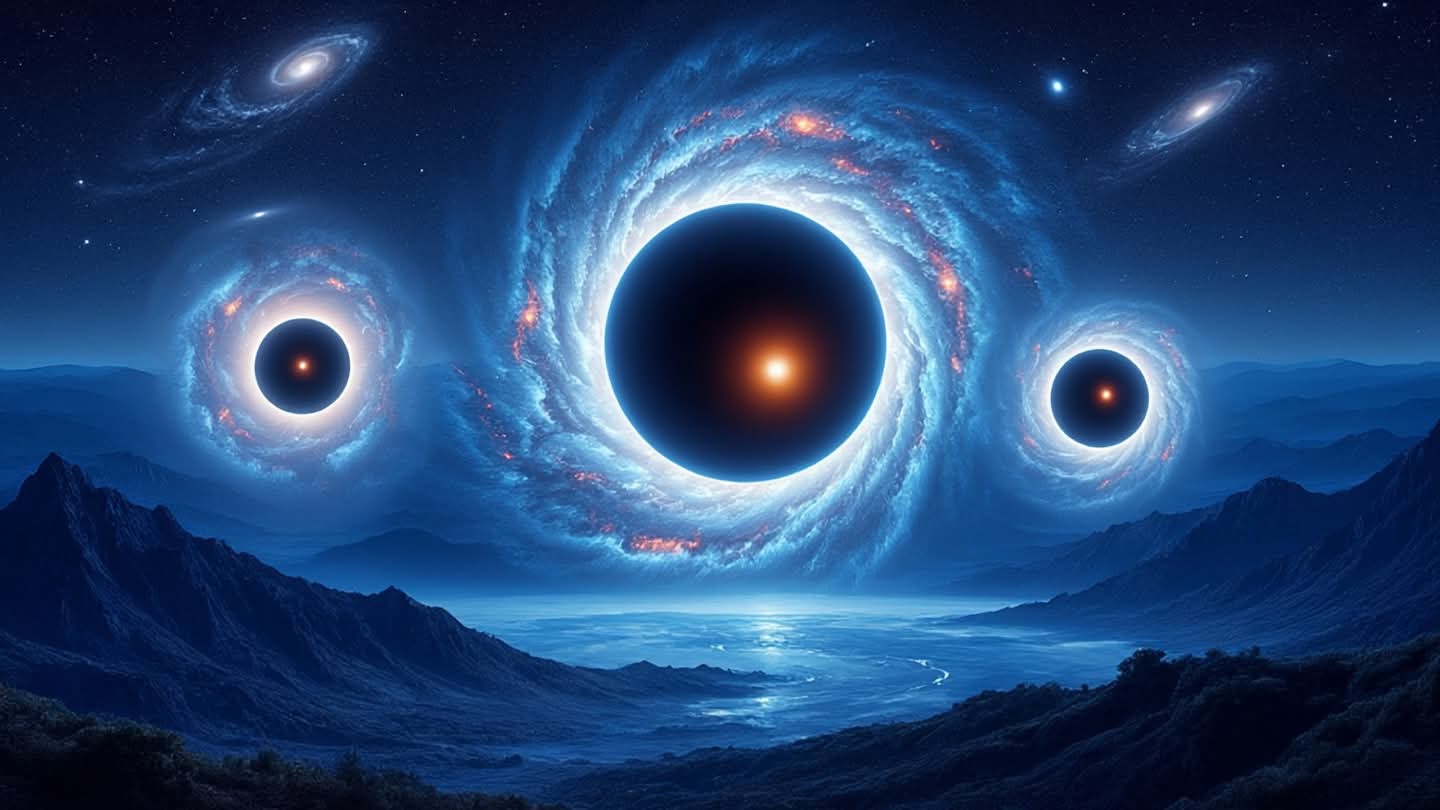
In the early universe, galaxies were forming and evolving at a rapid pace, often hosting massive black holes at their centers. Recently, astronomers have made a groundbreaking discovery: three supermassive black holes interacting within a single young galaxy. This finding invites reflection on the chaotic beauty of cosmic evolution and the complex dynamics that shape galactic structures. It is a moment where the past reveals its secrets, showing us how galaxies grow through merger and interaction.
The discovery was made using data from the Chandra X-ray Observatory and other telescopes, identifying the triple system in a galaxy located billions of light-years away. The presence of three black holes suggests that the galaxy is undergoing a rare multi-merger event. Rarity highlights significance. Mergers drive growth.
Black holes are typically found in pairs or isolation, making a triple system an exceptional find. Their gravitational interactions can lead to powerful emissions of X-rays and gravitational waves, offering unique opportunities for study. Gravity dances in threes. Energy radiates from chaos.
For astrophysicists, this observation provides insights into how supermassive black holes evolve and influence their host galaxies. The feedback from these black holes can regulate star formation and gas distribution. Influence shapes structure. Feedback balances growth.
The young age of the galaxy indicates that such complex systems formed earlier in the universe’s history than previously thought. This challenges existing models of galactic assembly and black hole seeding. History is rewritten by discovery. Models adapt to evidence.
As observational capabilities improve, more such systems may be found, helping to complete the picture of cosmic history. Each discovery adds a piece to the puzzle of our origins. Curiosity connects us to the cosmos. Knowledge expands horizons.
Astronomers have discovered three supermassive black holes in a young galaxy for the first time, revealing a rare triple merger event. The finding offers new insights into early galactic evolution and black hole dynamics. The hope is for further observations to understand the frequency and impact of such systems.
AI Image Disclaimer: Visuals associated with this article are AI-generated to illustrate the themes of astronomy and black hole physics.
Sources: Chandra X-ray Observatory NASA Scientific American
Published by Banx Network. This article is part of the Banx decentralized media programme, powered by the BXE token on the XRP Ledger.